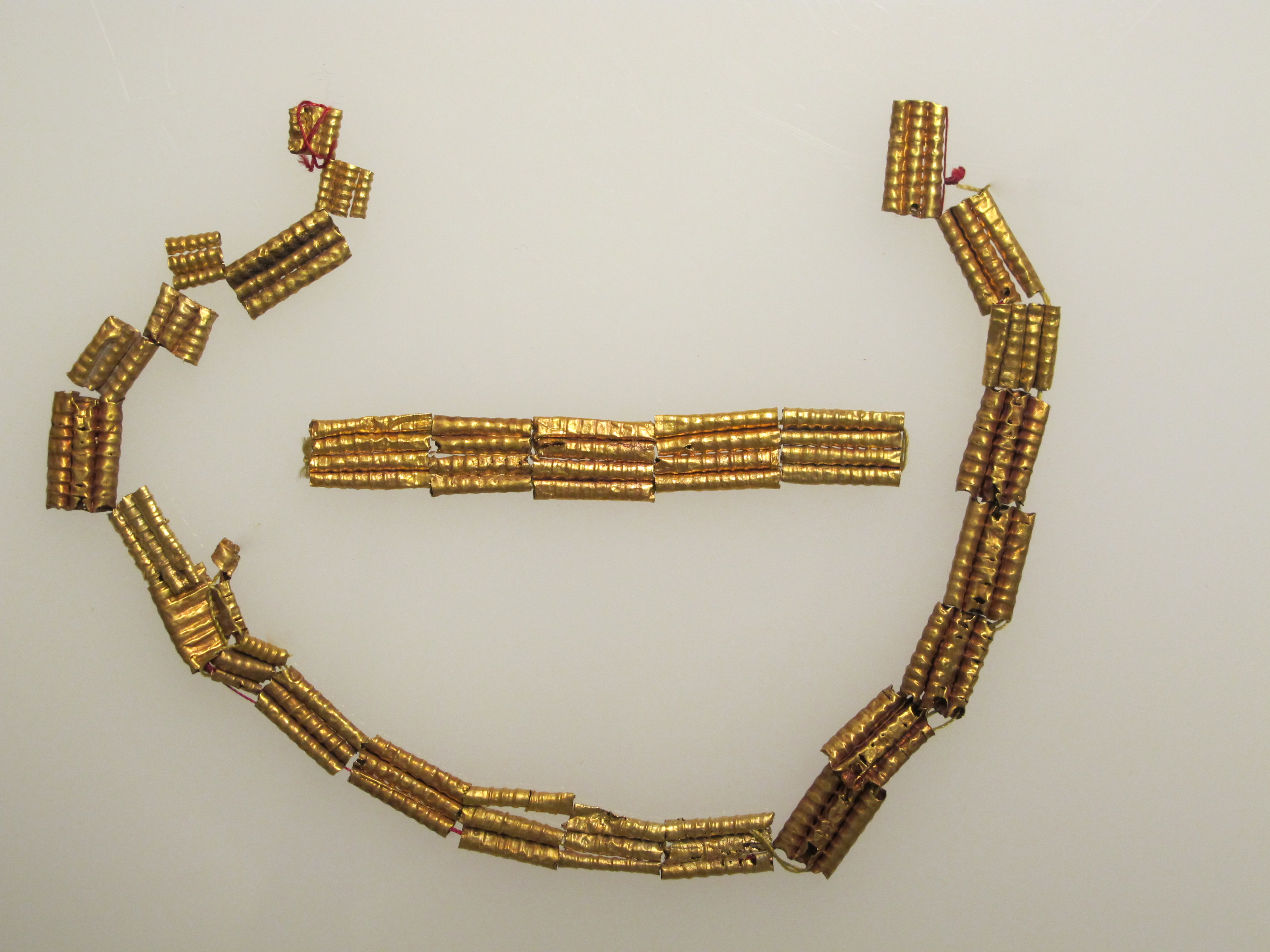
Heritage Analysis: Fragmentary Gold Necklace, Roman, c. 1st–3rd Century CE
Artifact Overview and Provenance
This fragmentary gold necklace, of Roman origin and dating to the early Imperial period, presents a compelling case study in the intersection of historical adornment, spiritual symbolism, and luxury brand strategy. The surviving elements—likely portions of a torque or a multi-strand lunula pendant—are crafted from high-carat gold, exhibiting granulation and filigree techniques that speak to the sophisticated metallurgical traditions of the Roman world. The necklace’s incomplete state does not diminish its value; rather, it emphasizes the material’s endurance and the symbolic potency that gold held across Roman society. For Katherine Fashion Lab, this artifact serves as a foundational reference for our 2026 high-end luxury strategy, particularly through its resonance with our ongoing study of the Mirror with Split-Leaf—a piece that juxtaposes polished silver mirror surfaces with gold-inlaid palm leaf motifs against the narrative relief of a sarcophagus lid. This duality—between reflective opulence and commemorative storytelling—finds a direct parallel in the Roman necklace’s ability to signify both personal status and cosmic protection.
Symbolic Power: Gold as Divine and Temporal Authority
In Roman culture, gold was not merely a marker of wealth but a conduit for spiritual and political power. The necklace’s fragmentary nature does not obscure its intended function: to adorn the wearer with a visible claim to divine favor and social rank. Gold was associated with the gods, particularly Jupiter and Sol Invictus, and wearing it was an act of aligning oneself with celestial order. The necklace likely featured pendants or clasps shaped as leaves, crescents, or mythological figures—each carrying specific symbolic weight. For instance, the lunula (crescent moon) motif, common in Roman women’s jewelry, invoked the goddess Diana and offered protection against the evil eye. This aligns with our research context: the Mirror with Split-Leaf displays a similar tension between surface brilliance and hidden narrative. The necklace’s gold, like the mirror’s silver, reflects light and attention, but its symbolism—rooted in fertility, fortune, and immortality—resonates with the sarcophagus’s relief, which tells a story of life, death, and rebirth. For Katherine Fashion Lab, this symbolic power translates into a brand strategy that prioritizes meaning over mere material. In 2026, our collections will not just adorn; they will communicate lineage, protection, and aspiration—qualities that the Roman necklace embodies in its very fragments.
Historical Adornment: The Body as a Canvas for Status and Identity
Roman jewelry was a sophisticated system of personal branding. This necklace, worn by a woman of the patrician or equestrian class, would have been part of a larger ensemble—earrings, rings, fibulae—that signaled her family’s wealth, her marital status, and her piety. The fragmentary state of the piece offers a unique advantage for heritage analysis: it forces us to consider the body as a living archive. The necklace’s breakage may have occurred through wear, ritual deposition, or burial, each scenario adding layers of historical narrative. The Romans often placed jewelry in tombs as grave goods, believing that such objects would accompany the deceased into the afterlife. This practice mirrors the sarcophagus imagery in our Mirror with Split-Leaf study, where the stone relief serves as a permanent record of the individual’s life. The necklace, in its fragmented form, becomes a metaphor for the incomplete stories we carry—a concept that Katherine Fashion Lab will leverage in our 2026 high-end strategy. We will introduce a “Fragmenta” line, where each piece is designed to appear as a recovered artifact, with intentional asymmetry and exposed joins that celebrate imperfection as a marker of authenticity and history. This approach appeals to the modern luxury consumer’s desire for objects with provenance and soul, rather than mass-produced perfection.
Spiritual Meaning: Protection, Transformation, and Eternal Life
The spiritual dimension of this necklace cannot be overstated. Gold was considered an incorruptible metal, symbolizing eternity and the divine spark within humans. The necklace’s circular or crescent form—typical of Roman torques and lunulae—represented the cyclical nature of life, death, and rebirth. It was a talisman, worn to ward off harm and to ensure safe passage through life’s transitions. The fragmentary nature of this piece may even enhance its spiritual resonance: breakage in antiquity was sometimes intentional, as part of a ritual “killing” of an object to release its spirit or to mark the end of a life. This concept of sacred fragmentation aligns with the Mirror with Split-Leaf, where the mirror’s polished surface reflects the living, while the sarcophagus relief speaks to the dead. The necklace, in its broken state, bridges these two worlds—it is both a relic of a living woman and a token for her afterlife. For Katherine Fashion Lab, this spiritual meaning will inform our 2026 luxury narrative. We will position our collections as “amulets for the modern soul,” using gold as a medium for personal empowerment and protection. Each piece will be accompanied by a digital provenance card that traces its design inspiration to Roman spiritual practices, creating a direct emotional connection between the wearer and the ancient past. This strategy taps into the growing market for intentional luxury, where consumers seek objects that offer more than aesthetic pleasure—they seek resonance, meaning, and a sense of continuity with history.
2026 High-End Luxury Strategy: DNA Correlation with the Mirror with Split-Leaf
The Roman necklace’s heritage analysis provides a clear roadmap for Katherine Fashion Lab’s 2026 high-end luxury strategy. The DNA correlation with our study of the Mirror with Split-Leaf reveals three key pillars: duality, narrative depth, and material integrity. First, duality: just as the mirror presents a contrast between silver’s reflective surface and gold’s intricate leaf inlay, the necklace’s gold embodies both public display and private symbolism. Our 2026 collections will feature dual-material pieces—gold combined with oxidized silver, blackened bronze, or matte ceramic—to evoke this tension between light and shadow, life and death. Second, narrative depth: the necklace’s fragmented state tells a story of time, loss, and preservation, much like the sarcophagus relief. We will develop a “Heritage Series” that includes limited-edition replicas of ancient artifacts, each accompanied by a scholarly essay and a digital archive of its archaeological context. This positions our brand not just as a jewelry house but as a curatorial partner for the discerning collector. Third, material integrity: Roman goldsmiths prioritized purity and craftsmanship over ostentation. Our 2026 strategy will emphasize ethical sourcing and artisanal techniques, such as hand-granulation and filigree, directly inspired by Roman methods. This commitment to authenticity will be marketed through exclusive atelier visits and behind-the-scenes documentaries, appealing to clients who value transparency and tradition.
Conclusion: From Fragment to Future
This fragmentary Roman gold necklace is far more than a broken ornament; it is a testament to the enduring power of symbolic adornment. For Katherine Fashion Lab, it serves as a muse for our 2026 high-end luxury strategy, grounding our designs in historical resonance while pushing the boundaries of contemporary luxury. By weaving together the threads of symbolic power, historical adornment, and spiritual meaning, we create a brand narrative that is both timeless and timely. The necklace’s fragments, like the mirror’s split leaves and the sarcophagus’s relief, remind us that beauty lies not in perfection but in the stories we carry forward. In 2026, Katherine Fashion Lab will not merely sell jewelry—we will offer fragments of eternity, crafted in gold and imbued with the soul of Rome.