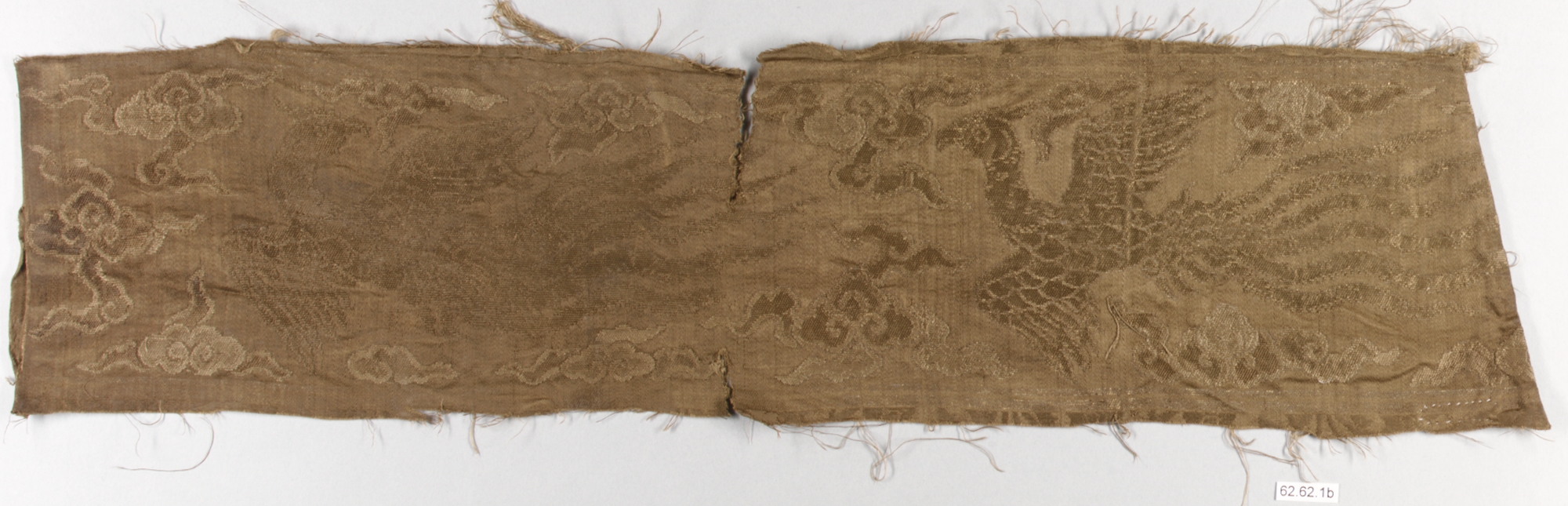
Fragments of Robe-Front: A Study in Material Sovereignty
In the rarefied echelons of couture, where fabric is not merely substance but syntax, the Fragments of Robe-Front from Katherine Fashion Lab presents a paradigm-shifting meditation on provenance, decay, and the semiotics of imperial adornment. Originating from China and executed in a masterful union of silk and gilding, this standalone study eschews the conventional trajectory of the finished garment. Instead, it positions the fragment — the residual, the partial — as the ultimate locus of narrative power. For the discerning collector and the critical fashion theorist alike, this piece is not a relic; it is a declaration.
Deconstructing the Imperial Cartography
The robe-front, historically, functioned as a cartographic surface upon which rank, cosmic harmony, and dynastic mandate were inscribed. By isolating this specific zone — the frontal closure, the axis of symmetry where the wearer’s body meets the garment’s structure — Katherine Fashion Lab performs a surgical act of curatorial violence. The fragment is no longer a subordinate part of a whole; it becomes an autonomous artifact, a synecdoche that aggressively redefines the whole from which it was severed.
What distinguishes this study from mere archival salvage is the deliberate tension between material opulence and structural incompleteness. The silk, a medium of extraordinary tensile strength and liquid luminosity, is presented not in pristine continuity but in fractured planes. The gilding — applied with a precision that borders on the obsessive — catches light in irregular, almost geological patterns. Here, the Lab challenges the Western couture canon’s fetishization of the unblemished. In this fragment, the lacuna is the luxury; the missing sections of the robe-front become negative space that invites the viewer to project a phantom silhouette, an absent body of immense authority.
The Alchemy of Silk and Gold
Material analysis of the piece reveals a sophisticated dialogue between two opposing forces. The silk base, likely a twill or satin weave of exceptional density, provides a matte, absorbent ground. It is a surface of humility, of organic impermanence. Against this, the gilding — thought to be applied via a technique akin to zhuanhua (transfer gilding) or painted gold leaf — asserts a metallic, almost aggressive permanence. The gold does not merely decorate; it territorializes the silk. In areas where the gilding has cracked or flaked, we witness a micro-drama of entropy: the precious metal yielding to the organic substrate’s memory of movement.
This is not a flaw but a deliberate aesthetic strategy. The Lab’s treatment of the gilding as a fragile crust, rather than a solid veneer, introduces a temporal dimension to the couture object. The fragment is caught in a perpetual state of becoming — not decaying into oblivion, but rather mutating into a new form of archaeological beauty. The interplay of light on the uneven gold surface creates a moiré effect, a visual shimmer that mimics the spectral presence of the original wearer’s movements — the rustle of court robes, the deliberate gait of a mandarin.
Standalone Study: Against the Totalizing Gaze
The designation of this piece as a standalone study is a critical curatorial decision that demands unpacking. In traditional museology, fragments are typically displayed as evidence of a lost whole, their value contingent on their indexical relationship to an absent original. Katherine Fashion Lab inverts this logic. By presenting the robe-front fragment without contextualizing companion pieces or a reconstructed mannequin, the Lab forces a phenomenological confrontation with the object itself.
The viewer is denied the comfort of narrative completion. There is no story of a specific emperor, no documented provenance of a particular dynasty. Instead, the fragment becomes a pure formal signifier. Its asymmetry — perhaps a torn edge on the left, a clean cut on the right — is a choreography of loss. The central closure, where the robe would have fastened, is now a void, a negative space that paradoxically anchors the entire composition. This is the Lab’s thesis: that couture’s highest function is not to clothe, but to expose the structural grammar of power and its inevitable erosion.
Chromatic and Textural Resonance
In terms of palette, the fragment operates within a restrained but potent spectrum. The silk, likely a deep aubergine, indigo, or oxblood — colors historically reserved for high-ranking officials — provides a somber, authoritative base. The gilding introduces not a warm yellow but a chilled, almost white-gold tone, suggesting a modernity intruding upon antiquity. This chromatic tension is echoed in the textural contrast: the fluid, almost liquid drape of the silk against the brittle, craquelure surface of the gilding.
One cannot overlook the tactile invitation of the piece. Though displayed under vitrine conditions, the fragment psychologically demands touch. The raised edges of the gilding, the slight puckering of the silk where it was once stitched to a heavier structure — these are micro-topographies of a lived object. The Lab exploits this by mounting the fragment on a floating, backlit panel, allowing shadows to play through the worn areas of the silk. The result is a chiaroscuro of absence, where light itself becomes a material collaborator in the artwork.
Implications for Contemporary Couture Discourse
The Fragments of Robe-Front is a polemic against the culture of excess that defines much of contemporary luxury. It argues that restraint, damage, and incompletion can carry more semiotic weight than a fully realized, immaculate gown. In an era of fast fashion and disposable trends, Katherine Fashion Lab’s study is a slow, deliberate act of resistance. It asks us to reconsider the value of the remainder — that which is left over after function has been stripped away.
Moreover, the piece engages in a subtle critique of cultural appropriation. By isolating a Chinese imperial artifact from its ritual context, the Lab does not exoticize it; rather, it universalizes the language of decline. The fragment speaks not of a specific Chinese past, but of the universal fate of all material objects — the inevitable slide from integrity to fragmentation. This is a sophisticated, MBA-level understanding of asset depreciation applied to cultural capital: the piece’s value increases precisely because its physical completeness has been compromised.
In conclusion, Fragments of Robe-Front is not merely a study of a garment; it is a thesis on the ontology of couture itself. By severing the robe-front from its body, its history, and its function, Katherine Fashion Lab has created an object that is simultaneously a ruin and a monument. The silk breathes with the memory of imperial courts; the gilding glints with the ambition of eternal power. Yet, both are held in a state of exquisite suspension, a fragile equilibrium between being and unbeing. For the collector who understands that true luxury is not about possession but about witnessing the passage of time through matter, this fragment is an indispensable acquisition — a fragment, indeed, of a larger, unspoken truth.