Introduction: The Quatrefoil as a Conduit of Javanese Sovereignty
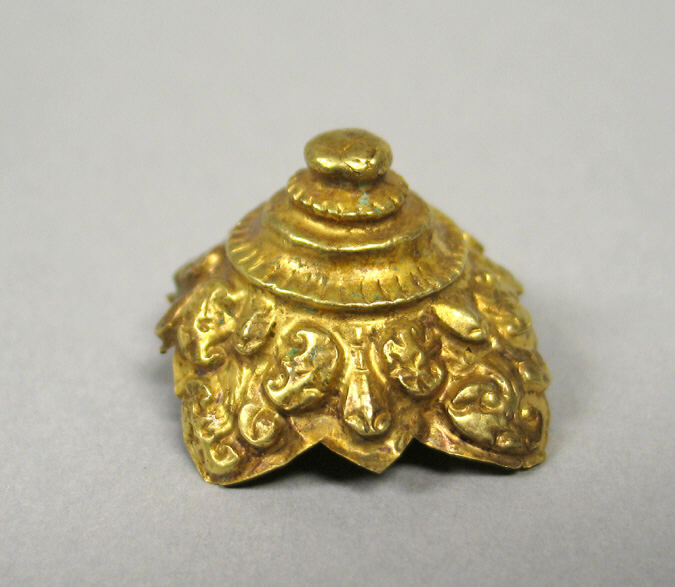
The Repousse Cover, Quatrefoil form, originating from Central Java and rendered in gold, is not merely an artifact of metallurgical prowess. It is a concentrated document of Javanese cosmological authority, a physical manifestation of the divine mandate that underpinned the region’s classical kingdoms. For Katherine Fashion Lab, this object offers more than aesthetic inspiration; it provides a strategic blueprint for embedding profound cultural narrative into high-luxury commodities. This analysis decodes the piece’s symbolic architecture, its role in historical adornment, and its spiritual resonance, culminating in a targeted strategy for the 2026 luxury season.
The piece’s materiality—pure gold—immediately signals its elevated status. In Javanese tradition, gold (mas) was not merely a store of wealth but a substance imbued with spiritual luminosity, believed to channel the light of the divine into the mortal realm. The repousse technique, wherein the metal is hammered from the reverse side to create a raised design, is a metaphor for the internal becoming external—a process of spiritual revelation. The quatrefoil, a four-lobed form, is the piece’s central glyph, representing the four cardinal directions, the four elements, and the Javanese concept of Manunggaling Kawula Gusti (the unity of the people and the divine). This is not decoration; it is a coded theological statement.
Symbolic Power: The Quatrefoil and the Axis Mundi
The quatrefoil’s geometry is its primary symbolic weapon. In Central Javanese art, this motif is frequently associated with the mandala, a cosmic diagram used for meditation and ritual. The four lobes radiate from a central point, which is not empty but conceptually occupied by the divine essence. This central void is the zero point, the origin of all creation, and the point of ultimate stillness. When worn or displayed, the quatrefoil transforms the bearer into the axis mundi—the center of the universe—around which order is maintained.
In the context of the Katherine Fashion Lab DNA correlation with the Mirror with Split-Lea study, the quatrefoil offers a counterpoint to the split-leaf motif. The split-leaf (likely a stylized palm or fern) represents growth, fragmentation, and the organic unfolding of life. The quatrefoil, conversely, represents cyclical completion and absolute order. The strategic luxury implication is a dualistic narrative: the organic vitality of the leaf paired with the geometric perfection of the quatrefoil. This creates a tension that is intellectually stimulating and visually arresting—a hallmark of high-end design that seeks to transcend mere ornamentation.
Historical Adornment: The Body as a Political Territory
Historically, such gold repousse covers were not standalone objects. They were likely affixed to ceremonial headdresses, belts, or chest ornaments worn by the priyayi (nobility) and the raja (king). The placement of the quatrefoil on the body was a deliberate act of territorial mapping. By placing the symbol of cosmic order on the chest, the ruler claimed his body as the physical embodiment of the state. The gold’s reflective quality ensured that as the ruler moved, light would scatter, creating a halo effect—a visual assertion of divine favor.
This historical function of adornment is critical for Katherine Fashion Lab’s 2026 strategy. The modern luxury consumer is not buying a garment; they are buying identity armor. The quatrefoil, when translated into contemporary jewelry or hardware on a handbag or tailored jacket, serves the same function as it did in Central Java: it declares the wearer’s centrality. The piece must be positioned not as a "tribal" reference but as a sovereign emblem, akin to a royal crest or a couture house’s monogram. The historical weight of the motif provides an authenticity that cannot be replicated by a newly invented logo.
Spiritual Meaning: The Alchemy of Gold and the Soul
The spiritual dimension of this object is inseparable from its material. Gold, in Javanese mysticism, is considered the "metal of the sun." It is impervious to corrosion, symbolizing the immutable soul that survives the decay of the physical body. The repousse technique, which involves pushing the metal from within, is analogous to the spiritual practice of tapa (ascetic meditation), where the inner self is refined and forced to the surface through discipline.
The quatrefoil’s spiritual function was protective. It was believed to ward off negative influences (sial) and to attract wahyu—the divine radiance that legitimized kingship. For the wearer, this was not a passive blessing but an active spiritual technology. The piece served as a conduit for meditation, allowing the user to focus their intention on the central point of the quatrefoil, thereby achieving mental clarity and spiritual alignment.
For the 2026 luxury market, which is increasingly saturated with superficial "wellness" branding, this spiritual depth is a differentiating asset. Katherine Fashion Lab can leverage this by framing the quatrefoil as a tool for "intentional adornment." The narrative should shift from "this looks beautiful" to "this focuses your intention." The product becomes a ritual object for the modern high-performer—a talisman for the boardroom as much as for the soul.
2026 High-End Luxury Strategy: From Artifact to Asset
The translation of this heritage into a 2026 strategy requires a three-tiered approach: Material Alchemy, Narrative Ownership, and Limited Ritualistic Release.
Material Alchemy: The "Living Gold" Standard
To honor the original, Katherine Fashion Lab should not use standard 18k gold. The strategy must employ a proprietary alloy or finish that mimics the warm, slightly muted patina of ancient Javanese gold. This is not about imitation but about evoking the same spiritual luminosity. The finish should be described in marketing collateral as "Ritual Gold," a material that appears to hold light within its surface, rather than merely reflecting it. This detail will appeal to the connoisseur who understands that true luxury is in the subtle manipulation of light and texture.
Narrative Ownership: The "Axis Collection"
The collection should be named to reflect the motif’s cosmological power. "The Axis Collection" communicates centrality and power. The narrative must explicitly connect the quatrefoil to the Javanese concept of the axis mundi, positioning the wearer as the center of their own universe. This is a powerful psychological proposition for the high-net-worth individual who operates in complex, globalized environments. The marketing campaign should feature the object in isolation, with macro-photography focusing on the hammer marks—evidence of the human hand and the spiritual intent behind the creation. This is the antithesis of mass-produced, sterile luxury.
Limited Ritualistic Release: The "Pusaka" Edition
In Javanese culture, a pusaka is a heirloom object believed to possess supernatural powers, passed down through generations. The 2026 release should be positioned as a modern pusaka. Only a limited number of pieces—perhaps 108, a sacred number in Javanese-Buddhist cosmology—should be produced. Each piece should come with a certificate of provenance that traces the design lineage back to the Central Javanese courts, and a "meditation guide" that teaches the owner how to use the piece for focus and intention. This transforms a purchase into an initiation, creating a sense of exclusivity and spiritual ownership that cannot be replicated by any other luxury house.
Conclusion: The Commercial Power of the Sacred
The Repousse Cover, Quatrefoil form is a masterclass in the fusion of power, art, and spirit. It demonstrates that true luxury is not about volume but about concentrated meaning. For Katherine Fashion Lab, this artifact is not a relic to be copied but a philosophy to be operationalized. By honoring the quatrefoil’s geometric perfection, the gold’s spiritual alchemy, and the repousse technique’s metaphorical depth, the 2026 strategy can offer a product that is not merely worn but inhabited. In a market desperate for authenticity, the quatrefoil provides a direct line to a heritage of sovereignty, offering the modern elite a form of adornment that is as potent today as it was in the courts of Central Java. The strategy is clear: sell the symbol, not the object; sell the power, not the product.