The Sampler: A Cartography of Stitch and Heritage
In the rarefied echelons of haute couture, where innovation is often conflated with technological disruption, Katherine Fashion Lab’s latest standalone study—titled simply The Sampler—offers a profound counter-narrative. This is not a garment in the conventional sense, nor is it a mere textile artifact. Rather, it is a philosophical treatise stitched in silk upon a ground of Irish linen, a cartographic exercise mapping the intangible geography of global craft. By isolating the sampler from the context of a full collection, the Lab elevates a pedagogical tool—historically the province of young girls and apprentice embroiderers—to the status of high art, demanding a re-evaluation of what constitutes luxury in the modern era.
Deconstructing the Lexicon of the Needle
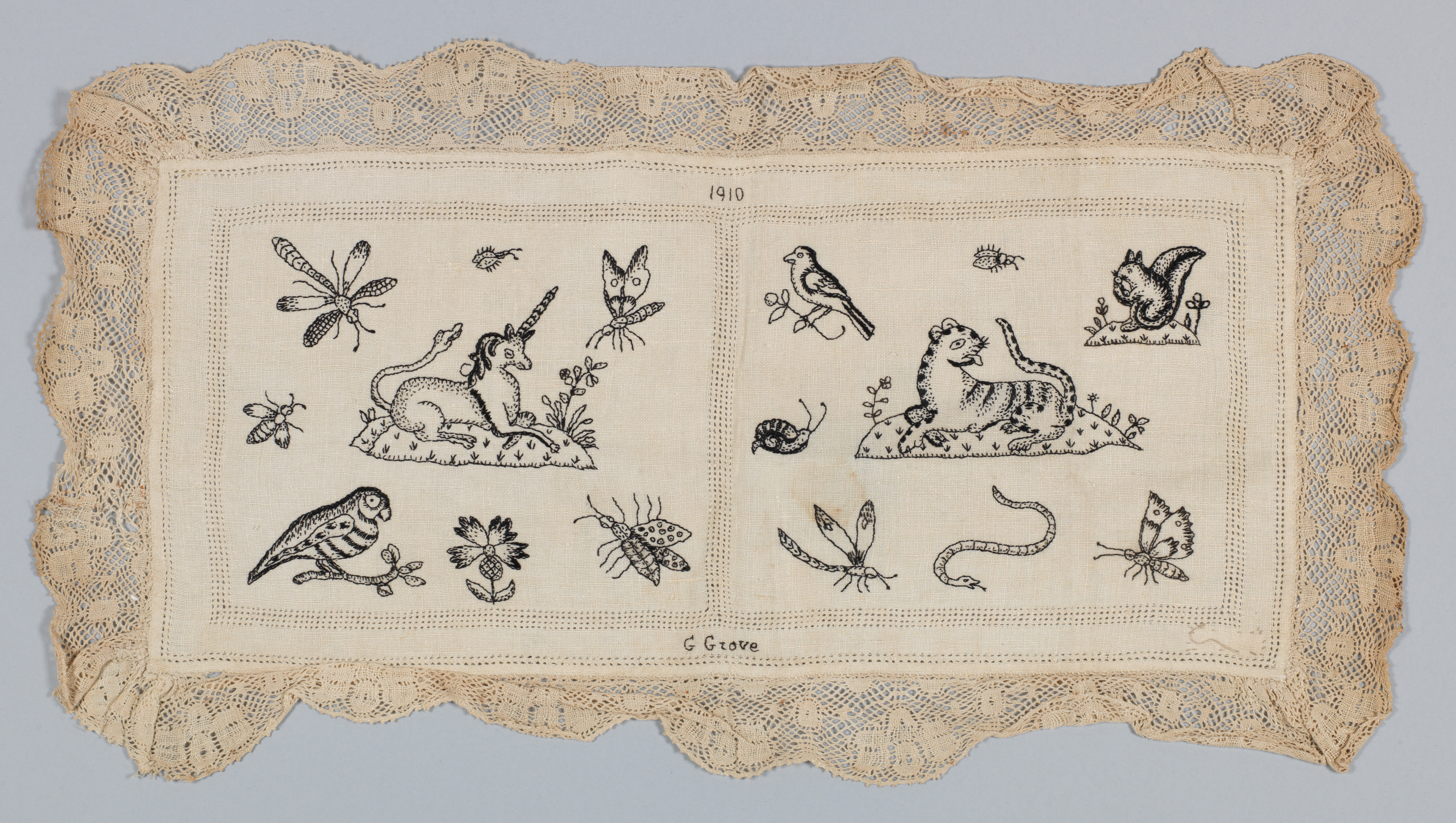
At first glance, The Sampler presents as a deceptively simple square of fabric, roughly one meter by one meter. Yet, upon closer inspection, the piece reveals itself as a dense, multi-layered text. The material dichotomy is the first point of intellectual engagement: the silk threads, with their inherent luminosity and fluidity, are juxtaposed against the rigid, grid-like structure of the linen. This is not a harmonious marriage but a deliberate tension—a dialogue between the ephemeral and the enduring, the opulent and the austere. The linen, undyed and unbleached, speaks of humble origins, of field and flax; the silk, in a spectrum from deep indigo to vermillion, whispers of ancient trade routes and imperial courts.
The composition eschews the symmetrical, decorative borders typical of Victorian samplers. Instead, the Lab has curated a chaotic yet meticulously ordered arrangement of stitch types sourced from disparate global traditions. One quadrant features the satin stitch of Japanese nuido, rendered in a gradient of grey silk that mimics the patina of aged silver. Adjacent to it, a section of Mexican tenango embroidery explodes in a riot of geometric flora, its vibrant threads creating a tactile relief that casts shadows across the linen. Further along, the eye encounters the delicate, counted-thread work of Scandinavian hardanger, its cutwork and pulled threads creating a lace-like transparency—a void that paradoxically defines the solidity of the surrounding fabric.
Global Heritage as a Curatorial Practice
The genius of The Sampler lies not in the execution of any single technique—all are executed with flawless, almost inhuman precision—but in the curatorial intelligence that governs their juxtaposition. The Lab positions itself not as a creator of new motifs, but as a custodian and re-interpreter of global heritage. Each stitch is a citation, a quotation from a vast, unwritten library of human expression. The piece functions as a visual encyclopedia, but one that refuses a linear, hierarchical reading. There is no central motif, no dominant culture. Instead, the eye is invited to wander, to draw connections across continents and centuries.
This approach challenges the very notion of authorship in couture. In an industry obsessed with the singular genius of the designer, Katherine Fashion Lab presents a model of collective, anonymous authorship. The sampler acknowledges that the language of embroidery is not proprietary; it is a shared, evolving dialect. The Lab’s role is that of the editor, the anthologist, selecting and arranging these voices into a cohesive, albeit polyphonic, statement. This is a radical act of humility, a deliberate decentering of the Western fashion canon in favor of a more equitable, globalized aesthetic discourse.
Materiality and the Semiotics of Time
The choice of materials is not merely aesthetic but deeply semiotic. Silk, historically a commodity of immense value, was the engine of global trade long before the advent of modern capitalism. Its presence here, stitched into a humble linen ground, is a commentary on the asymmetrical power dynamics inherent in historical globalization. The silk did not arrive in Europe as a neutral material; it carried with it the labor, the suffering, and the ingenuity of countless unnamed artisans. By re-contextualizing these threads within a contemporary art object, the Lab forces a reckoning with this history. The shimmer of the silk is not just beauty; it is the accumulated sheen of centuries of human toil.
Furthermore, the process of creating The Sampler is an act of radical slowness. In a fashion ecosystem predicated on speed and disposability, the thousands of hours required to execute this piece represent a form of quiet rebellion. The time embedded in each stitch is a direct counterpoint to the ephemerality of seasonal trends. This is not a garment to be worn and discarded; it is an object of contemplation, a meditation on the value of patience and the enduring power of handwork. The standalone study format reinforces this: without the distraction of a runway show or a commercial collection, the viewer is forced to engage with the object on its own terms, to slow down and read the texture like a text.
A New Paradigm for Couture Value
Ultimately, The Sampler proposes a new paradigm for evaluating couture. Its value does not reside in its rarity of material alone, nor in its wearability, but in its intellectual and cultural density. It is a luxury object because it contains multitudes—a world of knowledge, a spectrum of techniques, and a profound meditation on heritage. In this sense, it is less a product and more a proposition: that true luxury is the ability to hold complexity, to honor tradition while engaging critically with it, and to create beauty that is intellectually as well as sensorially stimulating.
Katherine Fashion Lab has not simply made an embroidered square. They have created a portable museum of human creativity, a testament to the enduring power of the hand in an age of the machine. The Sampler stands as a masterclass in how to look, how to value, and how to remember. It is a quiet, powerful argument that the future of couture lies not in novelty, but in a deeper, more meaningful engagement with the global past. In its silent, stitched eloquence, it speaks volumes about who we are, where we have been, and what we might yet become.