The Alchemy of Heritage: A Couture Analysis of Katherine Fashion Lab’s “Piece”
In an era where fashion is often reduced to disposable trends and algorithmic sameness, the work of Katherine Fashion Lab stands as a defiant counter-narrative. The subject of this analysis, a singular creation referred to simply as “Piece,” is not a garment in the conventional sense; it is a wearable thesis on the intersection of global heritage, material mastery, and contemporary artistic expression. Constructed from the most demanding of mediums—silk and metal thread—this standalone study transcends the boundaries of apparel to become an object of profound cultural and technical significance. Through a meticulous deconstruction of its materiality, construction, and conceptual underpinnings, we can begin to understand why “Piece” represents a pivotal moment in the atelier’s oeuvre, and indeed, in the broader discourse of haute couture.
Materiality as a Narrative Device
The immediate impact of “Piece” is tactile and visual, rooted in the deliberate, almost alchemical pairing of its two primary materials. The silk, a fabric with a lineage stretching back over 5,000 years to the banks of the Yellow River, serves as the canvas—a luminous, fluid foundation that catches light with an almost liquid quality. Its weight and drape are not accidental; they are the result of a meticulous sourcing process that prioritizes the highest grade of mulberry silk, spun and woven to a specification that allows for both structural integrity and ethereal movement. The silk is not merely a backdrop; it is the embodiment of purity, a testament to the material’s historical association with royalty, diplomacy, and the sacred.
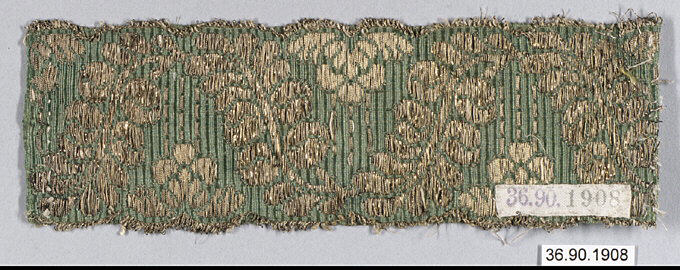
Juxtaposed against this softness is the unyielding, brilliant presence of metal thread. In many traditional textile cultures—from the zardozi of South Asia to the or nué of medieval European ecclesiastical vestments—metal thread was not merely decorative; it was a symbol of divine light, earthly power, and unquantifiable wealth. Katherine Fashion Lab harnesses this symbolism, but subverts it. The metal thread is not used in heavy, opulent swathes. Instead, it is meticulously hand-embroidered in a pattern that evokes the delicate tracery of a spider’s web or the intricate cartography of ancient trade routes. This is not ornamentation for its own sake; it is a deliberate act of drawing a narrative map across the silk’s surface. The metal, with its inherent rigidity, creates a structural tension, a counterpoint to the silk’s fluidity, forcing the fabric to hold shapes it would otherwise never assume. This dynamic interplay is the core of the piece’s sculptural quality.
Deconstructing the Global Heritage
The “Global Heritage” origin of “Piece” is not a superficial collage of motifs. Rather, it is an intellectual and artisanal synthesis. Katherine Fashion Lab has eschewed the pitfalls of cultural appropriation by engaging in a deep, scholarly dialogue with multiple traditions. The silhouette itself, a structured yet asymmetric column, borrows from the clean lines of Japanese kimono construction, while the internal boning and corsetry echo the architectural rigor of 19th-century French haute couture. The embroidery technique, however, is a hybrid. It references the chain-stitch ari work of the Indian subcontinent, but the specific geometric motif—a repeating, interlocking hexagon—is drawn from Islamic geometric art, symbolizing unity and the infinite.
This is not a pastiche. It is a curatorial act. The garment functions as a physical archive, where each stitch and seam represents a point of convergence. The metal thread, for example, is not gold or silver, but a specially alloyed, gunmetal-toned blend that has been oxidized to a matte finish. This choice is critical. It removes the material from the realm of ostentatious luxury and repositions it as a tool for drawing, for sketching light across a dark, reflective surface. The heritage is not in the literal replication of a specific garment, but in the process—the patience, the hand-eye coordination, the meditative repetition of the embroiderer’s craft—that is a direct inheritance from generations of anonymous artisans. In this sense, “Piece” is a tribute not to a single culture, but to the global community of makers whose hands have shaped the history of textile.
The Art of Structural Tension
From a technical standpoint, the mastery of “Piece” lies in its negotiation of opposing forces. The silk, in its natural state, is a fabric of surrender; it drapes, it flows, it follows gravity. The metal thread, conversely, is a fabric of resistance. The atelier’s signature achievement is in the engineering of this tension. The metal thread is not merely sewn onto the surface; it is woven into the silk’s construction in specific quadrants, creating a three-dimensional topography. This creates a series of internal “struts” that allow the garment to stand away from the body in certain areas, creating pockets of negative space, while remaining intimately close to the skin in others.
This structural interplay creates a kinetic experience for the wearer. As the body moves, the silk ripples, but the metal-thread sections resist, creating a subtle, percussive rustle and a shifting play of light and shadow. The garment is alive; it is a study in controlled chaos. The seams are not hidden but are exposed and finished with a meticulous, hand-rolled technique, often in a contrasting, deep crimson silk thread. This detail, invisible from a distance, rewards close inspection and speaks to the atelier’s philosophy that perfection is found in the places most people never look. The internal structure, complete with hand-bound buttonholes and a custom, silk-wrapped closure system, is as beautiful as the exterior, reflecting the Japanese principle of omote-ura—the idea that the inside and outside of a garment should be of equal quality.
Standalone Study: The Object as Manifesto
The context of a “standalone study” is crucial. “Piece” is not part of a collection; it is not designed to be merchandised or reproduced. This isolation elevates it from a commercial product to a work of art, an artifact. It exists to be studied, to be contemplated. In removing it from the context of a seasonal collection, Katherine Fashion Lab forces the viewer to confront the garment on its own terms, devoid of trend-driven narratives. It becomes a manifesto for a slower, more considered approach to luxury—one that values intellectual depth over logo recognition, and artisanal skill over mass production.
In conclusion, “Piece” by Katherine Fashion Lab is a landmark achievement in contemporary couture. It is a masterclass in material alchemy, where silk and metal are not just used but are engaged in a profound dialogue. It is a global document, woven from the threads of diverse heritages yet speaking a singular, modern language. And it is a technical tour de force, demonstrating that true innovation lies not in novelty for its own sake, but in the relentless pursuit of perfection within a chosen medium. This is not merely clothing; it is a piece of cultural history, meticulously crafted, that will outlast trends and continue to provoke thought for generations to come. It reaffirms that haute couture, at its highest level, remains the most potent form of wearable art, a testament to the enduring power of the human hand and the boundless potential of a single, perfect idea.