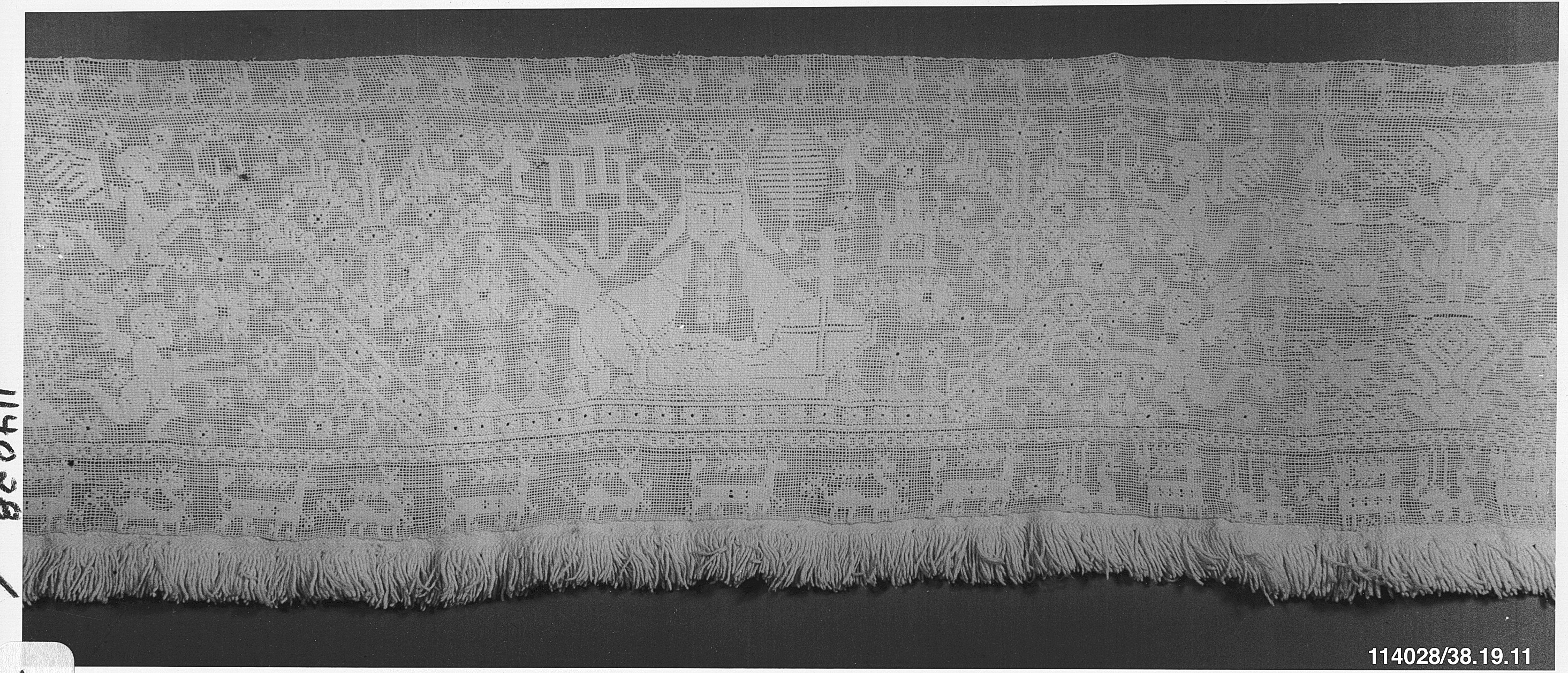
Deconstructing the Sacred: The Altar Frontal as a Study in Material Transcendence
In the rarefied echelons of couture, where fabric is not merely cloth but a vessel for narrative, the altar frontal emerges as a profound anomaly. At Katherine Fashion Lab, our ongoing series of standalone studies—divorced from the runway’s ephemeral demands—seeks to interrogate the very grammar of dress. The subject before us, an altar frontal of Global Heritage provenance, executed in embroidered net and buratto, offers a singular lens through which to examine the intersection of liturgical function, artisanal extremity, and the quiet violence of preservation. This is not a garment to be worn, but a textile to be read. And in its reading, we uncover a blueprint for couture’s most radical potential: the transformation of the profane into the eternal.
The Grammar of the Net: Negative Space as Divine Architecture
The foundational material—an embroidered net—immediately subverts conventional couture logic. Unlike the solidity of silk faille or the opacity of virgin wool, the net proposes absence as its primary structural principle. Its openwork grid, a matrix of deliberate voids, functions not as a deficiency but as a theological argument. In the context of the altar, this transparency allowed the sacred relics or the wooden surface beneath to ghost through, creating a layered visual hierarchy that mirrored the celestial hierarchy itself. The eye was never permitted to rest; it was perpetually drawn through the material, toward a beyond.
For the contemporary designer, this is a masterclass in negative-space tailoring. We often mistake volume for presence, but the altar frontal teaches us that presence is a function of controlled permeability. The net’s grid, typically a hexagonal or square mesh, imposes a rigid, almost mathematical order upon the chaos of hand-stitched embellishment. This tension—between the cold, rational infrastructure of the net and the organic, fluid embroidery that colonizes it—is the very essence of haute couture’s dialectic. It is the same tension found in a Charles James gown, where a seemingly unstructured drape is, in fact, a triumph of internal engineering, or in a McQueen silhouette, where the fragility of tulle is weaponized into architectural armor.
Buratto: The Loom of Patience and the Politics of Time
If the net is the skeleton, then buratto—a finely woven silk or linen gauze, often with a distinct, gauzy texture—is the sinew. Buratto is not a fabric for the impatient. Its production demands a level of manual dexterity that borders on the monastic. Each weft thread is a meditation; each intersection, a prayer. In this altar frontal, the buratto serves as the ground upon which the embroidery is laid, but its own subtle striations and irregular hand-spun character provide a tactile counterpoint to the glossy, metallic threads of the embellishment.
The choice of buratto is not incidental; it is a deliberate invocation of time as a luxury commodity. In an era of fast fashion, where a garment’s lifecycle is measured in weeks, the buratto’s creation is measured in months. This temporal density is the ultimate signifier of couture value. We are not paying for fabric; we are paying for the duration of human attention embedded within it. The buratto’s slight unevenness—its refusal of perfect machine uniformity—becomes a fingerprint of the artisan. It is a quiet rebellion against the sterile perfection of industrial production, and a reminder that true luxury is always, at its core, a record of human fallibility.
Embroidery as Exegesis: Stitches That Preach
The embroidery itself, executed in a technique that appears to combine couching, satin stitch, and intricate laid work, is not mere decoration. It is exegesis—a visual sermon rendered in thread. The motifs, likely floral or vine-based, are not naturalistic representations but symbolic abstractions, echoing the medieval hortus conclusus (enclosed garden) or the Tree of Life. Each stitch is a word; each motif, a sentence. The density of the embroidery increases toward the central panel, drawing the eye to the point of Eucharistic consecration. This is a sophisticated use of directional emphasis—a principle every couturier must master.
Consider the technical bravura required to embroider on net. There is no stable ground; the needle must navigate the void. This demands a choreography of precision that is fundamentally different from embroidering on a solid base. The artisan must work from a pattern, but the execution requires an almost preternatural spatial awareness. The result is a fabric that appears to float—a paradox of heavy, metallic thread suspended in a web of air. This is the same illusion that makes a couture gown ethereal: the appearance of weightlessness achieved through the most laborious of means. The altar frontal, in this sense, is a precursor to the modern bias-cut gown, where gravity is both exploited and denied.
Global Heritage and the Ethics of the Standalone Study
Our classification of this piece under “Global Heritage” is both a blessing and a burden. It acknowledges the object’s journey—likely from a European or Mediterranean atelier, perhaps Italian or Spanish, given the buratto tradition—into a global context of appreciation and study. However, it also compels us to confront the ethics of extraction. As a standalone study, we are not presenting this as a costume or a relic to be replicated. Rather, we are using it as a pedagogical instrument to interrogate our own design methodologies.
The standalone study, divorced from a collection or a client commission, allows for a radical form of close reading. We are not asking, “How can we wear this?” but rather, “What can this teach us about structural integrity, material dialogue, and the semiotics of ornament?” In this context, the altar frontal is a masterclass in restraint. Despite its opulence, there is no excess. Every stitch has a purpose; every open space is a calculated breath. This is a lesson our contemporary practice often forgets—that maximalism is not the absence of editing, but the highest form of it.
Moreover, the piece’s liturgical origin forces us to reconsider the purpose of couture. If the altar frontal is designed to facilitate a transcendent encounter, then why cannot a gown? The best couture—the work of Alaïa, Vionnet, or Gaultier in his ecclesiastical phases—always aspires to this. It seeks to elevate the wearer beyond the mundane. The altar frontal achieves this through its function; the couture garment must achieve it through form alone. This is the challenge the study poses: Can we imbue secular dress with the same gravity and intentionality? Can a jacket be a relic? Can a skirt be a sacred text?
Conclusion: The Frontal as a Mirror
In concluding this analysis, we must recognize that the altar frontal is not a historical artifact to be admired from a distance. It is a mirror held up to the contemporary atelier. It asks us to slow down, to value the void as much as the fill, to respect the material’s own logic, and to understand that true ornament is never superficial—it is structural. The embroidered net and buratto are not merely materials; they are philosophies. The net teaches us about the power of absence; the buratto, about the dignity of labor; the embroidery, about the necessity of intention.
For Katherine Fashion Lab, this standalone study is not an end but a beginning. It informs our next collection’s exploration of translucent layering and hand-stitched latticework. We are not copying the altar frontal; we are absorbing its principles. We are learning to design with the same reverence for material and the same ruthless editing of form. In a world saturated with visual noise, the altar frontal stands as a testament to the power of the deliberate, the slow, and the sacred. It is, in the truest sense, couture before couture existed—a reminder that the highest form of dress is not about covering the body, but about revealing the soul. And that, ultimately, is the only study worth undertaking.