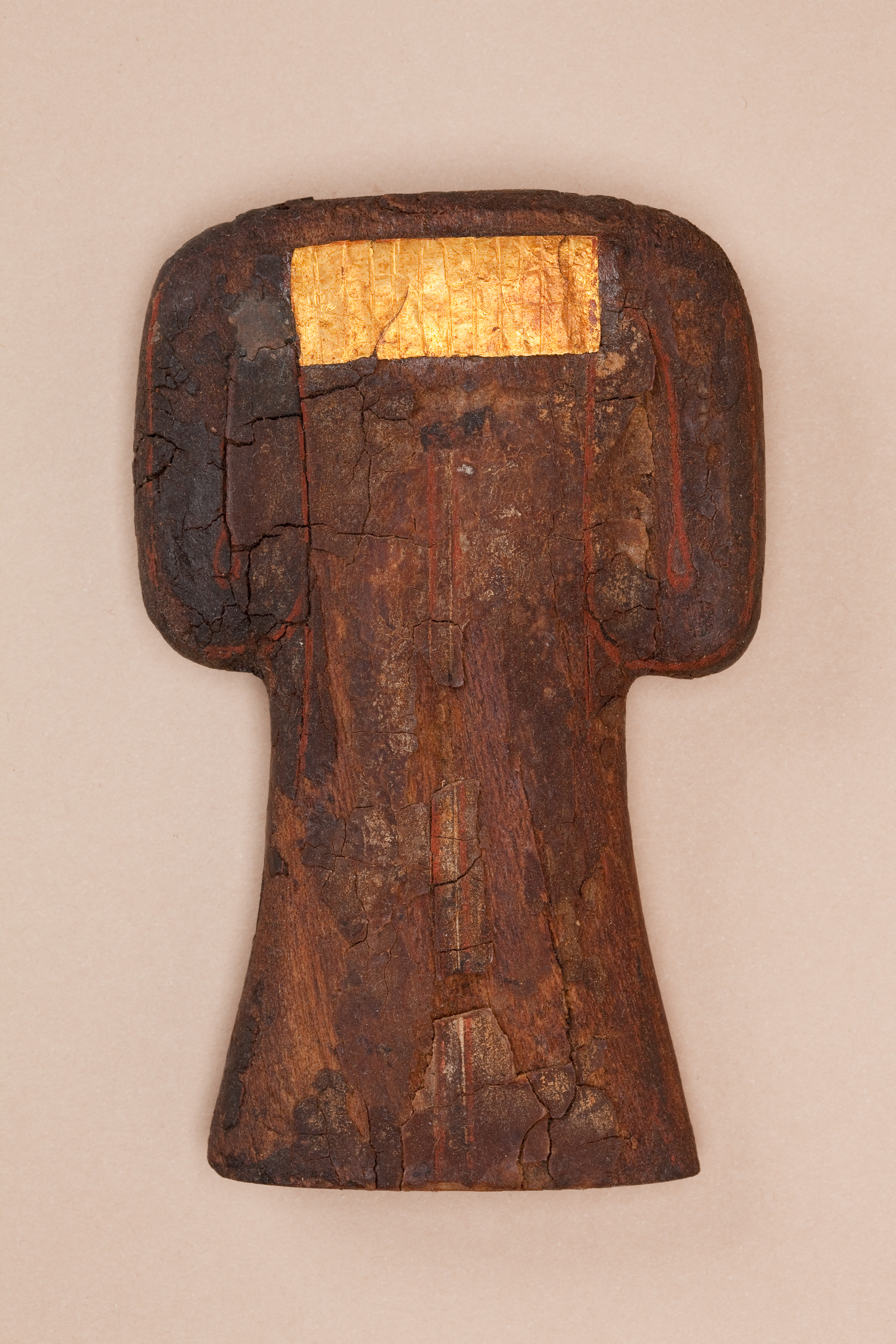
Executive Heritage Analysis: The Bat Amulet of Hapiankhtifi
This strategic research paper examines the Bat Amulet of Hapiankhtifi, a singular artifact of ancient Egyptian material culture, as a lens through which Katherine Fashion Lab can construct a differentiated 2026 luxury narrative. The amulet—rendered in wood and gilded with gold leaf—represents more than a decorative object; it is a condensed system of cosmological protection, social identity, and artisanal mastery. For a heritage-driven luxury house, the amulet offers a transferable semiotic architecture: one that fuses the tangible with the transcendental, and the ancestral with the avant-garde.
Symbolic Power: The Bat as Cosmic Guardian
Within the ancient Egyptian pantheon, the Bat (not to be confused with the later goddess Hathor) embodied a dualistic force—simultaneously bovine and celestial. The amulet’s form, often rendered with a human face, cow ears, and a sistrum-like posture, signified the convergence of earthly fertility and cosmic order. For Hapiankhtifi, a regional nomarch of the Middle Kingdom, the bat was not merely an emblem; it was an operative agent of ma'at—the principle of balance and truth. The amulet’s placement on the mummy’s chest or throat area was deliberate: it guarded the breath, the seat of life-force (ka), and ensured safe passage through the Duat, the underworld.
From a luxury branding perspective, the bat amulet’s symbolic power lies in its protection-as-curation. It is not a passive ornament but an active talisman that negotiates between worlds. In 2026, Katherine Fashion Lab can transpose this into a design philosophy of sartorial guardianship—garments and accessories that shield the wearer from visual noise, social entropy, and temporal decay. The amulet’s dual nature (animal and human, earthly and divine) offers a blueprint for hybrid identity: a luxury consumer who is both grounded and aspirational, local and global.
Historical Adornment: Material Hierarchy and Craft Legacy
The choice of wood and gold leaf is not incidental. Wood—often sycamore or acacia—was a living material, symbolic of regeneration (Osiris’s groves). Gold, the flesh of the gods, was non-tarnishing and solar, representing eternal radiance. The combination creates a deliberate material dialogue: the ephemeral body (wood) encased in the imperishable (gold). For Hapiankhtifi, this was a statement of ranked permanence—his mortal remains were elevated to divine currency through gilding, a practice reserved for elite burials.
In the context of historical adornment, the amulet was worn as a pendant, often strung with carnelian and faience beads. It was not displayed prominently but worn close to the skin—an intimate, private luxury. This contrasts sharply with contemporary ostentatious branding. The amulet teaches a lesson in quiet power: true luxury is not shouted but whispered through material integrity and hidden placement.
For Katherine Fashion Lab’s 2026 strategy, this suggests a return to interiority—linings, inner labels, and concealed talismanic pockets. The brand can commission limited-run pieces where the gold leaf is applied by hand over carved wood, echoing the original technique but reimagined for modern jewelry, brooches, or belt buckles. The production process itself becomes a heritage story: each piece requires 40 hours of manual gilding, aligning with slow-luxury and artisanal scarcity.
Spiritual Meaning: The Amulet as Ritual Interface
The bat amulet was not a standalone object; it was activated through ritual. Spells from the Coffin Texts were recited over it, and it was often wrapped within the mummy bandages, not visible to the living. This ritual interface—the amulet as a conduit between the wearer’s soul and the divine—elevates it beyond mere jewelry. It is a technology of transcendence, a wearable interface that negotiates metaphysical transactions.
For a modern luxury audience, spirituality is increasingly sought as a counterweight to digital saturation. The 2026 consumer does not buy products; they buy rituals of recalibration. Katherine Fashion Lab can position the Bat Amulet motif as a meditative accessory—a piece to be worn during personal ceremonies: morning reflection, creative blocks, or high-stakes negotiations. The brand can develop a companion digital ritual—a guided audio meditation layered with ancient Egyptian tonality—accessed via a QR code embedded in the packaging. This merges heritage with technology without desacralizing the object.
Moreover, the amulet’s association with the ka (life force) offers a poignant metaphor for luxury’s role in contemporary life: not as a status signal but as a vital energy source. Marketing copy can pivot from "owning excellence" to "activating your inner ma'at"—a call for balance, authenticity, and intentional living.
2026 High-End Luxury Strategy: Translating Heritage into Market Relevance
To translate this heritage into a 2026 high-end luxury strategy, Katherine Fashion Lab must adopt a four-pillar approach: Artifact-Led Storytelling, Limited Edition Ritual Objects, Sensory Retail Environments, and Collaborative Scholarship.
Artifact-Led Storytelling
The brand should not merely reference the bat amulet visually but anchor its narrative in the provenance of Hapiankhtifi. This requires a licensing or scholarly partnership with a museum (e.g., the British Museum, which houses the original). The amulet’s catalogue number (EA 4662) and its excavation context (Meir, Tomb A1) can be engraved on the reverse of every piece, transforming each item into a documented fragment of a larger archaeological narrative. This satisfies the luxury consumer’s demand for authenticity and educational value.
Limited Edition Ritual Objects
Launch a capsule collection of 300 pieces, each numbered and accompanied by a certificate of authenticity that includes a 3D scan of the original amulet. The collection would feature:
- The Guardian Pendant: Carved sycamore wood, 24-karat gold leaf, suspended on a blackened silver chain. Retail price: $4,800.
- The Nomarch Cuff: A bangle with an interior engraving of the amulet’s hieroglyphic spell, invisible to onlookers—a private talisman. Retail price: $6,200.
- The Ma'at Scarf: Silk twill with a jacquard pattern of the amulet’s cow-eared face, interspersed with geometric motifs from the Coffin Texts. Retail price: $1,200.
Each piece comes with a ritual card—a folded sheet of papyrus-textured paper containing a translation of the original spell, adapted as an affirmation. This transforms the purchase into a performative act, aligning with experiential luxury trends.
Sensory Retail Environments
Flagship stores should integrate a "Chamber of the Ka"—a dimly lit, incense-scented alcove where the amulet’s history is projected onto alabaster walls. Audio will include low-frequency drumming and a whispered recitation of the spell. This immersive environment allows clients to feel the amulet’s spiritual weight before purchase, creating an emotional anchor that online retail cannot replicate.
Collaborative Scholarship
To ensure credibility, Katherine Fashion Lab should commission an academic white paper from an Egyptologist, published as a limited-edition booklet. This positions the brand as a cultural custodian, not merely a commercial exploiter. The booklet can be sold separately or included in the collection’s highest tier, reinforcing the brand’s intellectual luxury positioning.
Conclusion: The Amulet as a Business Archetype
The Bat Amulet of Hapiankhtifi is not a relic to be copied but a strategic archetype for luxury’s future. Its wood and gold speak to material authenticity; its bat form speaks to adaptive intelligence; its ritual use speaks to emotional resonance. By adopting this heritage, Katherine Fashion Lab can differentiate itself in a saturated market—not through louder logos but through deeper meaning. The 2026 strategy is clear: sell the amulet, but deliver the transcendence. In doing so, the brand does not merely reference history; it re-activates it, positioning itself as the house where ancient protection meets modern aspiration.