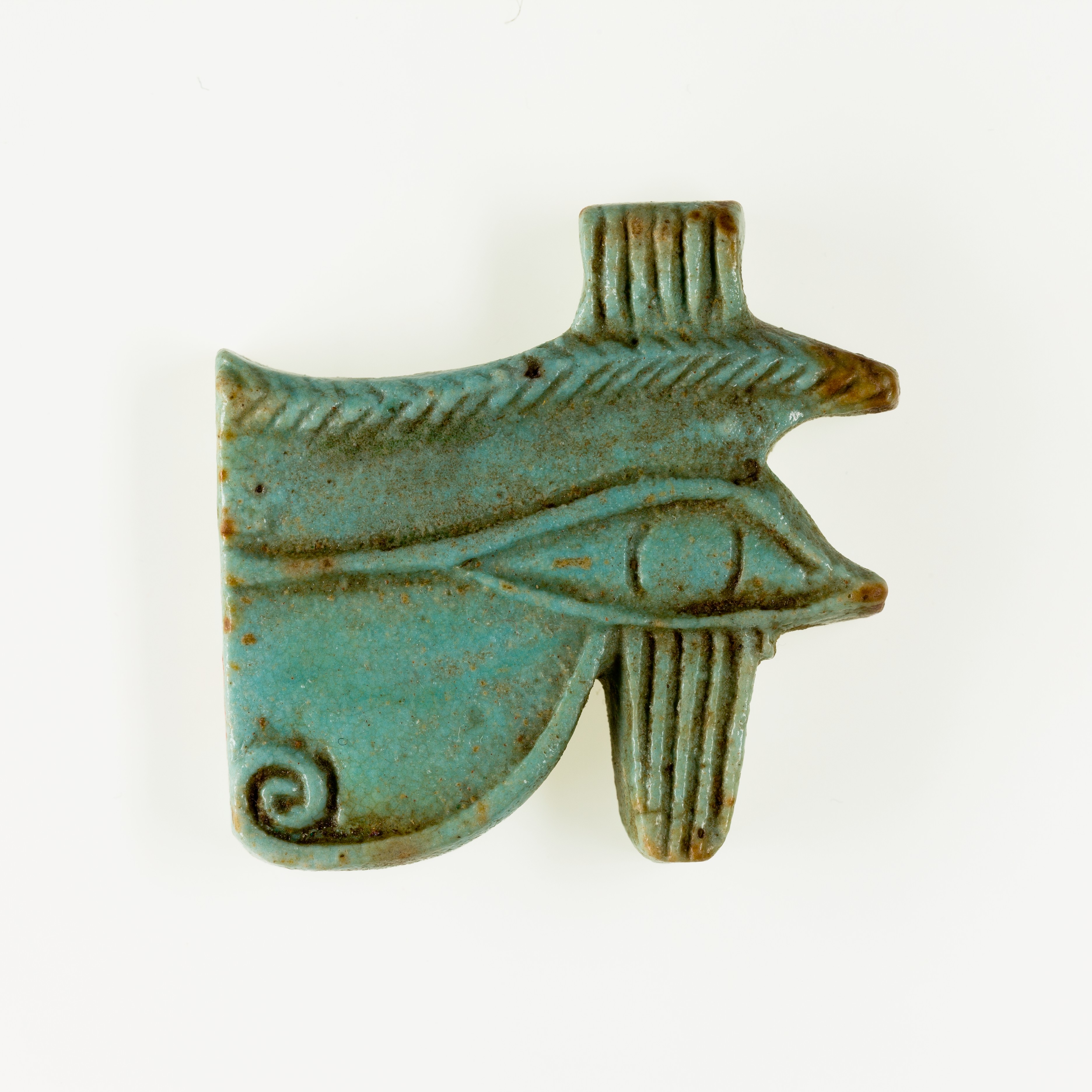
The Wedjat Eye Amulet: A Heritage Analysis for Katherine Fashion Lab
The Wedjat eye, or Eye of Horus, stands as one of the most enduring and potent symbols in the lexicon of ancient adornment. Originating in the Nile Valley’s predynastic period and reaching its apogee during the New Kingdom, this faience amulet transcended mere ornamentation to become a complex talisman of healing, protection, and royal legitimacy. For Katherine Fashion Lab, the strategic appropriation of this symbol demands a rigorous understanding of its layered semantics—not as a superficial trend, but as a curated narrative that bridges millennia of spiritual technology with the contemporary luxury consumer’s quest for meaning.
Symbolic Power and the Grammar of Protection
At its core, the Wedjat eye embodies the mythic restoration of the god Horus, whose left eye was torn apart by Set and subsequently reconstituted by Thoth. This act of divine reassembly imbued the symbol with a dual function: it is simultaneously a marker of wholeness and a prophylactic against fragmentation. In ancient Egyptian cosmology, the eye was not merely a visual organ but an active agent of perception and projection. The Wedjat’s power lay in its ability to see beyond the visible, to perceive the unseen forces of chaos, and to neutralize them through the sheer act of divine vigilance.
For the luxury strategist, this symbolic grammar translates into a potent narrative of protection without aggression. Unlike the aggressive apotropaic symbols of other cultures, the Wedjat does not threaten; it observes, heals, and restores. This aligns with the 2026 high-end consumer’s growing preference for quiet luxury—objects that offer psychological security rather than ostentatious display. The amulet’s power is internalized, a private covenant between wearer and symbol, which positions Katherine Fashion Lab to market not just an accessory, but a state of being.
Historical Adornment: From Faience to Fine Jewelry
The materiality of the Wedjat is as significant as its iconography. Crafted primarily in faience—a self-glazing quartz composite that produced a luminous turquoise or cobalt blue—the amulet was a democratized luxury. While gold and lapis lazuli were reserved for the elite, faience offered a simulacrum of preciousness, its vitreous sheen mimicking the regenerative qualities of water and the sky. This historical tension between material and meaning is critical for Katherine Fashion Lab’s 2026 strategy.
In ancient contexts, faience was not a cheap imitation but a technological marvel, a material that embodied the alchemical transformation of base elements into something eternal. The modern luxury house must therefore treat its chosen medium—whether high-karat gold, blackened silver, or innovative bio-resins—as a deliberate dialogue with this history. The strategic move is not to replicate faience but to honor its process: the transmutation of raw material into a vessel of spiritual significance. By employing artisanal techniques such as hand-enameling or micro-mosaic inlay, Katherine Fashion Lab can evoke the faience’s luminosity while asserting a contemporary, haute-couture provenance.
Spiritual Meaning and the Contemporary Wearer
The Wedjat’s spiritual resonance extends beyond its Egyptian origin, tapping into a universal human desire for agency against the unknown. In the ancient world, the amulet was placed on mummies to ensure safe passage, on the living to ward off disease, and on temple walls to protect sacred space. Its ubiquity suggests a profound psychological function: the externalization of inner resilience. For the 2026 luxury consumer—operating in an era of geopolitical volatility, digital surveillance, and environmental anxiety—the Wedjat offers a tactile anchor of personal sovereignty.
Katherine Fashion Lab should position the Wedjat not as a religious artifact but as a secular talisman of mindful protection. The spiritual meaning is reframed through the lens of self-care and intentionality. The wearer is not invoking a deity but activating their own capacity for wholeness. This requires a marketing narrative that emphasizes ritual: the act of donning the Wedjat becomes a daily meditation, a pause to recalibrate one’s focus. The amulet’s ancient role as a healing instrument dovetails with contemporary wellness culture, yet it retains a historical gravitas that distinguishes it from generic "crystal" trends.
2026 Luxury Strategy: The Wedjat as Narrative Asset
To integrate the Wedjat into a high-end strategy, Katherine Fashion Lab must avoid two pitfalls: archaeological pedantry and cultural dilution. The first alienates the modern consumer; the second insults the symbol’s integrity. The optimal path is a curatorial approach, treating the Wedjat as a signature motif within a broader collection titled, for instance, "The Restoration Series." This collection would not feature the eye as a literal pendant alone but as a recurring design element—an engraved interior, a clasp detail, or a filigree pattern—allowing for both conspicuous and discreet expressions of the symbol.
Product Architecture and Pricing Tiers
The strategy should deploy a three-tiered structure. The entry tier features small, daily-wear pieces in sterling silver with oxidized detailing, priced between $800 and $1,500, targeting the aspirational luxury buyer who values symbolic depth. The core tier elevates the Wedjat in 18-karat gold with tsavorite or iolite accents—stones that echo the faience palette—priced between $4,000 and $12,000, appealing to the established collector. The high jewelry tier presents a singular masterpiece: a Wedjat rendered in black diamond and Paraíba tourmaline, set on a cuff that evokes ancient armlets, priced above $80,000. This tier is not for sale in the traditional sense but is offered through private viewings, reinforcing exclusivity and narrative ownership.
Brand Storytelling and Digital Ritual
The 2026 luxury consumer demands provenance, but not a lecture. Katherine Fashion Lab should produce a digital heritage dossier—a short, cinematic film and an interactive 3D model of a museum-grade Wedjat—that allows the client to explore the symbol’s anatomy: the eyebrow representing thought, the pupil representing sight, and the teardrop representing the healing fluid of Thoth. This digital ritual transforms the purchase into an act of knowledge acquisition. Furthermore, a limited-edition "Restoration" packaging, featuring a hand-painted faience-blue interior, creates an unboxing experience that performs the ancient act of enshrining a sacred object.
Strategic Conclusion: From Artifact to Archetype
The Wedjat eye amulet is not a trend; it is an archetype of resilience. For Katherine Fashion Lab, its integration into a 2026 luxury strategy offers a rare opportunity to merge historical gravitas with contemporary psychological needs. The symbol’s power lies in its ambiguity—it is simultaneously protective and introspective, royal and intimate. By respecting its faience origins while reimagining its materiality, and by framing its spiritual meaning as a form of personal restoration, the brand can create a collection that is both intellectually rigorous and emotionally resonant. The Wedjat does not merely decorate the body; it fortifies the self. In an era of fragmentation, Katherine Fashion Lab can position itself as the house that restores wholeness—one eye at a time.