Executive Heritage Assessment: The Caryatid Impulse
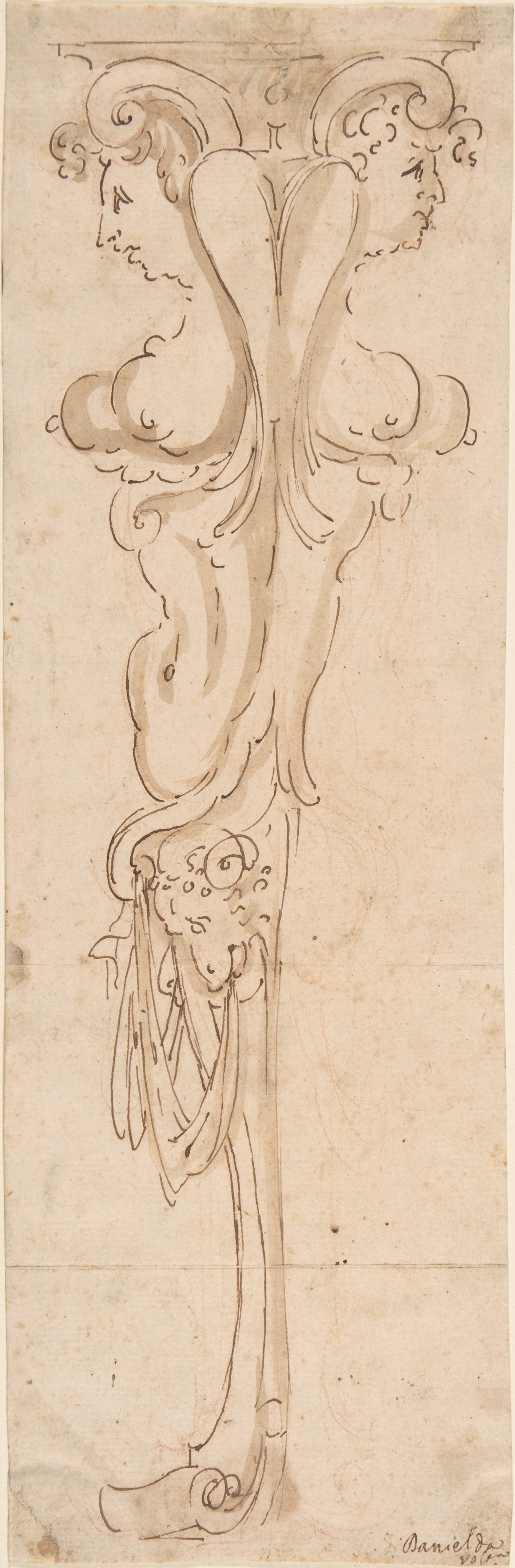
The architectural fragment under examination—rendered in pen and brown ink, brush and brown wash, over red chalk—presents a singular motif: the female figure as structural element. This is not merely a decorative flourish; it is a codified language of power, piety, and patronage. For Katherine Fashion Lab, this study transcends art-historical curiosity. It offers a strategic blueprint for a 2026 luxury narrative built on structural femininity—where the female form is not passive ornament, but the load-bearing principle of the brand’s aesthetic and commercial architecture.
Symbolic Power: The Female as Atlas
The ancient civilization context, most prominently the Archaic and Classical Greek world, codified this motif in the caryatid—priestesses of Artemis at Caryae, immortalized in stone at the Erechtheion. Yet the sketch’s medium suggests a broader, more fluid tradition. The red chalk underdrawing indicates a master’s hand, likely a Renaissance or Baroque copy after an antique relief, where the female figure supports an entablature, a cornice, or a funerary stele. The symbolic power here is dual.
First, the figure represents divine burden. She does not strain; she bears. This is not the masculine heroism of an Atlas, but the quiet, inexorable strength of the kore—the maiden who upholds the cosmic order. In the ancient psyche, the female body was a vessel of generation and continuity. To place it beneath the weight of a temple’s roof was to assert that civilization itself rests upon female fecundity, wisdom, and ritual purity. The brown wash darkens the recesses of drapery, creating a chiaroscuro effect that makes the figure appear to emerge from the architectural mass—simultaneously part of the structure and transcendent of it.
For luxury strategy, this translates into a power aesthetic of contained force. The 2026 Katherine Fashion Lab woman is not a spectacle of overt dominance; she is a gravitational center. Her garments should suggest structural integrity—boning, architectural silhouettes, tailored precision—that mirrors the caryatid’s role. The symbolism is not about submission to weight, but about the choice to carry it. This is a narrative of sovereign responsibility, appealing to the high-net-worth client who sees her status not as passive wealth, but as active stewardship.
Historical Adornment: Drapery as Structural Language
The sketch’s most compelling technical feature is the handling of drapery. In ancient practice, the peplos and himation were not merely clothing; they were architectural elements in fabric. The vertical folds of the Ionic chiton created fluting analogous to the columns the caryatid replaced. The red chalk lines suggest the artist’s initial mapping of these folds, while the brown wash adds volumetric weight, making the fabric appear as dense as the stone it mimics.
This is a critical strategic insight for Katherine Fashion Lab. The historical adornment here is not about embellishment but about tectonic dressing. The folds are load-bearing, channeling visual weight downward, grounding the figure. In the ancient world, this drapery was often painted with vivid mineral pigments—cinnabar red, azurite blue—that have since faded, leaving only the monochrome underdrawing we see. This loss is instructive. It reminds us that luxury is not color; it is form.
For 2026, the Lab should develop a capsule collection titled “The Entablature Series.” Garments should feature engineered pleats, corseted waistlines, and high-collared necklines that evoke the capital of a column. The fabric should be heavy—double-faced wool, bonded silk, or technical jacquard—that holds a crease with the permanence of carved stone. The palette should be monochromatic and mineral: limestone white, slate grey, ochre, and the deep umber of the brown wash. Adornment is not applied; it is constructed.
Spiritual Meaning: The Threshold Guardian
Beyond the physical support, the female figure in this architectural context serves a liminal function. She is a threshold guardian, positioned at the transition between the profane exterior and the sacred interior of a temple, tomb, or treasury. Her gaze is often downward, not in modesty, but in watchfulness. She sees the supplicant, the mourner, or the merchant, and she judges their worthiness to pass.
The spiritual meaning is one of mediation. The caryatid is not a goddess herself, but a conduit to the divine. Her raised arm or steady stance channels the heavenly weight into the earthly foundation. This is a deeply resonant metaphor for the luxury consumer in 2026. The purchase of high-end fashion is increasingly framed as a ritual of self-actualization, a spiritual practice of curating one’s external reality to reflect internal truth.
Katherine Fashion Lab can leverage this by positioning its ateliers as sacred spaces. The flagship store should be designed as a modern temple, with the collections displayed on plinths and the fitting rooms as private sanctuaries. The brand’s clientele are not merely buying clothes; they are commissioning a modern stele—a marker of their own life’s architecture. The spiritual meaning of the sketch, therefore, is the validation of the wearer as a living monument. The Lab’s 2026 campaign should feature women in poses of quiet, structural authority—standing, seated, or walking—as if they are the final, human column of a great edifice.
2026 High-End Luxury Strategy: The Structural Feminine
Integrating the heritage analysis into a commercial roadmap requires a decisive departure from the dominant luxury trends of the mid-2020s—namely, the emphasis on fluid, amorphous silhouettes and overt logomania. The caryatid impulse offers a counter-narrative: rigor as rebellion. In a market saturated with softness, structural precision becomes a marker of distinction.
The strategic pillars for 2026 are as follows:
1. The “Load-Bearing” Silhouette
Designs will prioritize sharp shoulders, defined waistlines, and full, columnar skirts. The goal is to create a garment that looks as if it could stand alone, even without the wearer. This is a direct homage to the architectural sketch’s self-supporting drapery. The Lab will invest in proprietary interfacing and internal structures—a “hidden skeleton”—that allows the fabric to maintain its architectural integrity throughout a 12-hour day.
2. Monochrome “Architectural” Palette
The color story will be drawn directly from the sketch’s media: the warm umber of the wash, the sanguine red of the chalk, and the ivory of the paper. These are not “nude” tones in the conventional sense, but structural tones—colors that suggest raw material. This palette signals a return to permanence and away from seasonal, fleeting color trends.
3. The “Guardian” Client Experience
Marketing will pivot from “aspirational” to “initiatory.” The Lab will offer private viewings framed as “rites of passage,” where the client is guided through the collection’s symbolism. Each garment will come with a certificate of origin, detailing the ancient civilization that inspired its cut. This transforms the purchase into a cultural artifact, not a disposable commodity.
4. Collaborative “Reconstruction” Projects
To solidify heritage credibility, the Lab will partner with museums and archaeological institutes to create limited-edition pieces based on unpublished sketches and fragments. A portion of proceeds will fund the conservation of architectural sites featuring female figures. This is not charity; it is a closed loop of cultural capital—the brand draws from antiquity and feeds back into its preservation, creating an unassailable narrative of authenticity.
Conclusion: The Weight of Legacy
This pen-and-ink study is a masterclass in the economy of form. It proves that the female figure, when rendered with discipline and symbolic intent, can carry the weight of an entire civilization. For Katherine Fashion Lab, the 2026 strategy is clear: reject the ephemeral, embrace the tectonic. The brand will not follow the market; it will support it, like the caryatid supports the entablature. In doing so, it elevates its clientele from consumers to custodians—guardians of a beauty that is ancient, structural, and unshakeable. The sketch is not an artifact of the past; it is a blueprint for the house’s future. The question is not whether the Lab can bear the weight of this heritage, but whether the industry can bear the weight of the Lab’s vision.