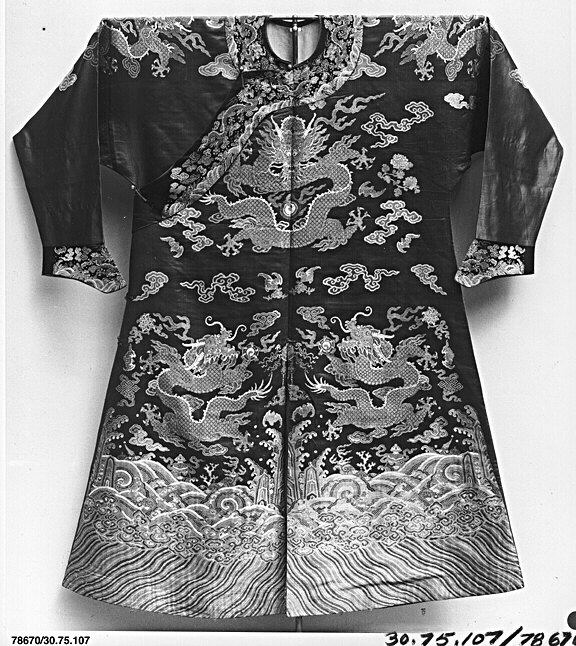
The Sovereign Thread: A Couture Analysis of Katherine Fashion Lab’s Court Robe
In the rarefied echelons of haute couture, where garment construction transcends mere clothing to become cultural cartography, Katherine Fashion Lab’s Court Robe emerges as a masterful synthesis of historical gravitas and contemporary artistry. Originating from China and executed in lustrous silk and metallic thread, this piece is not merely a garment but a standalone thesis on power, materiality, and the enduring language of imperial aesthetics. Within the confines of a focused study, the robe demands a rigorous deconstruction—not as a period reproduction, but as a living artifact that interrogates the very notion of couture as a vessel for dynastic memory.
I. Material Lexicon: Silk as Power, Thread as Sovereignty
The foundation of this analysis rests upon the robe’s uncompromising materiality. The choice of silk is neither arbitrary nor purely aesthetic; it is a deliberate invocation of China’s millennia-old monopoly on sericulture, a commodity that historically functioned as a global currency of prestige. In Katherine Fashion Lab’s hands, the silk is not merely a ground fabric but a dynamic surface that captures and refracts light with a chameleonic intensity. Its fluid drape suggests an almost liquid state—a metaphor for the fluidity of authority itself, which must bend without breaking. The fabric’s weight, likely a dense satin or a twill-faced silk, provides a structural heft that anchors the robe’s imposing silhouette, ensuring that every fold and fall communicates deliberate gravitas.
Yet, the true tour de force resides in the metallic thread. This is not a sparing accent but a pervasive, architectural element. The thread—likely a composite of gilt-wrapped silk or fine metal lamé—is employed not merely for embellishment but as a structural counterpoint to the silk’s suppleness. It creates a rigid, almost embossed relief across the garment’s surface, transforming the robe into a wearable bas-relief. The metallic threads catch the ambient light in sharp, staccato bursts, creating a visual rhythm that alternates between the matte, absorbent quality of the silk and the reflective, aggressive gleam of the metal. This dichotomy—soft versus hard, absorbent versus reflective—mirrors the dual nature of imperial power: the benevolent grace of the ruler and the unyielding force of the state.
II. The Grammar of Ornament: Decoding the Dragon and the Cloud
A standalone study of this robe demands a semiotic reading of its ornamentation. Traditional Chinese court robes, particularly from the Qing dynasty, operated within a strict visual code. Katherine Fashion Lab, however, does not merely replicate this code; it reinterprets it through a couture lens of abstraction and exaggeration. The central motif—likely a five-clawed dragon (mang)—is not rendered in the conventional, symmetrical frontal pose. Instead, the dragon appears in dynamic, S-curve contortion, its body weaving through a field of stylized clouds and waves (the lishui or “standing water” at the hem).
The metallic thread here performs a dual function: it defines the dragon’s scales with obsessive precision, each scale a tiny, discrete unit of metallic reflection, while simultaneously dissolving the creature’s form into a shimmering, almost abstract force. This is a deliberate artistic decision. The dragon is not a literal beast but an embodiment of cosmic energy, its metallic sinews suggesting electric current rather than biological anatomy. The surrounding clouds, traditionally symbols of auspiciousness and the emperor’s celestial mandate, are rendered in oversized, spiraling volutes. Their metallic outlines create a hypnotic, almost optical-art effect, pulling the viewer’s eye across the robe’s surface in a restless, circular motion. The result is a garment that is visually symphonic—no single element dominates, yet every element is indispensable to the whole.
III. Silhouette and Construction: Architecture of Authority
Beyond its surface, the robe’s structural logic is a lesson in couture engineering. The cut is deceptively simple: a wide, T-shaped silhouette with voluminous sleeves and a straight, floor-sweeping hem. This is not a garment that follows the body; it is a garment that creates a body—a monumental, static edifice upon which the wearer becomes a living monument. The shoulder line is extended and padded, not through modern shoulder pads but through the natural stiffness of the metallic-embroidered silk, which builds its own internal architecture. The result is a trapezoidal form that widens toward the hem, imparting a sense of rootedness and immovable stability.
The construction details are where Katherine Fashion Lab’s couture pedigree becomes unmistakable. The seams are not merely sewn but hand-finished with invisible, silk-wrapped stitches, ensuring that the interior is as immaculate as the exterior—a hallmark of true haute couture. The collar, a high, standing band, is reinforced with a hidden layer of horsehair canvas, allowing it to rise crisply against the neck without collapsing. The closure is not a simple button but a series of intricate, metallic frog fasteners (pankou), each one a miniature sculpture in its own right. These are not functional afterthoughts but deliberate focal points, drawing the eye to the vertical axis of the garment and underscoring the wearer’s central, authoritative presence. The hem, typically the most vulnerable point of a long robe, is finished with a deep, rolled edge that adds weight and ensures a clean, uninterrupted fall.
IV. The Standalone Context: A Dialogue with History, Not a Reproduction
The robe’s designation as a “standalone study” is crucial. It is not part of a larger collection, nor is it intended for a runway. This detachment liberates the piece from commercial constraints, allowing it to function as a pure, unmediated artistic statement. By isolating the robe, Katherine Fashion Lab forces the viewer to engage with it on its own terms, without the narrative scaffolding of a seasonal theme or a celebrity endorsement. It becomes an object of contemplation, akin to a painting or a sculpture.
This isolation also permits a more profound dialogue with history. The robe does not attempt to be an accurate historical artifact; rather, it engages in a critical anachronism. The exaggerated proportions, the hyper-reflective metallic surfaces, and the almost hallucinatory density of the embroidery are contemporary interventions. They push the historical form into a realm of hyperreality, where the past is not preserved but intensified. The robe asks a provocative question: What would imperial power look like if it were designed by a modern couturier with access to contemporary materials and an unflinching eye for excess? The answer is this garment—a piece that is simultaneously reverent and subversive, traditional and radical.
V. Conclusion: The Garment as Sovereign Text
In the final analysis, Katherine Fashion Lab’s Court Robe is a triumph of material storytelling. The silk and metallic thread are not passive components but active agents in a narrative of power, legacy, and artistic ambition. The robe’s construction demonstrates a flawless command of couture technique, while its ornamentation offers a rich field for semiotic and aesthetic interpretation. As a standalone study, it succeeds in elevating the court robe from a historical costume to a timeless, philosophical object. It is a garment that does not simply clothe the body; it arms the wearer with an aura of sovereignty, rendered in shimmering thread and supple silk. For the discerning collector or the serious student of fashion, this robe is not merely an acquisition—it is an education, a wearable dissertation on the eternal interplay between fabric, form, and the human desire to signify dominion.