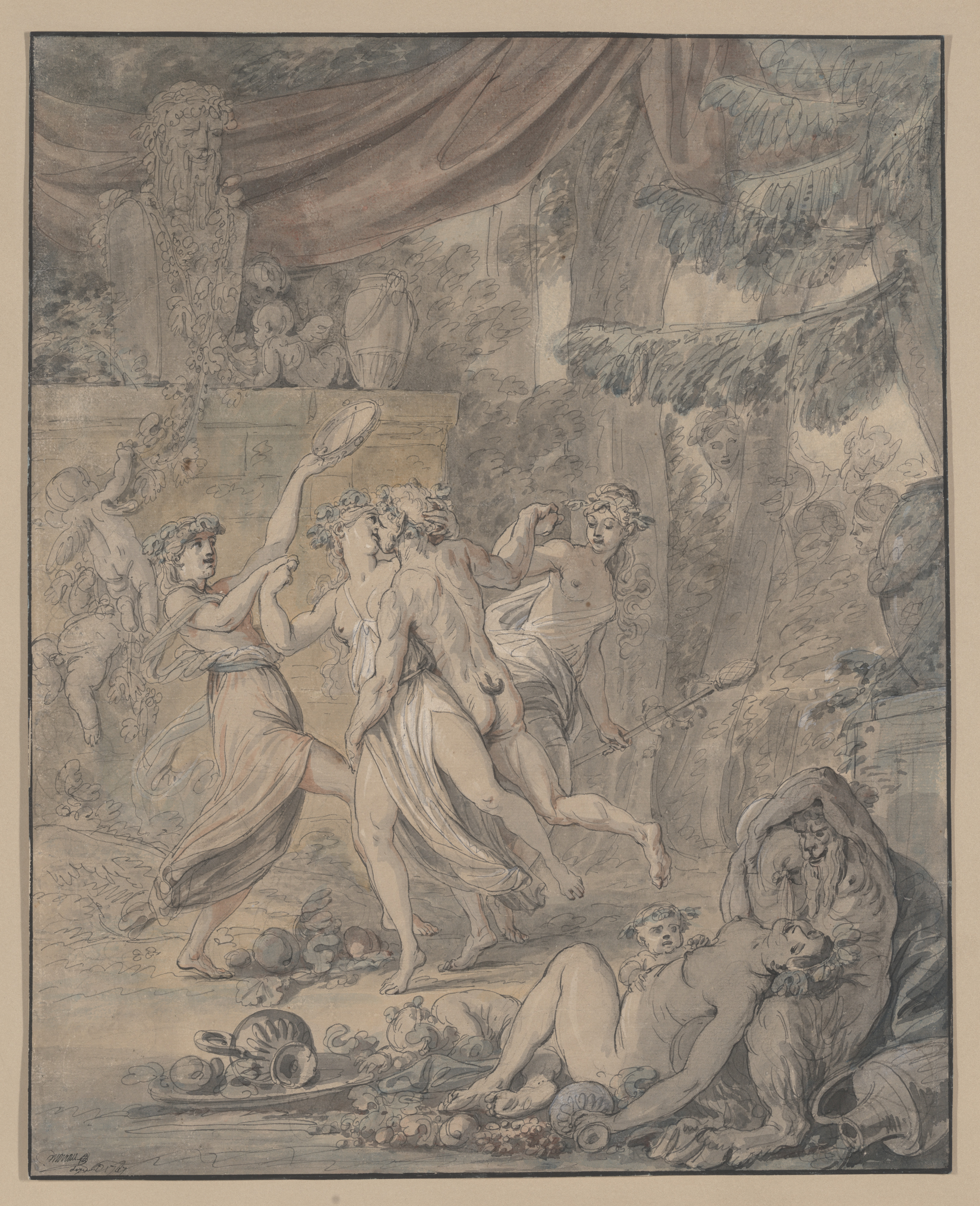
Bacchanale: A Heritage Analysis for Katherine Fashion Lab
The Bacchanale stands as one of antiquity’s most potent visual expressions of ecstatic release, communal transcendence, and the deliberate inversion of social order. For Katherine Fashion Lab, this subject—rendered in pen and black ink, watercolor, black chalk, and white heightening—offers a profound lexicon for a 2026 high-end luxury strategy that moves beyond mere ornamentation into the realm of ritualistic identity. This analysis deconstructs the Bacchanale’s symbolic power, historical adornment, and spiritual meaning, translating them into actionable strategic imperatives for the modern atelier.
Symbolic Power: The Aesthetics of Controlled Chaos
The Bacchanale, rooted in the cult of Dionysus (or Bacchus), is not a depiction of simple drunkenness; it is a symbolic representation of metanoia—a fundamental transformation of the self. In the ancient world, particularly within Greek and Roman societies, the Bacchanalia were secretive rites that temporarily dismantled hierarchical structures. The symbolic power lies in the tension between the thiasos (the ecstatic retinue) and the individual’s surrender to the collective pulse. The medium of pen and ink, overlaid with watercolor and heightened with white, captures this duality exquisitely. The black chalk provides structural bones—the societal framework—while the watercolor blurs boundaries, suggesting the fluidity of identity during ritual. The white heightening acts as a flash of divine illumination, a moment of clarity within the frenzy.
For Katherine Fashion Lab, the strategic takeaway is the curation of controlled subversion. In 2026, the luxury consumer is not seeking rebellion for its own sake, but rather a sanctioned space for expressive release. The Bacchanale teaches us that true luxury is the ability to orchestrate chaos with precision. The brand should adopt a design philosophy where sharp, architectural tailoring (the black chalk) is disrupted by fluid, liquid-like draping (the watercolor), and punctuated by crystalline embellishments or stark white accents (the heightening). This visual tension communicates power—not the power of rigidity, but the power of one who can navigate and command the liminal space between order and ecstasy.
Historical Adornment: The Vestments of the Devotee
Examining the historical adornment within Bacchic iconography reveals a sophisticated understanding of sensory stimulation. The devotees, or maenads, did not wear the heavy, structured garments of the polis. Instead, they wore the nebris (a fawn skin) draped over the shoulder, often pinned with a fibula of bronze or gold. Their garments were typically of fine linen or wool, deliberately loosened or belted with live snakes—a symbol of chthonic energy and renewal. The hair was unbound, a direct contrast to the veiled and pinned styles of respectable matrons, and crowned with ivy or vine leaves. Jewelry was not absent but was organic: clusters of grapes, pine cones (thyrsus tips), and amethyst—a stone believed to prevent intoxication while allowing spiritual clarity.
The materiality of the medium is crucial here. The pen and ink delineate the intricate folds of these garments, the watercolor suggests the dyed purples and wines of the fabrics, and the white heightening captures the glint of metal and the sheen of skin. This is not minimalist adornment; it is maximalist symbolism. For Katherine Fashion Lab’s 2026 collection, historical accuracy is less important than historical essence. The strategy should involve re-engineering these elements into a modern luxury vernacular. Consider a structured jacket cut with the asymmetry of the nebris, but rendered in buttery leather or technical silk. Replace the live snake with a serpentine chain belt, cast in recycled gold. The ivy crown becomes a delicate headpiece of enameled leaves, while the amethyst is featured prominently in statement cuffs and earrings. This approach allows the client to wear a piece of history without appearing costumed—a key differentiator in the upper echelons of the market.
Spiritual Meaning: The Ritual of Renewal
The spiritual core of the Bacchanale is the concept of sparagmos and omophagia—the tearing and raw consumption that leads to rebirth. While the literal practice is extreme, its metaphorical significance is profound: the breaking down of the old self to make way for a new, more authentic being. In a contemporary context, this aligns perfectly with the luxury sector’s shift towards experiential and transformational offerings. The Bacchanale’s spirituality is not about quiet contemplation; it is about active, embodied transcendence. It is a celebration of the life force itself, acknowledging that death and decay are necessary precursors to spring and renewal.
For the 2026 luxury strategy, Katherine Fashion Lab must position its offerings not merely as products, but as catalysts for personal transformation. The narrative should move from “buying a dress” to “entering a state of being.” This can be executed through exclusive, invitation-only events that mirror the structure of the ancient rites—secretive, immersive, and multi-sensory. The garments themselves should be designed to be worn in motion, with cutouts, fringe, and asymmetric hems that encourage a kinetic, dance-like engagement with the body. The spiritual meaning is also reflected in the choice of materials: prioritize raw silks, unpolished crystals, and artisanal techniques that show the hand of the maker, reinforcing the idea of a unique, sacred object rather than a mass-produced commodity.
2026 High-End Luxury Strategy: The Bacchanal Protocol
Synthesizing these pillars—symbolic power, historical adornment, and spiritual meaning—into a cohesive 2026 strategy requires a three-tiered approach for Katherine Fashion Lab.
Tier One: The Atelier Collection
Launch a limited capsule of 12 looks, each named after a figure from Bacchic myth (e.g., Ariadne, Pentheus, Agave). Each piece will incorporate the medium’s visual logic: black ink-like embroidery, watercolor-washed gradients in deep wines and violets, and white pearl or crystal accents for the “heightening.” The price point must reflect the narrative complexity, positioning these as investment pieces for the discerning collector.
Tier Two: The Immersive Retail Experience
Redesign flagship storefronts to evoke a sacred grove or a torch-lit cave. Use scent (vetiver, fig, and myrrh) and sound (percussive, rhythmic drumming) to create a synesthetic environment. Garments should be displayed on rotating mannequins that evoke the movement of the dance, allowing clients to perceive the fluidity of the fabric. This transforms shopping from a transaction into a pilgrimage.
Tier Three: The Private Rite
Develop a “Bacchanal Protocol” for top-tier clients—a private dinner or gala where the dress code is strictly interpreted through the collection’s lens. This event is not a party but a ritual, complete with a master of ceremonies and a guided narrative that explains the symbolism of the attire. This builds a community of like-minded individuals who share a deeper appreciation for the brand’s intellectual and cultural rigor, fostering fierce loyalty and word-of-mouth advocacy.
In conclusion, the Bacchanale is far more than a historical curiosity. It is a masterclass in the fusion of art, identity, and commerce. By decoding its symbolic power, reinterpreting its historical adornment, and honoring its spiritual meaning, Katherine Fashion Lab can craft a 2026 strategy that is intellectually sophisticated, emotionally resonant, and commercially potent. The brand will not simply sell clothing; it will offer a modern path to transcendence, one exquisitely tailored piece at a time.