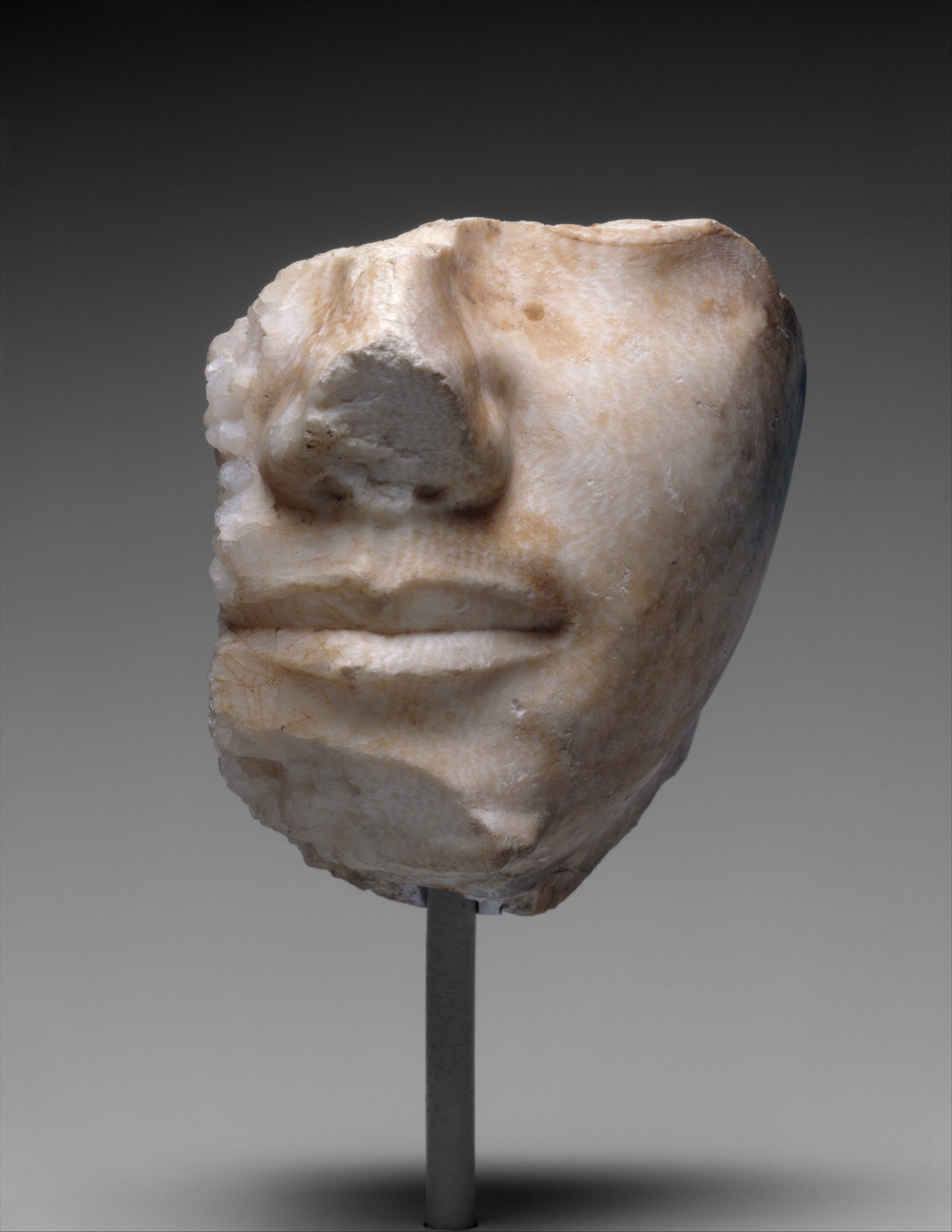
Executive Heritage Analysis: The Fragmentary Face of King Khafre
This strategic research paper, prepared for Katherine Fashion Lab’s 2026 high-end luxury portfolio, examines the Fragmentary Face of King Khafre as a masterclass in symbolic power, material transcendence, and spiritual authority. Carved from travertine—commonly known as Egyptian alabaster—this artifact from the Old Kingdom’s Fourth Dynasty (circa 2570–2544 BCE) offers a profound lexicon for contemporary luxury: the power of incompletion, the weight of sacred materiality, and the quiet authority of sovereign restraint. For a maison that seeks to define the next decade of elite adornment, Khafre’s fragmented visage is not merely an archaeological curiosity; it is a strategic blueprint for crafting objects that command reverence through absence, not excess.
I. Symbolic Power: The Sovereignty of the Fragment
In the context of ancient Egyptian royal iconography, the face of Khafre—builder of the second Giza pyramid—was never intended as a mere portrait. It was a living vessel for the ka, the spiritual double that required a permanent physical anchor. The deliberate use of travertine, a stone associated with the goddess Bastet and the sacred light of the sun, elevated the king’s image from mortal likeness to divine embodiment. However, the fragmentary state of this particular piece introduces a layered symbolic narrative: the partial face signifies neither defeat nor decay, but rather the eternal resilience of royal authority. What remains—the strong brow, the unyielding cheekbone, the idealized contour of the jaw—communicates power more effectively than a complete effigy ever could. The missing portions invite the viewer to project completion, a psychological mechanism that luxury brands can harness: scarcity of form amplifies perceived value. For Katherine Fashion Lab, this translates to a 2026 strategy where deliberate incompleteness—a cut, a drape, a silhouette that stops just short of expectation—becomes a signature of sovereign taste.
II. Historical Adornment: Travertine as the Original "Quiet Luxury"
Long before the modern lexicon of stealth wealth, ancient Egyptian artisans understood that material choice is the first language of status. Travertine, with its warm, honeyed translucency and natural veining, was not the hardest stone available—that distinction belonged to granite or diorite—but it was the most exclusive for royal visages. Its softness allowed for exquisite detailing, yet its luminous quality made it appear almost alive under torchlight. This paradox—delicate yet enduring—made travertine the medium of choice for intimate cult statues, not monumental public ones. Khafre’s face, therefore, was an object of private veneration, not public spectacle. In the 2026 luxury landscape, where mass-produced logos have diluted symbolic capital, Katherine Fashion Lab can reposition itself by adopting a similar material philosophy: utilize rare, tactile, and light-responsive materials—such as alabaster-toned silks, mineral-infused leathers, or hand-polished organic resins—that whisper exclusivity rather than shout it. The historical precedent is clear: true adornment is not about the volume of decoration, but the precision of material selection.
III. Spiritual Meaning: The Eye of Horus and the Invisible Crown
The fragmentary nature of Khafre’s face is particularly potent when viewed through the lens of spiritual protection. In Egyptian cosmology, the eye was the seat of the soul and the conduit of divine vision. Though the surviving fragment may lack the full eye, the sculpted socket retains the memory of the Wedjat—the Eye of Horus—which symbolized healing, protection, and royal clarity. The missing crown, whether the White Hedjet or the Red Deshret, is equally significant; its absence does not diminish the king’s authority but instead suggests that his sovereignty is innate, not conferred by accessory. This is a profound lesson for high-end luxury strategy: the wearer of a Katherine Fashion Lab piece should feel that their power emanates from within, with the garment or jewel serving as a spiritual amplifier, not a source of identity. For 2026, the maison should develop a "Khafre Code" collection—pieces that incorporate asymmetric closures, negative-space cutouts, and veiled embroidery—to evoke the spiritual completeness of the fragment. The design language should communicate: I am whole, even in my chosen incompletion.
IV. Strategic Application: The 2026 Luxury Framework
Translating this ancient heritage into a market-ready strategy requires a three-tiered approach: Artisan Provenance, Narrative Scarcity, and Ritualized Consumption.
Artisan Provenance
Just as Khafre’s face was carved by a master sculptor whose name is lost to history but whose skill is eternal, Katherine Fashion Lab must foreground the hand of the artisan. Each 2026 piece should be accompanied by a "Travertine Index"—a certificate detailing the hours of manual labor, the specific mineral batch, and the artisan’s signature. This transforms a product into a relic, aligning with the ancient Egyptian belief that the maker’s intention infuses the object with spiritual energy.
Narrative Scarcity
Do not reproduce the fragment. Instead, create a limited series of seven haute couture ensembles, each inspired by a different aspect of Khafre’s surviving features—the brow, the cheek, the jawline. Each piece will be sold with a 3D-printed replica of the fragment in miniature, encased in a travertine base. This physical connection to the artifact anchors the narrative in authenticity, appealing to the ultra-high-net-worth collector who seeks objects with historical gravity.
Ritualized Consumption
The ancient Egyptians did not casually display royal images; they housed them in sanctuaries and attended to them with daily rituals. For 2026, Katherine Fashion Lab will launch a private client experience titled "The Sanctuary of Khafre." Clients are invited to a dimly lit, ash-scented atelier where the fragment’s replica is unveiled under a single beam of warm light. The purchase is not a transaction but a private consecration, complete with a hand-written papyrus scroll detailing the spiritual meaning of the chosen piece. This elevates the brand from a seller of goods to a custodian of meaning.
V. Conclusion: The Fragment as the Ultimate Signifier
The Fragmentary Face of King Khafre demonstrates that in the highest echelons of power, authority is not expressed through completeness but through the confident curation of absence. For Katherine Fashion Lab, this ancient artifact offers a timeless directive: embrace the power of the fragment, honor the sanctity of rare materials, and design for the spirit as much as for the silhouette. As the 2026 luxury market pivots toward authenticity, spiritual resonance, and anti-excess, the maison that learns to speak the language of Khafre will not merely sell fashion; it will bestow legacy. The fragment, ultimately, is more than a piece of stone—it is a permanent reminder that true luxury is the art of leaving something sacred unsaid.