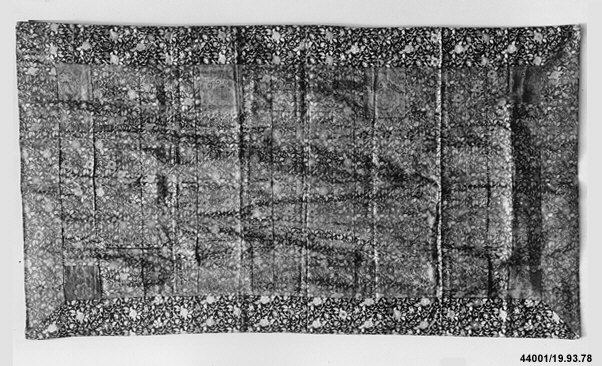
The Shichijō Priest’s Robe: A Study in Sacred Geometry and Material Transcendence
In the rarefied echelons of couture, where fabric is not merely draped but articulated, the study of historical vestments offers an unparalleled lexicon of form, restraint, and symbolic intent. Katherine Fashion Lab’s standalone analysis of the Japanese Shichijō priest’s robe—a silk garment of profound liturgical heritage—transcends conventional textile criticism. This is not an exercise in nostalgia, but a forensic deconstruction of how a single, unadorned surface can encode centuries of theological hierarchy, seasonal impermanence, and artisanal perfection. For the contemporary designer, the Shichijō robe is not an artifact; it is a masterclass in the economy of gesture and the power of negative space.
Provenance and the Weight of Lineage
The term “Shichijō” refers to the Seventh Avenue of Kyoto’s ancient grid, a district historically synonymous with the Shichijō-dono weaving workshops that supplied the imperial court and the highest echelons of Buddhist clergy from the Heian period (794–1185) onward. To hold a Shichijō robe is to hold a fragment of institutional memory. Unlike the flamboyant brocades of the Momoyama era, the Shichijō aesthetic is one of austere opulence. The robe’s primary function—as a kesa or outer vestment worn over the monk’s inner robes—dictates a specific structural logic. It is a rectangle, folded and stitched, with a collar that creates a precise architectural V. The genius lies not in the silhouette’s innovation but in its absolute adherence to a canonical blueprint. In this, Katherine Fashion Lab identifies a precursor to modern modular dressing: the robe is a piece of fabric that becomes a garment through a series of deliberate, ritualized folds.
Deconstructing the Silk: A Materialist Reading
The robe’s material—habutae silk or a tightly woven rinzu (damask)—is the silent protagonist. In its unadorned state, the silk’s surface is a field of subtle optical variation. The weave’s directionality catches light differently with each movement, creating a moiré effect that is never static. This is not a textile that shouts; it whispers. The lab’s analysis emphasizes the tensile integrity of the silk: its ability to hold a sharp crease while simultaneously flowing with liquid grace. This duality—rigidity and fluidity—is the robe’s central paradox. The silk is not dyed with the vibrant saffron of the Zen sect or the deep indigo of the Tendai school; rather, the Shichijō robe often employs natural, undyed silk or a muted palette of grey, brown, or pale ochre. This chromatic silence is a deliberate theological statement. It eschews the ego of color, redirecting the gaze toward the purity of the material and the discipline of the wearer’s posture.
Structural Semiotics: The Patchwork of Humility
At first glance, the robe appears seamless. Yet, a closer inspection reveals a meticulous system of horizontal and vertical seams that bisect the fabric into a grid of rectangular panels. This is the patchwork tradition, a direct visual reference to the Buddha’s original practice of sewing together discarded rags from cremation grounds and refuse heaps. The Shichijō robe elevates this humble origin into a high-art form. Each panel is cut with surgical precision, then joined with a hand-stitched seam that is both functional and decorative. The stitching—often in a contrasting yet muted thread—creates a subtle raised relief, a topographic map of the maker’s labor.
Katherine Fashion Lab posits that this patchwork grid functions as a visual metronome for the wearer’s breath and movement. The seams create lines of tension that guide the fabric’s fall, ensuring that the robe drapes in a predictable, meditative cascade. This is couture as choreography. The modern designer can learn from this: the seam is not merely a join; it is a line of intent. The Shichijō robe demonstrates that the most profound structural complexity is often invisible to the untrained eye, manifesting instead as an ineffable sense of balance and repose.
Seasonal Impermanence and the Art of the Fold
The robe’s relationship with time is cyclical. In Japanese monastic tradition, the kesa is not hung on a hanger; it is folded with exacting precision into a small, compact square. This act of folding is a ritual of spatial compression—the garment’s volume is reduced to a near-platonic solid, erasing its human form. The silk’s memory allows it to spring back to its full dimensions without a permanent crease, a testament to the fiber’s resilience. This temporal duality—the robe as a flowing garment in use, and a rigid block in repose—echoes the Buddhist concept of mujo (impermanence). The fabric is never static; it is always in a state of becoming.
For the couture house, this offers a radical proposition: garment as architecture, but architecture that breathes. The Shichijō robe rejects the flamboyant draping of Western ballgowns. Instead, it proposes a form of elegance rooted in ma—the meaningful void between elements. The space between the robe’s edge and the wearer’s neck, the shadow cast beneath the hem, the empty expanse of the chest panel—these are not absences but presences. Katherine Fashion Lab’s analysis highlights how this negative space directs the viewer’s attention to the wearer’s mien, not the fabric’s spectacle. It is a garment that humbles the body while magnifying the spirit.
Implications for Contemporary Couture
In an era of fast fashion and visual noise, the Shichijō priest’s robe stands as a corrective. Its lessons are manifold: First, the power of a limited palette—true luxury is monochromatic, relying on texture and light. Second, the integrity of construction—hand-stitched seams are not a cost but a commitment to longevity. Third, the importance of ritual in dressing—a garment that requires deliberate folding and unfolding creates a mindful relationship between wearer and cloth. Katherine Fashion Lab proposes that the robe’s design principles can be translated into a modern capsule collection: a structured kimono jacket with hidden interior seams, a floor-length coat in raw silk with a grid of inset panels, or a minimalist gown whose only ornament is the precise fall of its fabric.
Ultimately, the Shichijō robe is not an antique to be preserved under glass. It is a living codex of design intelligence. Its geometry is a prayer, its silk a meditation, and its seams a lineage of hands. To study it is to understand that the highest form of couture is not about adding more—but about having the courage to leave the fabric alone, to let its own nature and the discipline of its construction speak in a language far older than trends.