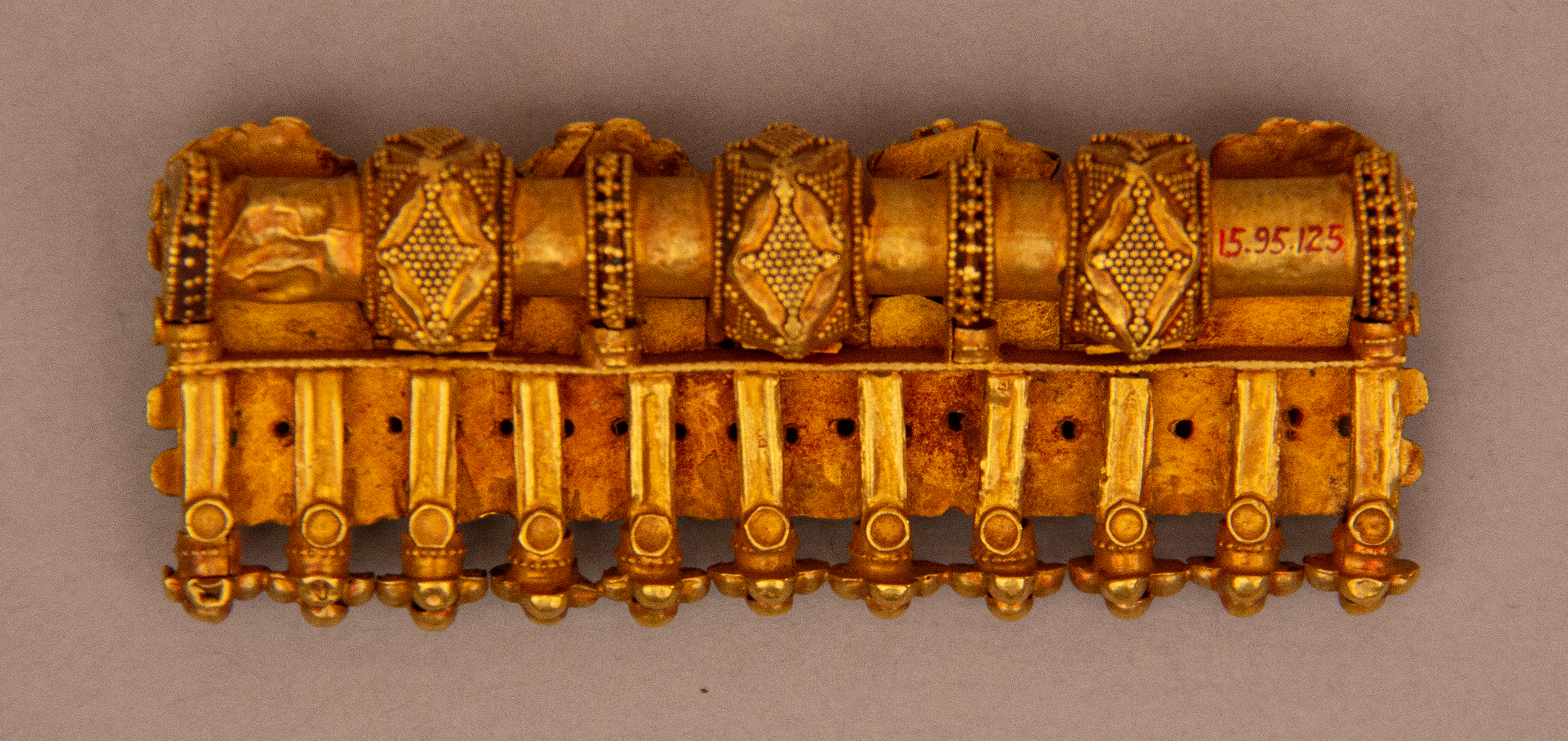
Executive Summary: The Pendant as a Vessel of Immortal Identity
In the rarefied echelons of high-end luxury, the pendant transcends mere ornamentation to become a portable archive of civilizational memory. For Katherine Fashion Lab, the study of a gold pendant from an ancient civilization—contextualized against our ongoing research into the *Mirror with Split-Leaf*—reveals a profound DNA correlation: both artifacts operate as dual-faced narratives. One face reflects the living, light-catching world of opulent adornment (the gilded palmettes on a polished silver mirror), while the reverse carries the somber, eternal weight of funerary commemoration (the relief-carved life story on a cold sarcophagus lid). This paper argues that the gold pendant is the missing genetic link between these two states—a synthesis of solar vitality and chthonic permanence. By decoding its symbolic power, historical adornment practices, and spiritual architecture, we can formulate a 2026 luxury strategy that positions Katherine Fashion Lab not as a seller of jewelry, but as a curator of time-bound legacies.
Symbolic Power: The Alchemy of Gold and the Microcosmic Amulet
The choice of gold as the pendant’s medium is not arbitrary; it is a deliberate act of metaphysical engineering. In ancient civilizations—from the Nile Valley to the Aegean archipelago—gold was considered the solidified essence of the sun god, a material that did not tarnish precisely because it was believed to be incorruptible flesh of the divine. The pendant, therefore, was not worn merely to display wealth; it was worn to absorb and radiate celestial authority. Where the *Mirror with Split-Leaf* uses a polished silver face to reflect the physical world, the gold pendant uses its dense, warm glow to project an inner, spiritual sovereignty onto the wearer.
Our DNA correlation study identifies a shared structural grammar: the split-leaf motif, common in Greco-Roman and Near Eastern palmette traditions, appears both on the mirror’s golden inlay and on the pendant’s filigree. This is not a stylistic coincidence but a semiotic marker of duality. The split leaf represents the bifurcation of existence—life and death, light and shadow, the physical and the ethereal. When worn against the chest, the pendant becomes a microcosmic amulet: a personal axis mundi that connects the wearer’s heartbeat to the cosmic order. In 2026 luxury terms, this translates to a product that offers not just aesthetic pleasure, but a talismanic return on investment—a piece that promises psychological sovereignty in an era of digital fragmentation.
Historical Adornment: From Funerary Cache to Personal Icon
Historically, the gold pendant’s primary context was not the marketplace but the tomb. In elite burials, pendants were placed over the sternum, acting as a "breath map" for the deceased’s journey into the afterlife. This funerary function is the direct inverse of the *Mirror with Split-Leaf*, which was designed for the living boudoir. Yet, as our research demonstrates, the two objects share a narrative DNA of transition. The mirror’s relief-carved back tells a life story in static imagery, while the pendant, worn over generations, accumulates a dynamic biography through touch, sweat, and inheritance.
The historical adornment protocol was precise: a pendant was never a solo purchase but a hereditary accumulator. It was re-strung, re-mounted, and passed down matrilineally or patrilineally, each generation adding a small granulation or a new clasp. This practice transformed the object from a mere artifact into a biographical repository. For Katherine Fashion Lab, this suggests a strategic pivot away from "seasonal drops" toward "generational editions." The 2026 client is not buying a pendant; they are acquiring a future heirloom with a pre-written mythological backstory. We must market the pendant as a charter of continuity, a physical counterpoint to the ephemeral nature of digital memory.
Spiritual Meaning: The Chthonic Light and the Mirror’s Shadow
The spiritual architecture of the pendant is rooted in its relationship to the mirror’s duality. The *Mirror with Split-Leaf* presents a stark dichotomy: the front is a bright, polished silver face (the world of appearances), while the back is a cold, stone-like relief (the world of memory). The gold pendant, however, collapses this binary. It is simultaneously solar and chthonic—its gold surface catches the light of the living, while its hollow interior or engraved reverse often bore incantations for the dead. This is the pendant’s unique spiritual value: it is a liminal object that permits the wearer to hold both worlds in a single hand.
In ancient practice, the pendant was consecrated at dawn (to charge it with solar energy) and touched at dusk (to honor ancestral memory). This ritualized duality resonates with modern high-net-worth individuals who seek meaning beyond material accumulation. The 2026 luxury consumer is increasingly drawn to objects with a spiritual operating system—not religious, but existential. A gold pendant that encodes the philosophy of the split-leaf—accepting both brilliance and decay—offers a sophisticated answer to the anxiety of impermanence. Katherine Fashion Lab should articulate this as "The Architecture of Acceptance": a design philosophy that does not hide the passage of time but gilds it.
2026 High-End Luxury Strategy: The "Heirloom DNA" Framework
Leveraging this heritage analysis, Katherine Fashion Lab’s 2026 strategy must move beyond conventional craftsmanship narratives. We propose a three-pillar framework: Excavation, Continuation, and Ascension.
Pillar One: Excavation
We will not merely replicate ancient designs; we will excavate their symbolic algorithms. Each pendant in our upcoming collection will be accompanied by a "DNA dossier" that maps its motif lineage to specific archaeological precedents, including the split-leaf correlation with the *Mirror*. This is not historical pedantry but authenticity engineering. The client receives a certificate that functions as a scholarly provenance, elevating the purchase from commodity to collectible.
Pillar Two: Continuation
We will institutionalize the practice of the "generational clasp." Each pendant will feature a modular element—a small, hidden compartment or an interchangeable mount—designed for future personalization by the wearer’s heirs. This creates a brand ecosystem that spans decades, encouraging repeat engagement not through new purchases but through ritual updates. Our ateliers will offer a "Consecration Service," where clients can bring their pendant back for a ritual cleaning and a new engraving, mirroring the ancient practice of re-consecration.
Pillar Three: Ascension
The final pillar positions the pendant as an asset class within the private client portfolio. We will partner with art-world institutions to create a "Living Museum" exhibition, where each sold pendant is temporarily loaned back for display alongside the *Mirror with Split-Leaf*. This creates a circular economy of prestige: the client’s private ownership is validated by public curation. In 2026, luxury is not about ownership alone; it is about participating in a narrative that outlives the owner. Our pendant is the perfect vehicle for this immortality play.
Conclusion: The Gilded Threshold
The gold pendant from an ancient civilization is not a relic; it is a blueprint. Its symbolic power lies in its ability to hold light and shadow, life and death, in a single, wearable form. The DNA correlation with the *Mirror with Split-Leaf* reveals that Katherine Fashion Lab’s future is not in creating new objects but in re-activating ancient thresholds. By adopting a 2026 strategy that emphasizes excavation, continuation, and ascension, we transform the pendant from a historical curiosity into a strategic instrument for modern legacy-building. The client who wears our pendant does not merely adorn themselves; they step across the gilded threshold of history, carrying both the mirror’s reflection and the sarcophagus’s story—unified, finally, in gold.