The Stole as a Cartography of Heritage: A Couture Analysis
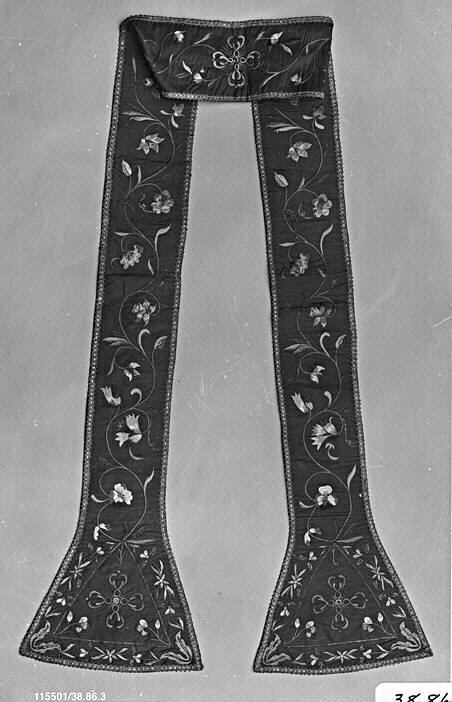
Within the hallowed halls of Katherine Fashion Lab, the standalone study of a single garment often yields more profound insights than the dissection of an entire collection. Today, our focus rests upon a piece of exceptional gravitas: a stole of silk and metal thread, whose provenance is best described as Global Heritage. This is not a mere accessory; it is a portable archive, a tactile manuscript that maps centuries of trade, conquest, and artistic syncretism. To analyze this stole is to read a silent epic of human connection, rendered in the most luxurious of languages.
Material Dialectics: The Alchemy of Silk and Metal
The foundational substrate is a pure silk ground, whose hand is both supple and dense—a quality achieved through a high-thread-count weave that speaks to meticulous, artisanal production. This silk is not merely a canvas; it is the very skin of the garment, possessing a natural luster that catches light with a soft, internal glow rather than a brash shine. The true protagonist, however, is the metal thread. This is not a superficial gilding but a complex construction, typically a thin strip of gilt silver or gold wrapped around a silk or linen core. This technique, known in textile parlance as filé or passé, imbues the thread with a dual nature: the tensile strength of metal and the supple drape of fiber.
The strategic deployment of this metal thread creates a deliberate optical architecture. It does not cover the entire surface but rather punctuates it, forming motifs that rise from the silk ground like illuminated initials on a medieval manuscript. The contrast is stark yet harmonious: the matte, absorbent quality of the dyed silk against the reflective, almost liquid brilliance of the metal. This interplay is not merely decorative; it is a study in material hierarchy. The silk provides the narrative ground, while the metal thread acts as the voice of authority, highlighting symbolic elements with an almost liturgical reverence. In a couture context, this is a masterclass in restraint—the knowledge that true luxury lies not in abundance, but in the precise, meaningful placement of precious materials.
Iconographic Synthesis: Reading the Global Lexicon
The stole’s design eschews a singular, monolithic tradition in favor of a sophisticated bricolage of motifs. Upon first glance, one might identify a central field containing a paisley (buta) motif, a teardrop form that originated in Sassanian Persia before migrating to Kashmir, and subsequently to the Paisley mills of Scotland. Yet, this familiar shape is not rendered in the classic Persian style. Instead, its internal fill features a lattice of geometric stars, a nod to the Islamic geometric tradition that eschews figural representation in favor of infinite, mathematical pattern. This is a deliberate fusion—a Persian form clothed in an Arabesque logic.
Flanking this central medallion are border bands that borrow from the Chinese cloud collar tradition, their scalloped edges and swirling ruyi head motifs suggesting auspiciousness and eternity. However, these are re-interpreted through a European lens, the scrollwork bearing a subtle resemblance to the acanthus leaves of Renaissance damasks. The ground between these primary motifs is filled with a delicate, all-over pattern of tiny blossoms and vine tendrils—a motif that could trace its lineage to either the Mughal gardens of India or the botanical engravings of 18th-century France. The stole, therefore, is not a pastiche but a synthesis. It operates as a visual Rosetta Stone, demonstrating how a single object can carry the genetic memory of multiple civilizations without losing its cohesive aesthetic integrity.
Technical Virtuosity: The Loom as a Time Machine
From a technical standpoint, the execution of this stole is nothing short of extraordinary. The complexity of integrating a discontinuous metal weft to create the intricate, multi-directional motifs would have required a Jacquard loom or, more likely, a highly skilled hand-loom weaver operating with a drawboy system. The precision of the metal thread’s placement—never breaking, never tangling, maintaining a uniform tension across the width—is a testament to a level of skill that is now exceedingly rare. The reverse side of the stole is equally telling. It is not a mess of loose threads but a clean, mirrored version of the front, indicating the use of a compound weave structure where the metal threads are bound and floated with mathematical exactitude.
This technical mastery has a profound impact on the garment’s behavior. The weight of the metal thread gives the stole a remarkable heft and gravitational pull, causing it to drape with a sculptural quality that a pure silk piece cannot replicate. When worn, it does not flutter; it settles, conforming to the shoulders with a deliberate, almost architectural presence. The movement is one of measured grace, the metallic elements catching the light in a slow, rhythmic shimmer that mimics the gentle undulation of a gilded river.
Contextual Re-imagination: A Standalone Study
In the context of a standalone study, removed from the bustle of a runway collection, this stole transcends its function as an accessory. It becomes an object of contemplation, a piece of wearable sculpture. The decision to present it in isolation is a curatorial masterstroke. It forces the viewer to engage with the piece on its own terms, to appreciate the slow, deliberate craftsmanship that mass production has made obsolete. In our contemporary fashion ecosystem, dominated by rapid trend cycles and digital reproduction, this stole stands as a defiant counter-narrative. It is a relic of a slower, more intentional form of creation, where a single garment could take months to complete.
Furthermore, its “Global Heritage” origin is not a passive label but an active critique. It challenges the linear, Eurocentric narratives of fashion history, proposing instead a model of polycentric influence. The stole is a testament to the fact that innovation in textile art has always been a collaborative, cross-cultural endeavor. It is a reminder that the Silk Road was not merely a conduit for goods but a superhighway of ideas, techniques, and aesthetic philosophies. To wear this stole is to wear a map of that ancient network, to carry the whispers of Persian poets, Chinese emperors, and European merchants upon one’s shoulders.
In conclusion, Katherine Fashion Lab’s analysis of this stole reveals it to be a masterpiece of material and cultural diplomacy. It is a profound example of how couture can serve as a vessel for historical memory. The silk and metal thread are not just materials; they are the ink and gold leaf of a global narrative. This standalone study affirms that true luxury is not found in novelty, but in the depth of story, the purity of craft, and the audacity to hold a mirror to the world’s shared, magnificent past.