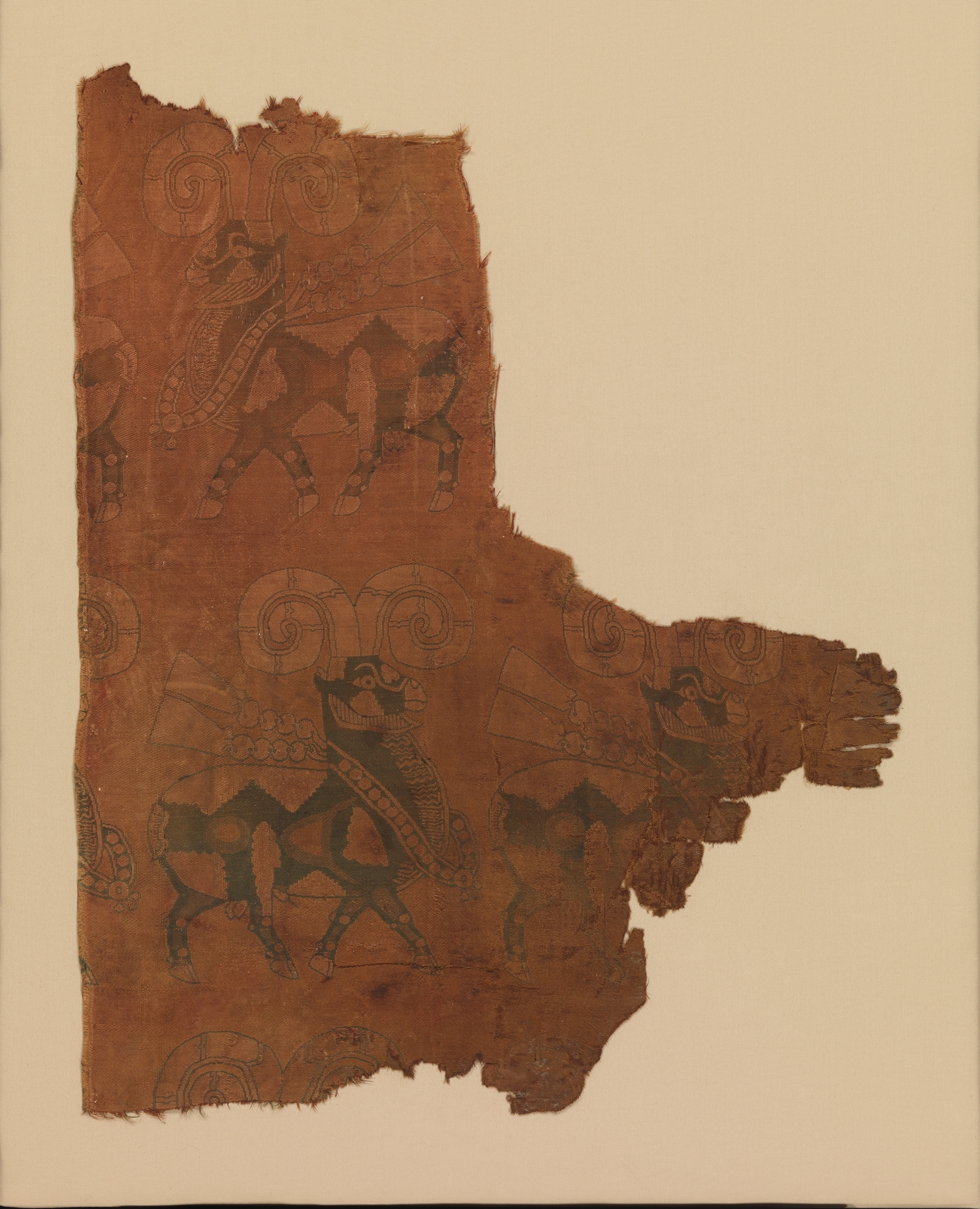
A Study in Thread and Symbol: The “Textile with Processions of Rams”
Within the hallowed halls of textile history, certain artifacts transcend their materiality to become primary documents of cultural confluence. The “Textile with Processions of Rams,” a silk samite fragment attributed to the Sasanian or early Islamic period, with provenance spanning Iran, Afghanistan, or the Xinjiang Autonomous Region of China, is precisely such an object. At Katherine Fashion Lab, we approach this piece not merely as a relic, but as a sophisticated articulation of power, trade, and aesthetic intelligence. Its analysis reveals a masterclass in technical execution, iconographic strategy, and cross-cultural adaptation—a blueprint for how luxury goods have always functioned as diplomatic and economic currency.
Technical Mastery: The Samite Weave as a Medium of Prestige
The term samite itself denotes a fabric of considerable historical weight. Derived from the Old French samit, via the Greek hexamiton (“six threads”), it refers to a compound weave structure, typically a twill, where multiple warp systems—a main warp and a binding warp—interlace with wefts of various colors. This is not a simple cloth; it is an engineered structure designed for maximum visual impact and durability.
In this specific fragment, the weaver’s command of the loom is evident in the crisp delineation of the ram’s forms against the ground. The use of silk, a material as coveted as gold in the ancient world, elevates the piece from mere textile to a statement of immense economic and political capital. The technical precision required to produce such a repeating pattern, with its intricate curves of horns and the rhythmic spacing of the animals, speaks to a workshop environment of exceptional skill, likely operating under royal or aristocratic patronage. The weave’s structure, which allows for a play of light across the raised pattern, creates a shimmering, almost sculptural effect—a deliberate tactic to enhance the fabric’s presence in a candle-lit or sun-drenched court. The survival of the piece, albeit in fragmentary form, is a testament to the inherent stability of the samite construction, a quality that has allowed this ancient message to reach us across millennia.
Deconstructing the Motif: The Ram as a Polyvalent Symbol
The central motif—the procession of rams—is no arbitrary decorative choice. Its repetition, typically arranged in horizontal bands or within pearl roundels (a hallmark of Sasanian design), transforms the animal from a naturalistic figure into a powerful heraldic emblem. The ram’s symbolism is deeply rooted in the Zoroastrian cosmology of pre-Islamic Iran, where it was associated with Farr (or Khvarenah), the divine glory or kingly fortune that legitimized a ruler’s right to the throne. In this context, the ram is not merely a male sheep; it is a vessel of royal charisma, a visual assertion of the sovereign’s connection to the divine and his role as the protector of his realm.
Simultaneously, the ram held significant martial connotations. Its horns, formidable and curved, were symbols of strength, aggression, and virility, often linked to the god of victory, Verethragna. A textile bearing this image would have been used to drape thrones, adorn ceremonial saddles, or be cut into garments for the elite, thereby cloaking the wearer in the very essence of power. The processional aspect—the ordered, forward-facing line of animals—suggests a sense of disciplined movement, perhaps evoking a royal hunt, a military parade, or a religious procession, all of which were spectacles designed to reinforce the social hierarchy.
Geographic and Temporal Crossroads: A Silk Road Narrative
The attribution of this textile to Iran, Afghanistan, or Xinjiang is not an indication of scholarly indecision but rather a profound insight into the nature of production and exchange along the Silk Road. This vast network was not a single route but a complex web of conduits for goods, ideas, and artisans. The samite technique, while perfected in Sasanian Persia, was rapidly adopted and adapted by skilled weavers in Central Asia and the oasis cities of the Tarim Basin (modern Xinjiang), which were under varying degrees of Sasanian, Sogdian, and Chinese influence.
The presence of such a textile in Xinjiang, a region far from the Sasanian heartland, could be explained by several scenarios. It might be a high-value import, a diplomatic gift exchanged between courts, or a piece of tribute. Alternatively, it could be a local production, a masterful imitation or a deliberate adaptation of a popular Sasanian motif by a Central Asian workshop catering to a local elite who aspired to the cultural prestige of the West. The subtle stylistic variations—perhaps in the rendering of the ram’s fleece or the configuration of its horns—could hold the key to its precise origin, but the very ambiguity is a powerful reminder that cultural identity in this period was fluid and layered. The textile embodies a shared visual language of power that transcended political borders, a lingua franca of luxury.
Comparative Analysis: Dialogues with the East
From a design perspective, the “Textile with Processions of Rams” engages in a fascinating dialogue with its Eastern counterparts. While the core motif is unequivocally Iranian in its symbolism, the treatment of the composition and the use of specific colors may reflect Chinese aesthetic sensibilities. Chinese silks of the same period often favored more symmetrical, balanced compositions and a specific palette, sometimes incorporating shades of indigo, rust, and cream. If this fragment exhibits a more pronounced use of negative space or a particular color harmony, it might suggest a Chinese or Sino-Sogdian atelier catering to a taste that favored clarity and repose over the dense, heraldic horror-vacui of some Western examples.
Furthermore, the ram motif itself finds echoes in Chinese art, where it is a symbol of filial piety and good fortune. The specific rendering of the animal—whether it is more naturalistic or more geometrically stylized—can be a subtle indicator of the cultural lens through which the weaver interpreted the design. This piece, therefore, is not a static object but a dynamic point of intersection, a material testament to how aesthetic ideas were translated, reinterpreted, and re-energized as they traveled across continents. It is a precursor to the globalized fashion system we know today, where a silhouette or a print can originate in one culture and be transformed into a statement of identity in another.
Implications for Contemporary Couture and the Katherine Fashion Lab Ethos
For Katherine Fashion Lab, this ancient textile is not a historical curiosity but a vital source of creative intelligence. It offers profound lessons in the management of ornament and the construction of narrative through repetition. The disciplined rhythm of the ram procession is a study in pattern design, demonstrating how a single, powerful motif can be deployed to create a sense of grandeur and order. In an era of fast fashion and disposable trends, this artifact reminds us of the enduring value of slow, deliberate craftsmanship and the deep, symbolic resonance that can be embedded in a garment.
Our lab’s design philosophy is predicated on the idea that luxury is not about conspicuous consumption but about meaningful materiality. The “Textile with Processions of Rams” exemplifies this principle. Every thread, every weave structure, every repetition of the ram’s form was a deliberate choice with cultural and political consequences. When we, as contemporary designers, study this piece, we are not seeking to copy it but to learn its grammar—how to use pattern to convey power, how to use material to assert value, and how to create a garment that speaks a language of sophistication that is both timeless and culturally literate. The fragment’s journey from a royal loom to a museum collection is a narrative of resilience and enduring beauty, a narrative that continues to inspire our own pursuit of excellence in the modern atelier. It is a benchmark against which we measure our own work, a challenge to create textiles that are not merely worn, but experienced and remembered.