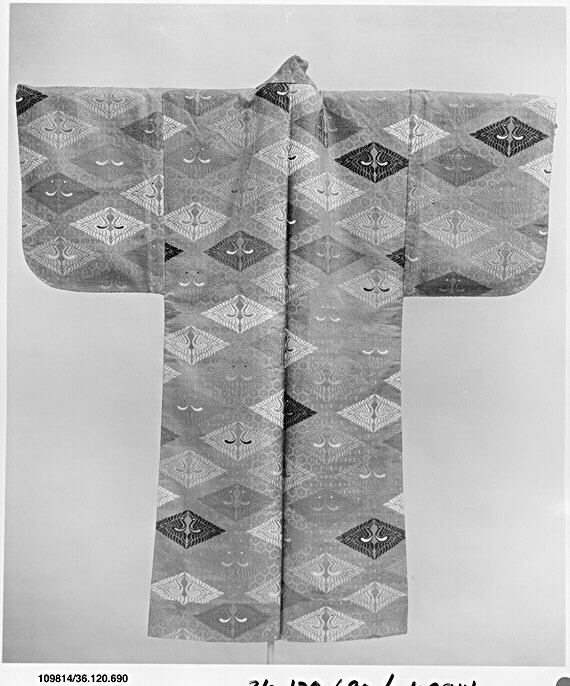
The Geometry of Silence: A Couture Analysis of the Japanese Noh Robe (Karaori) with Tortoise Shell Pattern and Crane Lozenges
In the rarefied lexicon of global couture, few artifacts command the quiet authority of the Japanese Noh robe, or karaori. Unlike the transient whims of seasonal fashion, this garment is a fixed star in the firmament of textile art, embodying a synthesis of technical virtuosity, symbolic density, and performative transcendence. The specific example under examination—a karaori executed in twill-weave silk brocade with supplementary weft patterning, featuring a tortoise shell (kikkō) ground and crane (tsuru) lozenges—offers a masterclass in the principles that Katherine Fashion Lab holds paramount: structural integrity, narrative depth, and the deliberate orchestration of surface tension. This is not merely a garment; it is a three-dimensional treatise on the aesthetics of restraint and the power of encoded meaning.
Material Poetics: The Engineering of Opulence
At first glance, the textile’s technical foundation appears to be a paradox: a fabric of immense rigidity that must drape with ethereal fluidity. The karaori technique, literally translating to “Chinese weave,” is a feat of pre-industrial engineering. The base is a twill weave, typically in a silk ground, which provides a subtle diagonal ribbing—a textural whisper that catches light differently than a plain weave. Upon this foundation, the artisan introduces supplementary weft threads, often in gold leaf-wrapped paper or dyed floss silk. These are not woven across the entire width but are inserted only where the pattern demands, creating a raised, embossed effect that is the signature of high-grade Japanese brocade.
Katherine Fashion Lab’s analysis focuses on the tactile hierarchy this creates. The twill ground offers a matte, almost granular surface, absorbing light to create a sense of depth. The supplementary wefts, by contrast, are specular and reflective. In the tortoise shell hexagons, the gold threads are laid in precise, concentric rows, mimicking the natural segmentation of the shell. This is not a flat print; it is a topographical map. When the actor wearing the robe moves—a slow, deliberate pivot or the sudden snap of a fan—the gold catches the torchlight in staccato bursts, while the silk twill remains in shadow. This oscillation between brilliance and obscurity is the garment’s primary kinetic language. It is a lesson in controlled luminosity, a principle that Katherine Fashion Lab applies to modern eveningwear: true luxury is not constant shine, but the management of shine as a dramatic event.
The Tortoise Shell Ground: A Matrix of Longevity
The choice of the kikkō (tortoise shell) pattern as the ground is not decorative happenstance. In Japanese iconography, the tortoise is a symbol of longevity, wisdom, and the cosmic order. The hexagon is a geometric form that appears in nature—from honeycomb to basalt columns—and its repetition here creates a visual rhythm that is both hypnotic and stabilizing. The pattern is rendered in a scale that is remarkably small relative to the garment’s total surface area, perhaps 4 to 5 centimeters across each cell. This micro-scale is critical.
From a couture perspective, this represents a commitment to micro-ornamentation that modern mass production cannot replicate. Each hexagon is not a stamp; it is a meticulously executed weave structure. The lines of the shell are formed by a change in the direction of the supplementary weft, creating a subtle bevel that catches light at an angle distinct from the flat interior. The effect is that of a mosaic that shimmers with the viewer’s movement. The repetition is not monotonous but meditative, providing a stable visual bass line against which the more dynamic crane lozenges can perform. This is a strategic design decision: the ground must be quiet enough to allow the motif to sing, yet rich enough to prevent the garment from feeling vacant. It is the couture equivalent of a perfectly tuned silence between musical notes.
The Crane Lozenges: Narrative Interruptions
Interspersed across this tortoise shell ground are lozenges—diamond-shaped cartouches—containing cranes in flight or at rest. The crane (tsuru) is the most auspicious of Japanese symbols, representing honor, fidelity, and the ascension to higher realms. In the context of Noh, where the play often concerns ghosts, deities, or the spirits of nature, the crane lozenge serves as a narrative anchor. It is a visual code that the audience, trained in classical symbolism, decodes instantly: this character is of a high spiritual rank, perhaps a deity or a noble soul in transition.
The placement of these lozenges is far from arbitrary. They are distributed in a staggered, asymmetric rhythm across the robe’s surface, typically clustered near the shoulder, the hem, and the trailing sleeve. This is a deliberate disruption of the tortoise shell grid. The lozenges are larger than the hexagons, perhaps 15 to 20 centimeters in length, creating a focal point that draws the eye upward to the actor’s face and hands. The cranes themselves are rendered in a stylized, almost calligraphic manner—their wings are not feathered in detail but suggested through sweeping, curved lines of gold and white silk. This abstraction is essential. It prevents the motif from becoming mere illustration and keeps it within the realm of pure pattern.
Katherine Fashion Lab’s design philosophy underscores this dialectic between ground and motif. The tortoise shell provides the continuum, the immutable passage of time; the cranes provide the event, the fleeting moment of transcendence. In a modern couture context, this teaches us that ornamentation should not be uniformly distributed. True sophistication lies in creating zones of intensity and zones of respite. A gown that is heavily embroidered from collar to hem is visually exhausting. Here, the negative space of the twill ground—even within the pattern—allows the eye to rest, making the crane lozenges feel like precious revelations rather than visual noise.
Structural Draping and the Architecture of Movement
Beyond the surface, the karaori’s construction is a study in architectural draping. The robe is cut in a T-shape, with a deep, trailing skirt and enormous, pendulous sleeves. There is no tailoring in the Western sense—no darts, no princess seams, no fitted waist. The garment relies entirely on the weight and stiffness of its own fabric to create its silhouette. The silk brocade, despite its fineness, has a tactile density that allows it to hold folds and create sharp, sculptural creases. When the actor stands still, the robe falls in a series of vertical, columnar pleats, reminiscent of Doric fluting. When the actor moves, these pleats open and close like a bellows, revealing the contrasting lining—often a deep vermilion or a complementary silk—in a flash of hidden color.
This is a critical lesson in negative volume. The garment does not cling to the body; it creates a space around it. The body is the armature, but the robe is the architecture. The trailing hem, often several feet long, is not merely decorative. It is a functional element that the actor manipulates with subtle footwork, creating a sweeping, fluid line that extends the body’s reach into the stage space. The sleeves, too, are not for the arms; they are weighted pockets of silk that swing with gravity, their momentum used to punctuate gestures. In this, we see the absolute antithesis of the modern bodycon dress. The karaori demonstrates that power in dress comes not from revealing the body’s contour, but from cloaking it in a movable architecture that commands spatial authority.
The Synthesis: A Masterclass in Restraint
What ultimately elevates this karaori from a mere historical artifact to a timeless couture object is its profound restraint. There is no color explosion; the palette is dominated by deep, resonant tones—often a rich aubergine, forest green, or indigo—overlaid with gold and silver threads. The pattern, while complex, is never chaotic. The tortoise shell ground is a discipline; the cranes are the reward. The garment’s opulence is not shouted but whispered, requiring the viewer to lean in, to observe closely, and to understand the language of its symbols.
For Katherine Fashion Lab, this robe is a benchmark. It challenges the contemporary obsession with instant gratification in design. It demands patience—from the weaver who spent months at the loom, from the actor who trained for decades to wear it correctly, and from the viewer who must decode its iconography. It is a reminder that couture is not merely about making clothes; it is about making objects of duration that transcend the season. The karaori does not chase trends; it exists in a permanent present, its geometry of silence and its cranes of transcendence speaking to a universal desire for order, beauty, and meaning. In its folds, we find the ultimate couture principle: that the most powerful statement is often the one that is most carefully, and most beautifully, withheld.