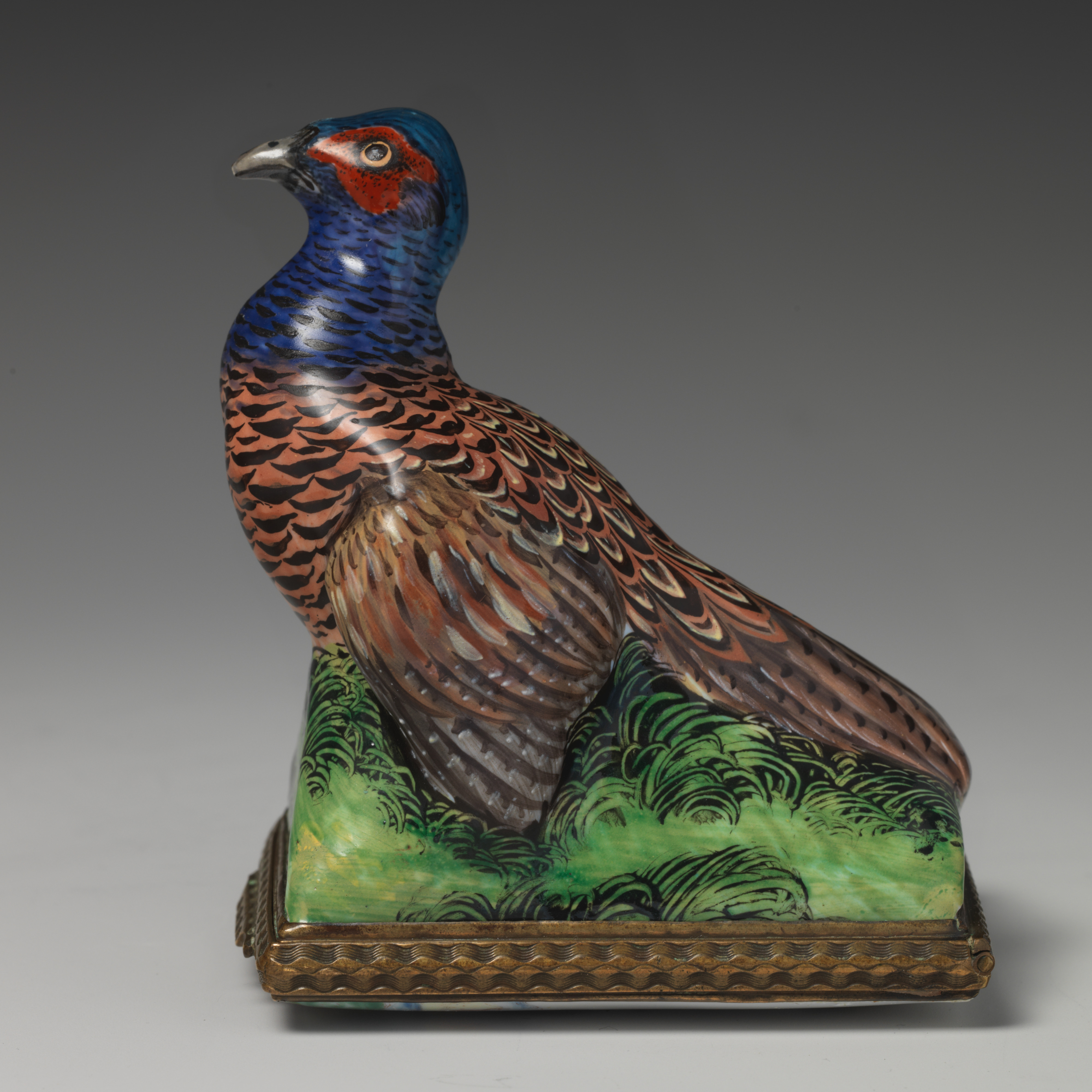
Bonbonnière as Avian Allegory: A Couture Analysis of Enameled Copper
Within the curated silence of the Katherine Fashion Lab, the Bonbonnière in the form of a pheasant transcends its primary function as a confectionery vessel. This standalone study, an artifact of Global Heritage rendered in enameled copper, is not merely an object of decorative arts; it is a profound sartorial cipher. It demands to be read not for its contents, but for its container—a form that encapsulates the very principles of haute couture: transformation, structural integrity, surface narrative, and the dialogue between nature and artifice. This analysis deconstructs the pheasant bonbonnière as a pre-industrial prototype of couture philosophy, where material, form, and context converge to instruct contemporary fashion practice.
Structural Architecture: The Corsetry of Copper
The foundational genius of the object lies in its medium: enameled copper. Copper provides the malleable, supportive armature—the toile or base structure—upon which the fantasy is built. Much like the boning in a corset or the internal architecture of a Balenciaga bodice, the copper form is engineered for both strength and specific silhouette. The bird's body, with its rounded breast and tapered tail, demonstrates a mastery of three-dimensional patterning, a complex exercise in geometric segmentation that must be perfectly joined to create a seamless, hollow volume. This is the equivalent of a garment’s foundational garment, unseen but essential, determining the ultimate shape and how it interacts with space. The hinge mechanism of the head, allowing access to the interior, introduces a element of functional engineering, reminiscent of the hidden closures, transformative sleeves, or detachable elements in high fashion that invite interaction and reveal layered complexity.
Surface Narrative: The Haute Couture of Enamel
If the copper is the couture (the sewing, the structure), the enamel is the haute (the high, the artistic). The application of vitreous enamel is a direct parallel to the most revered techniques of the couture atelier: it is a painstaking, risk-laden process of addition and transformation. Each color field is a deliberate decision, each feathery stroke of the brush a miniature act of embroidery. The vibrant, glossy finish does not conceal the copper; it glorifies it, creating a new, impervious skin of intense color and light-reflective quality. This process mirrors the alchemy of the fashion studio, where a flat, inert textile is transformed through beading, embroidery, pleating, or dyeing into a luminous, narrative surface. The pheasant’s iridescent plumage, simulated through enamel, speaks directly to the couturier’s obsession with capturing natural beauty through artificial, exalted means—think of the legendary feather work of Lemarié for Chanel or the intricate embroideries of Lesage. The surface tells the story of the bird, just as a garment’s fabric and embellishment tell the story of its inspiration.
Form as Symbol: The Pheasant in the Global Heritage Context
The choice of a pheasant is semantically rich and deeply instructive for fashion. As an element of Global Heritage, the pheasant carries multivalent symbolism: in Eastern traditions, it is often associated with beauty, refinement, and good fortune; in Western contexts, it is a symbol of the cultivated landscape, a bridge between the wild and the ornate. This positions the bonbonnière as an object of cultural portability and layered meaning. In couture terms, it represents the practice of borrowing and recontextualizing motifs from a global lexicon—not as appropriation, but as a sophisticated act of translation. The pheasant is nature, but stylized, idealized, and rendered precious. This is the core of many fashion collections, where a natural form (a flower, an animal, a landscape) is abstracted, amplified, and encoded into the language of drape, texture, and color. The object teaches us that inspiration must be processed through a lens of artistry and technical precision to become heritage-worthy design.
The Standalone Study: Object as Muse for Contemporary Practice
The designated context of this analysis—a standalone study—is critical. Isolated for examination, the bonbonnière forces us to consider its intrinsic virtues beyond utility. In fashion, this is akin to the study of a single, impeccable garment: a coat, a dress, a jacket. It champions the ideology of the objet d’art in clothing, where a piece is so rich in concept, construction, and finish that it sustains and rewards deep, solitary contemplation. It argues for fashion as a sculptural discipline. For Katherine Fashion Lab, this object serves as a multifaceted muse. It prompts technical inquiries into achieving structural rigidity with a sense of organic fluidity. It challenges designers to consider color application as integral to form, not merely as decoration. Most importantly, it embodies the principle of holistic creation, where material, technique, form, and symbolism are inextricably fused from the inception of the idea.
Ultimately, this enameled copper pheasant is a silent manifesto for couture. It demonstrates that true luxury lies in the marriage of robust, intelligent construction with a surface of poetic brilliance. It proves that an object—or a garment—can be a vessel for both tangible craftsmanship and intangible narrative, carrying within its form the seeds of beauty, culture, and technical ambition. For the modern couturier, the lesson is clear: aspire to create not just clothing, but wearable bonbonnières—sealed worlds of meaning, engineered from the inside out, where every stitch, seam, and surface detail contributes to an unforgettable, and enduring, aesthetic encounter.