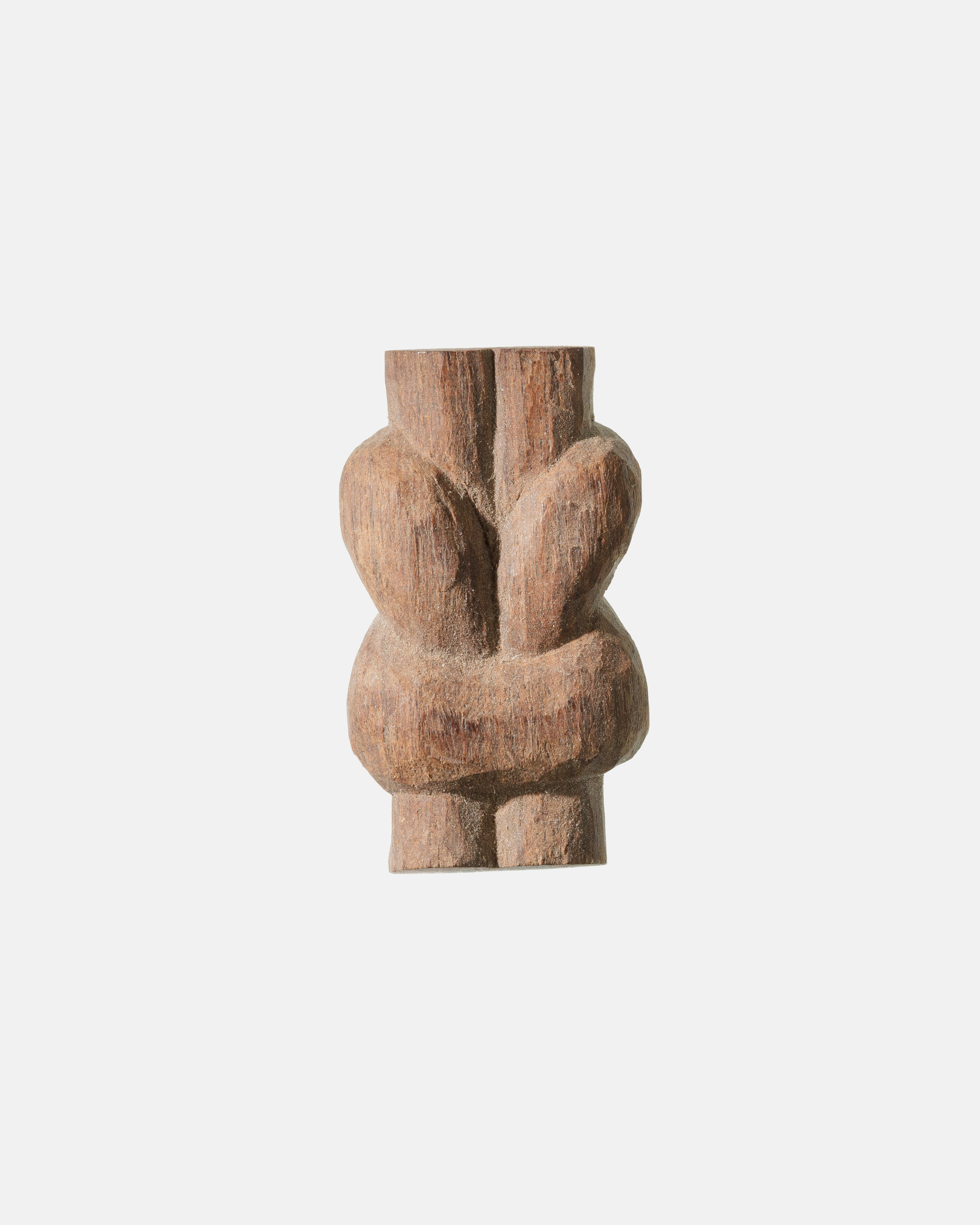
Executive Heritage Analysis: The Tjes-Knot Amulet
This strategic research dossier examines the Tjes-Knot amulet, an artifact of profound symbolic resonance from an ancient civilization, as a cornerstone for Katherine Fashion Lab’s 2026 luxury narrative. The analysis decodes the amulet’s dualistic nature—as a functional object of protection and a sophisticated marker of social and spiritual status—to propose a curated integration into contemporary high-end adornment. The Tjes-Knot, rendered in ebony, offers a unique convergence of material rarity, metaphysical gravitas, and geometric elegance, positioning it as an ideal asset for a clientele seeking depth beyond aesthetics.
I. Symbolic Power and Spiritual Lexicon
In the ancient cosmological framework, the Tjes-Knot was not merely an ornament but a phonetic and pictorial hieroglyph signifying welfare, life, and stability. Its form—a looped cord with a central fold—mirrors the concept of binding and uniting, often associated with the girdle of the goddess Isis. This association imbues the amulet with a potent feminine protective energy, linking the wearer to themes of resurrection and cyclical renewal. The knot’s closed, continuous line represents eternity, a promise of continuity against the fragmentation of mortal existence.
For the ancient wearer, the Tjes-Knot functioned as a talismanic interface between the terrestrial and the divine. Placed on the mummy or worn during life, it was believed to secure the soul’s integrity in the afterlife. This spiritual utility elevates the object beyond mere decoration; it is a portable sanctuary. The strategic value for Katherine Fashion Lab lies in this inherent narrative of protection—a concept that translates seamlessly into modern luxury, where clients increasingly seek jewelry as a shield against external chaos and as a vessel for personal intention.
II. Historical Adornment and Material Prestige
The choice of ebony wood as the primary medium is a decisive factor in the amulet’s historical and commercial gravitas. In antiquity, ebony was a coveted import from sub-Saharan regions, reserved for royal regalia and high-status temple offerings. Its density, near-black hue, and ability to take a high polish signified wealth, rarity, and permanence. Unlike gold or faience, ebony carried a distinct tactile warmth and an organic authority, grounding the spiritual symbolism in a material that felt both ancient and alive.
Historically, adornment with such amulets was not democratic. Access was governed by sumptuary laws and priestly prerogative, making the Tjes-Knot an early exemplar of exclusive luxury. The amulet’s placement on the body—often at the throat or chest—was deliberate, aligning the knot’s power with the wearer’s breath and heartbeat. This anatomical curation anticipates modern bespoke jewelry design, where placement is engineered for both aesthetic harmony and energetic efficacy. Katherine Fashion Lab can leverage this historical precedent to justify a limited-edition release, emphasizing the amulet’s lineage as an object of aristocratic and sacred reserve.
III. Design Semiotics and Modern Reinterpretation
From a design perspective, the Tjes-Knot’s geometry is remarkably minimalist and architectural. Its vertical elongation and central loop create a powerful silhouette that reads as both primitive and futuristic. This dual-temporality is critical for a 2026 luxury strategy, where consumers oscillate between nostalgia for authenticity and desire for avant-garde forms. The amulet’s abstract shape—a folded ribbon of wood—allows for versatile styling: as a pendant on a leather cord, a brooch on a tailored lapel, or a charm on a structured handbag.
The tactile contrast of polished ebony against metal or skin offers a sensory marketing angle. Unlike cold gemstones, ebony warms to the body, creating a perceived intimacy with the object. This haptic quality can be highlighted in high-touch retail environments and digital content, emphasizing the material’s living essence. Furthermore, the dark, lustrous surface provides a striking counterpoint to the prevailing trends of gold and diamond saturation, offering a monochromatic, grounded alternative for the discerning minimalist.
IV. 2026 High-End Luxury Strategy Integration
To position the Tjes-Knot amulet for commercial success, Katherine Fashion Lab must adopt a curatorial strategy that blends anthropological storytelling with scarcity economics. The recommendation is a three-tiered approach:
Tier 1: The Archival Collection
A limited series of 500 hand-carved ebony amulets, each numbered and accompanied by a certificate of provenance and a QR code linking to an immersive digital archive of the artifact’s history. This tier targets ultra-high-net-worth collectors who value intellectual property and provenance. Pricing should reflect the material’s rarity and the artisan hours required, positioning it as an investment piece.
Tier 2: The Contemporary Edit
A diffusion line that reinterprets the knot motif in mixed materials—ebony inlaid with 18k gold or sterling silver—to appeal to a broader luxury demographic. This tier maintains the symbolic core but enhances wearability for daily use. Marketing should emphasize the amulet’s protective function as a modern-day talisman for career transitions, travel, or personal milestones.
Tier 3: Bespoke Commission
An exclusive service allowing clients to commission a personalized Tjes-Knot, selecting wood grain, metal accents, and engraving of personal hieroglyphic-signifiers. This service leverages the ancient tradition of custom amulet creation, transforming the piece into a heirloom with unique narrative ownership.
V. Brand Narrative and Consumer Psychology
The success of this strategy hinges on the articulation of the amulet’s spiritual utility as a form of wellness luxury. In 2026, the luxury consumer is not merely purchasing objects but energetic investments. The Tjes-Knot’s promise of stability and protection aligns with a global cultural shift toward mindfulness and resilience. Katherine Fashion Lab should position the amulet as a silent companion—an object that does not shout status but whispers continuity and inner strength.
Marketing collateral should avoid overt religiosity, instead framing the amulet’s power through the lens of psychological anchoring and historical continuity. Visual campaigns could juxtapose macro-photography of the ebony’s grain with abstract desert landscapes, evoking timelessness without cultural appropriation. The narrative must be one of reverence, not replication, acknowledging the artifact’s sacred origins while adapting its essence for contemporary secular life.
VI. Risk Mitigation and Authenticity
A primary risk is the potential for cultural commodification. To mitigate this, Katherine Fashion Lab should establish a heritage advisory board comprising Egyptologists and cultural historians to vet all storytelling and design adaptations. A percentage of proceeds could be allocated to archaeological preservation, creating a transparent philanthropic loop that reinforces brand integrity. This approach not only safeguards ethical standards but also enhances the amulet’s authenticity quotient, a key differentiator in a saturated market.
Additionally, the use of ebony necessitates a rigorous sustainability protocol. The lab must source wood from certified, ethically managed plantations, with full traceability documentation. This addresses modern consumer scrutiny regarding environmental impact, turning a potential liability into a competitive advantage through verified green luxury credentials.
VII. Conclusion and Forward Trajectory
The Tjes-Knot amulet, in its ebony incarnation, represents a rare fusion of aesthetic restraint, spiritual depth, and historical authority. For Katherine Fashion Lab, it offers a strategic vehicle to differentiate from ephemeral trends, anchoring the brand in a narrative of permanence and protective elegance. By executing the proposed three-tier strategy with rigorous cultural sensitivity and material integrity, the amulet can become a signature icon, driving both commercial revenue and brand equity well beyond 2026.
The final recommendation is to proceed with the Archival Collection launch in Q1 2026, timed to align with international art and antique fairs, thereby capturing the attention of collectors and editors simultaneously. The Tjes-Knot is not merely a product; it is a philosophy of adornment—an invitation to wear history as a shield and a statement. This is the essence of Katherine Fashion Lab’s next chapter.