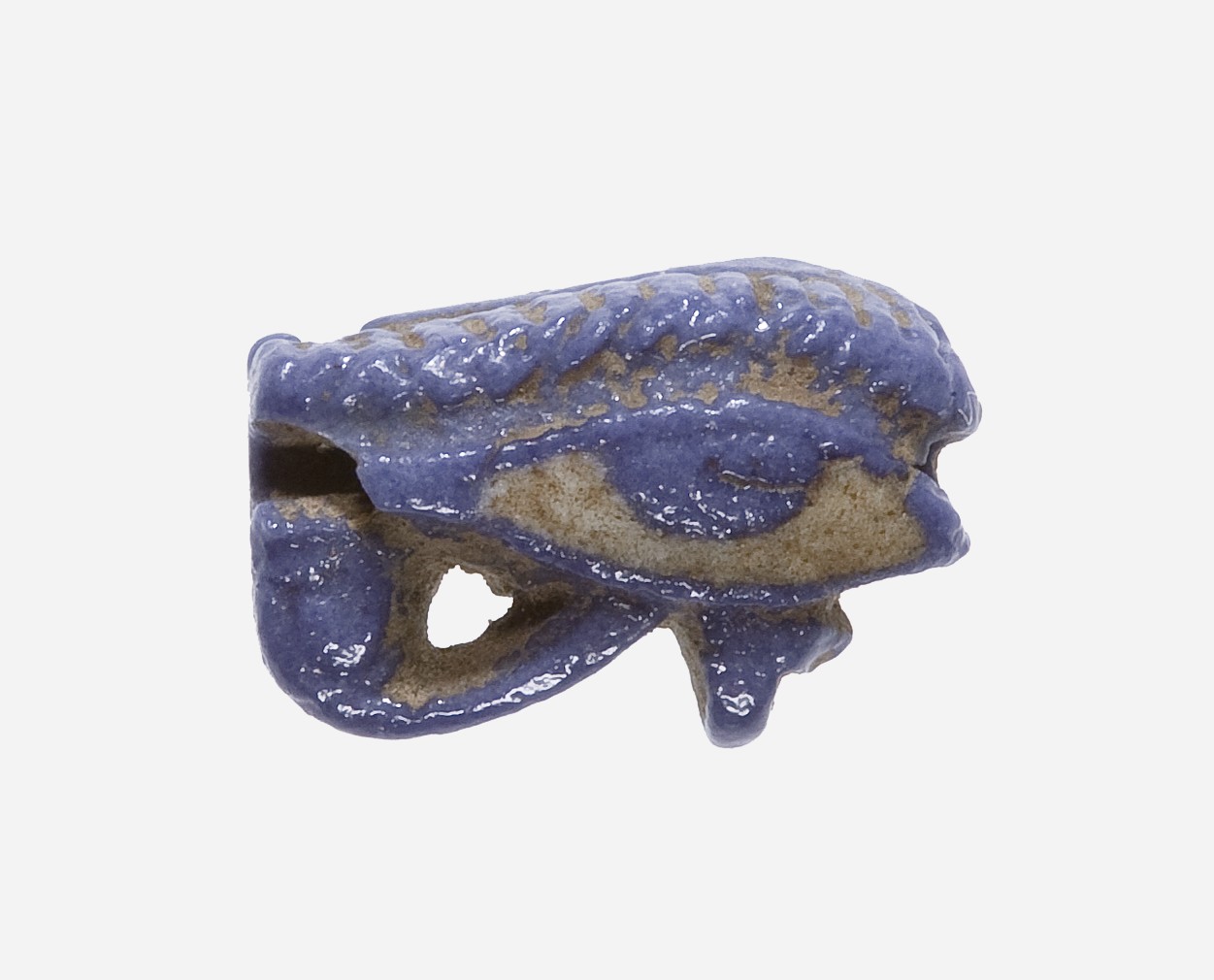
The Wedjat Eye Amulet: A Heritage Analysis for Katherine Fashion Lab
The Wedjat Eye, also known as the Eye of Horus, represents one of the most potent and enduring symbols in the canon of ancient adornment. Originating in the Nile Valley of ancient Egypt, this faience amulet was not merely a decorative object but a functional instrument of cosmic protection, royal legitimacy, and physiological restoration. For Katherine Fashion Lab, a house dedicated to the synthesis of archaeological gravitas and contemporary luxury, the Wedjat Eye offers a profound strategic asset. This analysis deconstructs the amulet’s symbolic power, its historical role in bodily adornment, its spiritual architecture, and proposes a rigorous 2026 high-end luxury strategy predicated on authentic cultural transmission rather than superficial appropriation.
Symbolic Power: The Mathematics of Wholeness
The symbolic potency of the Wedjat Eye is rooted in a mythological narrative of dismemberment and reassembly. According to the Osiris myth, Horus lost his left eye in a conflict with Set; the god Thoth subsequently restored it, rendering the eye whole. This act of restoration imbued the symbol with the semantic field of integrity, healing, and invincibility. In ancient Egyptian arithmetic, the Wedjat was also used as a fractional system to measure grain and land, with each part of the eye representing a different fraction—1/2, 1/4, 1/8, 1/16, 1/32, and 1/64. The sum of these fractions approximates 63/64, with the remaining 1/64 believed to be the secret magic imparted by Thoth. For a modern luxury house, this numerical nuance offers a compelling narrative: perfection is not a closed system but a dynamic equilibrium that acknowledges a mystical remainder. This is a powerful metaphor for the bespoke craftsmanship ethos of Katherine Fashion Lab, where the human hand’s subtle imperfection is the ultimate signature of authenticity.
Historical Adornment: Faience as a Democratic and Elite Medium
Faience, the medium of this amulet, is a self-glazing quartz composite that predates glass. Its vibrant turquoise or deep blue hue was intended to mimic lapis lazuli and turquoise, stones associated with the sky, the Nile, and the regenerative powers of the sun. In the context of historical adornment, the Wedjat Eye amulet was worn in multiple configurations—as a pectoral, a bracelet element, or a ring bezel. It was a unisex adornment, appearing on mummies to ensure safe passage through the Duat (underworld) and on the living to ward off the "evil eye" and prevent accidents, illness, and malevolent magic.
The strategic relevance of faience lies in its duality. On one hand, it was a mass-produced material accessible to the lower echelons of society. On the other, when crafted in royal workshops with exceptional precision, it became a marker of high status, often inlaid with gold or set within electrum. This duality provides Katherine Fashion Lab with a historical precedent for tiered luxury. The Wedjat Eye can be translated into a "core" line of high-polish ceramic or resin, accessible to a broader clientele, and a "Haute Heritage" line featuring hand-fired faience, 18k gold inlays, and natural diamonds, reserved for private clients. This mirrors the ancient economic reality while satisfying the modern luxury consumer’s desire for both entry-level brand access and pinnacle exclusivity.
Spiritual Meaning: The Eye as a Sensorium
Beyond physical protection, the Wedjat Eye functioned as a spiritual sensorium—an organ of perception that allowed the wearer to see the invisible and perceive the divine order (Maat). It was a symbol of the moon, whose cycles of waxing and waning mirrored the eye’s mythic destruction and restoration. In funerary contexts, it was painted on the prow of solar boats to guide the sun god Ra through the nightly underworld journey. In life, it was worn to enhance clairvoyance and to align the wearer’s own vision with the gods’ perspective.
For the contemporary consumer, the spiritual meaning translates into a search for agency and mental clarity in a fragmented world. The 2026 luxury market is increasingly driven by "quiet spirituality"—an understated desire for objects that offer psychological grounding rather than overt religious affiliation. The Wedjat Eye, with its geometric precision and cosmic associations, is perfectly positioned as a secular talisman for the high-performing professional. It represents the ability to "see clearly" amidst chaos, to restore one’s internal wholeness after external stress. Katherine Fashion Lab can position this amulet not as a superstitious charm but as a "cognitive heirloom," a piece that serves as a focal point for meditation, decisiveness, and resilience.
2026 High-End Luxury Strategy: Curatorial Authenticity
To deploy the Wedjat Eye effectively in 2026, Katherine Fashion Lab must adopt a curatorial strategy that treats the amulet not as a motif to be printed but as an archetype to be re-engineered. The following pillars constitute the recommended strategic framework:
1. Archaeological Collaboration and Provenance
Katherine Fashion Lab should establish a formal advisory board with Egyptologists from institutions such as the British Museum or the Metropolitan Museum of Art. This collaboration ensures iconographic accuracy and provides a provenance narrative that is verifiable. Each piece in the "Wedjat Collection" should be accompanied by a digital certificate of cultural heritage, detailing the mythological source, the material science of faience, and the specific artistic decisions made in adaptation. This moves the product beyond mere merchandise into the realm of wearable scholarship.
2. Material Innovation: "Neo-Faience"
While authentic faience is historically significant, its fragility is impractical for daily luxury wear. The 2026 strategy should introduce "Neo-Faience," a proprietary composite developed in collaboration with ceramic engineers. This material will replicate the luminous, self-glazing quality of ancient faience—its subtle crackle and glassy surface—while offering the durability of aerospace-grade alumina. The color palette should be restricted to the historical spectrum: deep turquoise, lapis blue, and a muted Nile green. This restraint signals editorial authority and avoids the chromatic chaos common in contemporary costume jewelry.
3. Modular Adornment Systems
Ancient Egyptians wore amulets in dynamic configurations, layering them for cumulative protection. Katherine Fashion Lab can translate this into a modular system: a central Wedjat Eye pendant that can be detached and integrated into a bracelet, a belt buckle, or a lapel pin. This modularity addresses the modern consumer’s demand for versatility and investment value—a single high-ticket item that serves multiple functions. The system should be engineered with a proprietary magnetic clasp that is silent and secure, echoing the precision of ancient joinery.
4. Experiential Retail: The "Chamber of Restoration"
Retail environments for this collection should be designed as immersive "Chambers of Restoration." Using projection mapping and scent diffusion (frankincense, myrrh, and cedar), the client is transported to a meditative space. The sales narrative should focus on the "63/64" principle: the idea that the client completes the amulet’s power through their own intention. This transforms the purchase into a ritual act, aligning with the luxury sector’s shift toward experiential ownership over mere possession.
5. Brand Narrative: "The Visionary’s Shield"
The marketing campaign for 2026 should be titled The Visionary’s Shield, targeting C-suite executives, creative directors, and cultural influencers. The campaign’s visual language should be minimalist, featuring macro-photography of the Neo-Faience surface, emphasizing its texture and depth. The copy should avoid esoteric jargon, instead focusing on the psychological benefits: "Protect your vision. Restore your focus. See what others miss." This positioning leverages the Wedjat’s historical function as an enhancer of perception, directly translating it into a modern professional asset.
Conclusion: A Legacy of Restored Vision
The Wedjat Eye amulet is not a static artifact; it is a living philosophy of restoration. For Katherine Fashion Lab, it offers a rare opportunity to create a collection that is simultaneously historically erudite and commercially avant-garde. By honoring the material authenticity of faience, the mathematical elegance of its fractions, and the spiritual imperative of clear sight, the house can produce objects that are not merely worn but activated. In a 2026 market saturated with ephemeral trends, the Wedjat Eye stands as a testament to the enduring power of symbols that promise wholeness. Katherine Fashion Lab’s strategy must be to serve as the custodian of this promise, delivering it to a clientele that seeks not just luxury, but meaning, resilience, and a tangible connection to the deep past. The amulet’s ancient purpose—to restore what was broken—becomes the brand’s modern covenant.