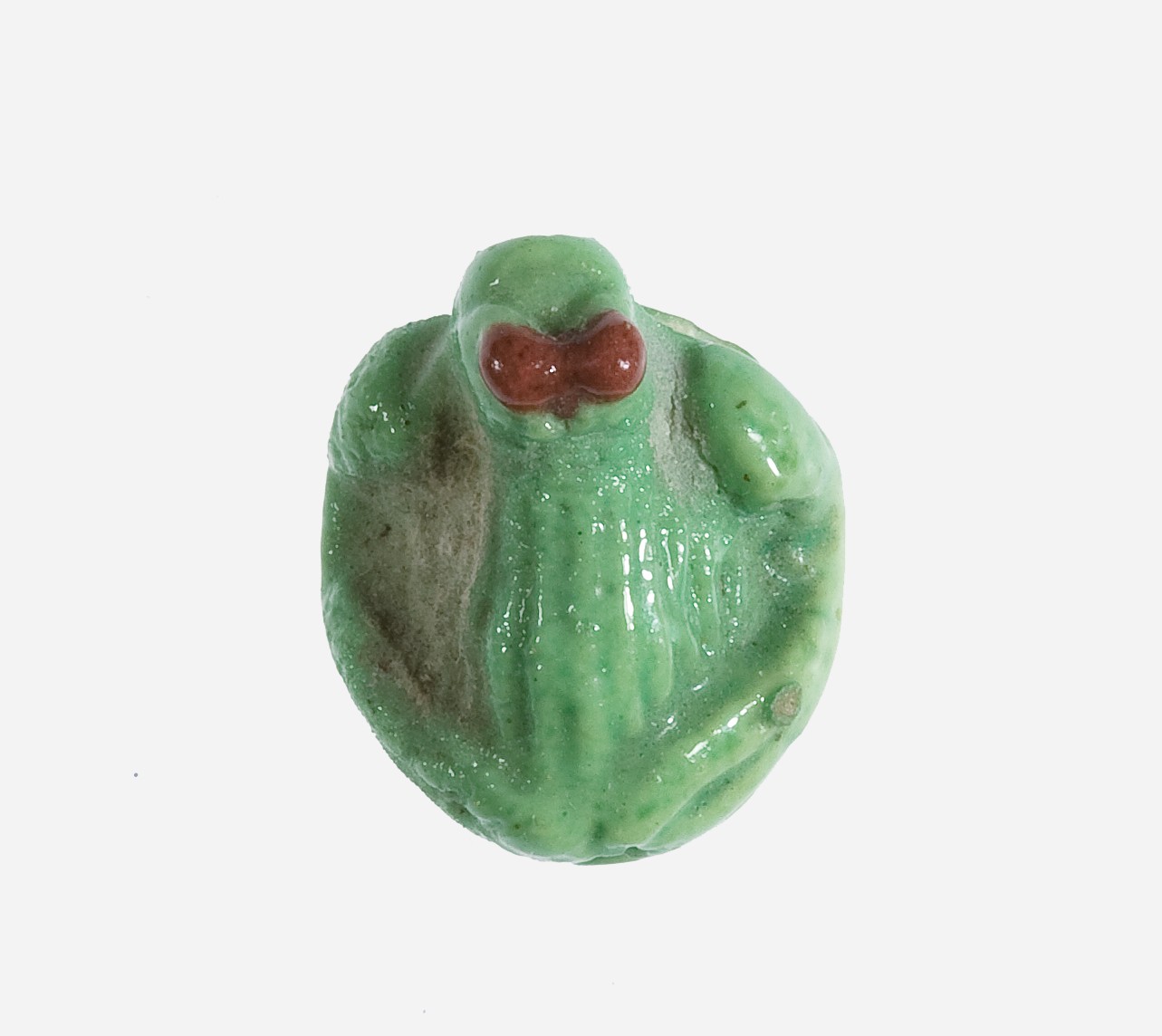
Executive Heritage Analysis: The Frog Seal Amulet of Nefer and Maat
This standalone research paper, commissioned by Katherine Fashion Lab, presents a strategic heritage analysis of a singular artifact: a faience frog seal amulet, engraved upon its base with the hieroglyphs Nefer (perfection, beauty, goodness) and Maat (truth, cosmic order, justice). Originating from the complex spiritual and material culture of Ancient Egypt—specifically the New Kingdom to Late Period (circa 1550–332 BCE)—this object is not merely a decorative curio. It is a concentrated repository of symbolic power, a historical testament to adornment as a functional talisman, and a profound source of inspiration for a 2026 high-end luxury strategy. This analysis dissects the amulet's layered meanings and translates them into actionable, brand-level insights for Katherine Fashion Lab’s forthcoming collections.
Symbolic Power: The Convergence of Fertility, Renewal, and Divine Order
The frog (Heqet) in ancient Egyptian cosmology was the sacred animal of the goddess Heqet, a deity of childbirth, fertility, and the primordial mud from which life emerged. The frog's annual appearance after the Nile's inundation transformed it into a potent emblem of resurrection, regeneration, and untold abundance. To wear a frog amulet was to align oneself with the cyclical rebirth of the land and the promise of progeny. However, the power of this specific artifact is exponentially amplified by the hieroglyphs carved into its base—a deliberate fusion of two distinct yet complementary forces.
The hieroglyph Nefer (𓄤) is universally recognized as the symbol of beauty and perfection, but its semantic range extends to the concept of completeness and youthful vitality. Conversely, Maat (𓐙𓌴𓂣𓏏𓁦) represents the ethical and cosmic foundation of the universe—truth, balance, and the immutable law that governed both gods and mortals. By physically uniting these two glyphs on the seal's base, the artisan created a talisman of holistic equilibrium: the dynamic, fecund energy of the frog is disciplined and elevated by the moral weight of Maat, while the austere principle of truth is humanized and made accessible through Nefer's aesthetic grace. This is not a simple charm; it is a theological statement that beauty must be grounded in truth, and that renewal must be guided by order.
Historical Adornment: The Functional and Status-Driven Role of the Seal
In the context of historical adornment, the frog seal amulet occupies a unique dual role as both a personal amulet and a signet instrument. The faience medium—a glazed, non-clay ceramic renowned for its brilliant blue-green or turquoise sheen—was itself considered a material of rebirth, mimicking the color of the Nile and the sky. The amulet would have been strung on a leather thong or gold wire and worn around the neck, wrist, or waist, serving as a constant, tactile reminder of divine protection. Yet, the flat, engraved base indicates its secondary function: when pressed into soft clay or wax, it would imprint the owner’s personal seal, authenticating documents and goods.
This dual function elevates the amulet beyond mere ornamentation. It was a marker of elite identity and administrative authority. The individual who wore this seal was not only protected by Heqet's regenerative powers but also publicly declared their alignment with Maat's legal and ethical principles. Every document they sealed was, in effect, a declaration of truthful perfection. This integration of the sacred and the bureaucratic is a hallmark of high-status ancient adornment—a wearable declaration of one's role in maintaining cosmic and social order. For a modern luxury house, this represents the zenith of quiet power: an accessory that is simultaneously intimate and authoritative, personal and institutional.
Spiritual Meaning: A Portable Altar for Daily Life
The spiritual resonance of this amulet cannot be overstated. In the ancient Egyptian worldview, there was no separation between the secular and the sacred; the physical world was a mirror of the divine. Thus, the frog seal functioned as a portable altar, allowing the wearer to carry a microcosm of divine principles into the marketplace, the courtroom, and the home. The act of pressing the seal into clay became a ritual act—a physical manifestation of the wearer's commitment to Nefer (doing good) and Maat (speaking truth).
The choice of faience further deepens the spiritual meaning. The material's luminous glaze was believed to hold a spark of the sun's eternal light, and its production involved a chemical transformation that mirrored the alchemical journey of the soul from base matter to divine radiance. Wearing this amulet was thus an act of self-divinization, a daily affirmation that the wearer was partaking in the eternal cycle of death, rebirth, and the ultimate triumph of order over chaos. The amulet was not meant to be hidden; its visible beauty was a public testament to the wearer's inner spiritual alignment, a concept that resonates powerfully with contemporary high-end consumers seeking authenticity and purpose in their acquisitions.
2026 High-End Luxury Strategy: From Artifact to Icon
For Katherine Fashion Lab, the frog seal amulet is not a historical curiosity but a strategic blueprint for a 2026 luxury collection that differentiates through narrative depth and symbolic resonance. The following strategy translates the artifact's core values into tangible brand actions.
Design Language: The "Regenerative Seal" Capsule
Katherine Fashion Lab should develop a capsule collection titled The Maat Seal, centered on a reimagined motif of the frog and the twin hieroglyphs. The design language must prioritize sculptural minimalism over literal reproduction. Imagine a heavy, 18-karat gold signet ring with a flat, bezel-set base, engraved with a stylized, geometric frog and the Nefer and Maat glyphs. The faience element can be translated into modern vitreous enamel in deep Nile blues and malachite greens, applied using the champlevé technique to evoke the ancient glaze's luminosity. The collection should extend to leather goods, where the seal motif is debossed into bag hardware, and to silk scarves, where the frog is abstracted into a repeating, hypnotic pattern that whispers of regeneration.
Brand Positioning: The Currency of Truth
The 2026 luxury market is increasingly defined by a demand for authenticity and ethical resonance. Katherine Fashion Lab can leverage the amulet's duality—beauty (Nefer) and truth (Maat)—to position the brand as a purveyor of conscious opulence. The marketing narrative should not focus on the artifact's age but on its timeless relevance. The message is clear: Katherine Fashion Lab's client does not simply purchase a product; she acquires a talisman of integrity. This positioning allows the brand to command a premium price point, justified not by material cost alone, but by the profound symbolic equity embedded in each piece.
Client Experience: The Ritual of Authentication
To fully realize the spiritual and historical power of the symbol, Katherine Fashion Lab should introduce a ritualized purchase experience. Each piece from The Maat Seal collection could be presented in a bespoke, clay-based box, echoing the ancient seal's function. Upon purchase, a brand specialist would demonstrate the "sealing ritual"—pressing the ring or pendant into a soft wax disc, imprinting the client's personal monogram alongside the Nefer and Maat glyphs. This transforms the transaction into a memorable, multisensory event that reinforces the product's value as a personal, functional artifact of power. It creates a direct, tactile link between the modern owner and the ancient Egyptian elite, satisfying the deep human desire for objects that carry meaning beyond the surface.
Strategic Collaborations and Storytelling
To amplify reach, Katherine Fashion Lab should consider a limited collaboration with a contemporary Egyptologist or a curator from a major museum (e.g., the British Museum or the Met) to co-author a digital heritage dossier accompanying the collection. This content would not be a dry historical text but a cinematic, immersive story—short films showing the amulet's creation, its use in ancient courtrooms, and its modern reincarnation in Katherine Fashion Lab's ateliers. This strategy positions the brand as a cultural steward, not just a fashion house, thereby attracting a sophisticated demographic that values intellectual and spiritual depth alongside aesthetic excellence.
Conclusion: A Legacy of Equilibrium
The frog seal amulet with Nefer and Maat is a masterclass in ancient symbolic engineering. It demonstrates that true luxury is not the accumulation of beautiful objects, but the mastery of meaning—the ability to craft an object that is at once a declaration of beauty, a tool of authority, and a vessel of divine truth. For Katherine Fashion Lab, this artifact is a strategic compass for 2026. By embracing the amulet's core dialectic—renewal tempered by order, beauty grounded in truth—the brand can develop a collection that is not only commercially successful but also culturally significant. In a market saturated with transient trends, The Maat Seal offers a timeless proposition: the acquisition of power, grace, and equilibrium, sealed in gold and enamel for the modern era.