The Quiet Architecture of Heritage: A Couture Analysis of Katherine Fashion Lab’s “Band”
In an era where fashion often mistakes noise for innovation, Katherine Fashion Lab’s “Band” emerges as a masterclass in restrained subversion. This standalone study, drawn from the house’s ongoing dialogue with global heritage, does not shout. It whispers—through the disciplined language of linen, the meticulous violence of cutwork, and a silhouette that references the body’s most primal architecture: the band, the girdle, the binding that both constrains and liberates. To analyze “Band” is to deconstruct a paradox: a garment that feels simultaneously ancient and futuristic, ethnographic and couture, humble and opulent.
Deconstructing the Silhouette: The Band as Structural Metaphor
The immediate visual anchor of “Band” is its namesake—a wide, sculptural cummerbund-like structure that wraps the torso not as an accessory, but as an integral load-bearing element. Unlike conventional waist-cinching, this band is engineered to float. It rises from the hip to just beneath the bust, creating a cantilevered tension that alters the wearer’s posture and, consequently, their presence. The garment’s overall line is a study in verticality interrupted by a single horizontal force. This is not the soft, romantic drapery of Western evening wear; it is the rigid, ceremonial geometry found in the woven belts of the Andes or the obi of Japan, recontextualized through a European couture lens.
Katherine Fashion Lab’s design philosophy here is one of negative space. The band does not compress the flesh; it frames the void between fabric and skin, creating a micro-architecture of shadow. This deliberate gap—a millimeter of air—transforms the garment from a second skin into a wearable sculpture. The sleeves, or rather the absence of them, are replaced by a sharp, tailored armhole that exposes the deltoid, further emphasizing the band’s role as the sole source of structural support. The skirt, if it can be called that, falls in a column of unbroken linen, its weight pulling downward to counterbalance the upward thrust of the band. The result is a dynamic equilibrium, a garment that seems to hold its own breath.
Material Poetics: Linen as a Living Archive
The choice of linen is not arbitrary; it is a declaration of ideological intent. In a couture landscape dominated by silk, taffeta, and synthetic blends, linen is the proletarian aristocrat—a fiber with a memory. Katherine Fashion Lab sources a specific, high-twist European flax linen, woven in a dense, almost canvas-like construction. This is not the crisp, starched linen of a summer shirt; it is a supple yet unyielding textile that holds creases like a topographic map. The fabric’s natural slubs and irregularities are not hidden but celebrated, serving as a tactile record of its botanical origin.
Here, linen functions as a cultural signifier. It is the cloth of ancient Egyptian mummy wrappings, of medieval European peasantry, of the American frontier. By elevating this humble material to couture status, the Lab challenges the hierarchical taxonomy of luxury. The material’s breathability and thermal conductivity are secondary to its narrative weight. When worn, linen creases and softens, conforming to the body’s unique topography. This is a garment that ages with its owner, becoming a personalized artifact—a stark contrast to the disposable nature of fast fashion. The matte, slightly toothy surface of the fabric absorbs light rather than reflecting it, lending the piece a solemn, almost liturgical gravity.
Cutwork as Calligraphy: The Language of Perforation
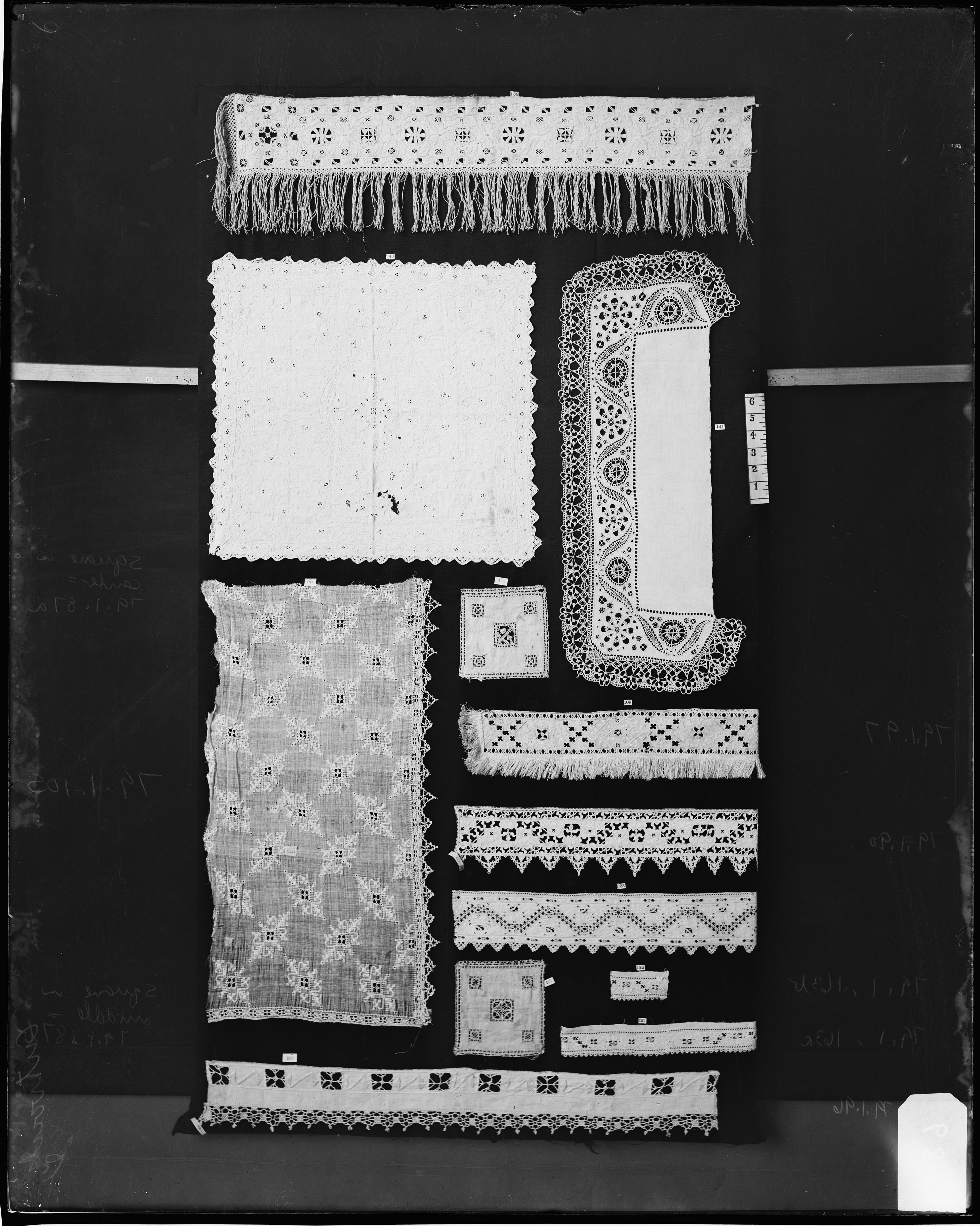
The most intellectually demanding aspect of “Band” lies in its cutwork. This is not the delicate, floral broderie anglaise of Victorian nostalgia. Rather, it is a bold, almost brutalist application of negative space. The cutwork is concentrated in precise, geometric clusters along the band’s upper edge and descending in a sparse, irregular rhythm down the center front. The patterns are not representational; they are abstracted glyphs, reminiscent of the perforated leatherwork of the Tuareg, the paper-cutting traditions of Polish wycinanki, or the intricate lattice of Islamic mashrabiya screens.
Each aperture is hand-cut, then meticulously finished with a rolled, whip-stitched edge using a silk thread dyed to match the linen’s undyed ecru. This labor-intensive process—which takes a single artisan over 40 hours—is a form of slow violence against uniformity. The cutwork does not weaken the fabric; it re-architects its tensile strength. The holes become structural vents, allowing the skin to breathe while creating a visual rhythm of light and shadow. When the wearer moves, the cutwork becomes kinetic calligraphy, drawing the eye across the body’s contours. This is not decoration; it is a form of communication. The voids speak as loudly as the material, articulating a philosophy of absence, of what is left unsaid.
Global Heritage, Localized Expression
The “Global Heritage” origin of “Band” is not a superficial moodboard of exotic motifs. Katherine Fashion Lab’s approach is deeply researched and anthropologically informed. The design team spent two years studying the binding traditions of various cultures—from the corsetry of 16th-century Europe to the woven sashes of the Kente cloth weavers in Ghana, and the metal girdles of ancient Celtic chieftains. The result is a synthesis, not a pastiche. The band’s width echoes the faja of Spanish flamenco dress, while its closure—a hidden series of hand-worked bone toggles—recalls the toggle fastenings of Inuit parkas.
This is cultural translation, not appropriation. The Lab treats heritage as a living language, not a museum specimen. By stripping these elements of their original ceremonial function and re-contextualizing them within a contemporary, secular silhouette, the garment becomes a meditation on the universality of human adornment. The band is a universal archetype—found in every culture as a symbol of transition, protection, and status. “Band” thus becomes a garment that speaks a global dialect, yet remains utterly specific to its wearer. It is a standalone study precisely because it refuses to be categorized within a single national tradition.
Wearability and the Couture Paradox
Despite its sculptural severity, “Band” is surprisingly wearable—a testament to the Lab’s technical mastery. The internal structure uses a horsehair canvas interfacing, hand-boned with spiral steel, but shaped with a curve that follows the natural lumbar lordosis. The result is a garment that provides posture correction without discomfort. The cutwork’s placement allows for strategic ventilation, making the piece suitable for both a climate-controlled gallery and a summer evening outdoors.
Yet, wearability is not the garment’s primary objective. “Band” is a standalone study—an object of contemplation that happens to be functional. It demands a wearer with a strong sense of self, someone who understands that fashion can be intellectual without being inaccessible. The garment’s true power lies in its ability to alter the wearer’s perception of their own body. The band’s pressure points create a somatic awareness, a reminder of one’s physical presence in space. In a world of amorphous, oversized silhouettes, “Band” offers a return to definition—not of the body’s curves, but of its purpose.
Conclusion: A Monument to Material Memory
Katherine Fashion Lab’s “Band” is not merely a garment; it is a thesis on the enduring power of craft. In its linen, we read the history of agriculture and trade. In its cutwork, we see the patience of human hands. In its silhouette, we find a dialogue between constraint and freedom. This is couture at its most profound—not as spectacle, but as philosophy. The band, traditionally a symbol of servitude or restriction, is here reimagined as an emblem of agency. It does not bind the wearer; it empowers them to inhabit their own space with intention.
As a standalone study, “Band” invites repeated viewing. Each encounter reveals a new detail—a shadow cast by a cutwork aperture, a subtle shift in the linen’s sheen under different light. It is a garment that rewards patience and punishes haste, much like the heritage it honors. In its quiet, insistent way, Katherine Fashion Lab has created not just a piece of clothing, but a relic of the future—one that will be studied, dissected, and reverenced long after the season has passed. This is the new language of luxury: not louder, but deeper.