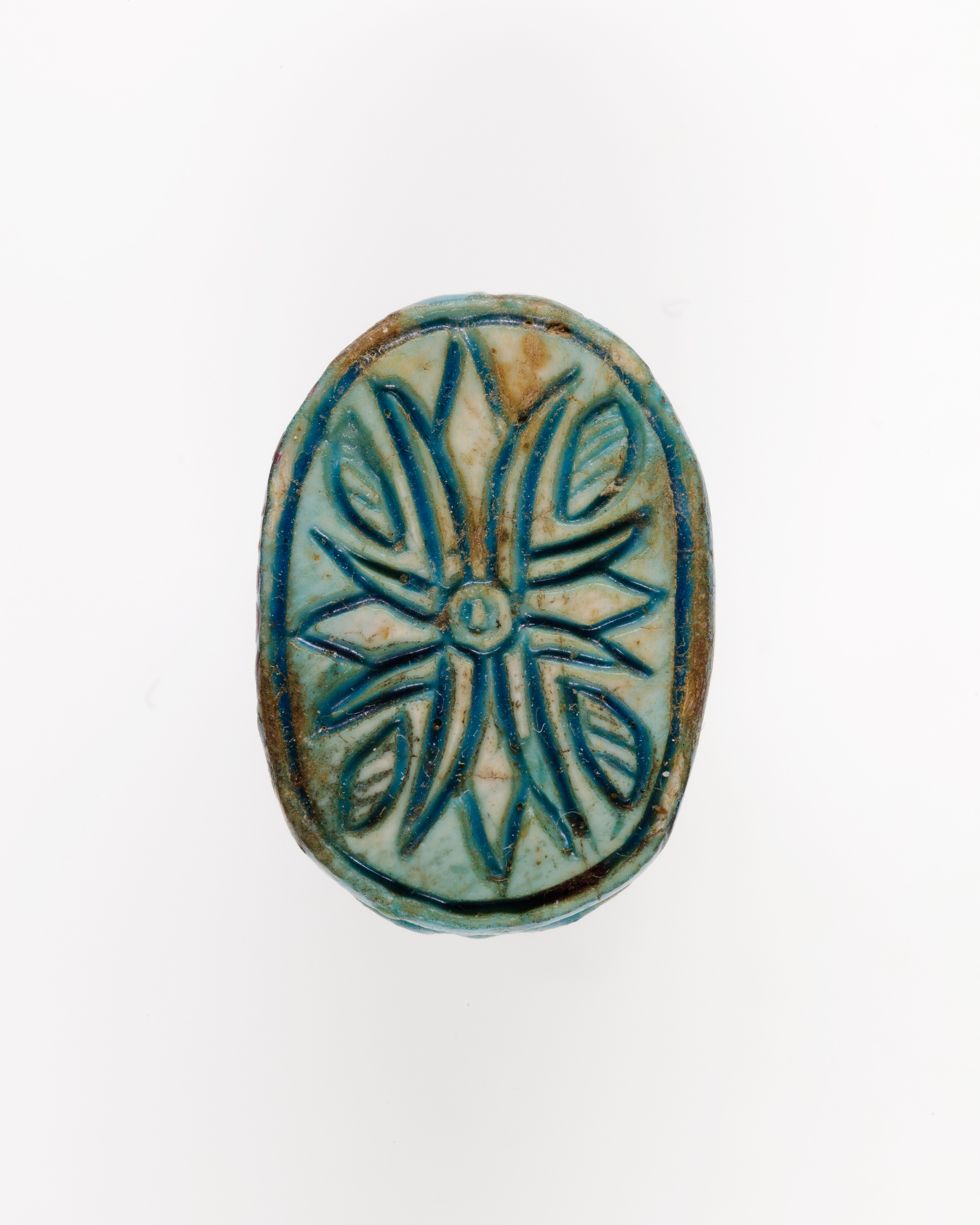
Executive Heritage Analysis: The Scarab with Cruciform Lotus
This strategic research paper examines the Scarab with Cruciform Lotus Flower Decoration, a singular artifact rendered in bright blue glazed steatite from an ancient civilization. For Katherine Fashion Lab, this object is not merely a historical curiosity but a blueprint for 2026 luxury differentiation. The analysis decodes its layered symbolism—from solar rebirth to floral transcendence—and translates these codes into a tangible, high-end design and brand strategy. The artifact’s power lies in its duality: it is both a talisman of personal protection and a statement of cosmic order, a duality that modern luxury consumers increasingly crave.
I. Symbolic Power and Historical Adornment
The Scarab as a Vector of Transformation
The scarab beetle, in ancient Egyptian and broader Near Eastern contexts, was the preeminent symbol of spontaneous creation and resurrection. Carved from steatite and glazed to a brilliant blue—the color of the Nile and the heavens—the scarab was not worn as mere ornament. It was a functional amulet, placed over the heart of the deceased or worn by the living to channel the sun god’s daily rebirth. The bright blue glaze, often achieved through copper compounds, was not decorative but alchemical: it transformed a mundane stone into a celestial object, a miniature sun. For the wearer, this meant the constant, tangible presence of regenerative energy. In historical adornment, the scarab was a silent declaration of one’s alignment with divine cycles, a wearable contract with eternity.
The Cruciform Lotus: A Fusion of Sacred Geometries
The addition of the cruciform lotus flower elevates the scarab from a solar emblem to a synthesis of earth and sky. The lotus, emerging pristine from murky waters, symbolizes spiritual purity and the unfolding of consciousness. The cruciform (cross-shaped) arrangement is critical; it anchors the lotus’s fluid petals into a structure of cardinal points—north, south, east, west. This is not a random pairing. The cross provides the architectural discipline, while the lotus provides the organic vitality. Together, they represent the intersection of the mortal plane (the cross) and the divine bloom (the lotus). In a luxury context, this is the perfect metaphor for the modern consumer: a person grounded in reality but aspiring to transcendence. The artifact’s power is its insistence that these two states are not opposed but interlocked.
II. Spiritual Meaning and Material Alchemy
Steatite as a Medium of Humble Transcendence
The choice of steatite (soapstone) is strategically significant. Unlike gold or lapis lazuli, steatite is a soft, common stone. Its transformation into a high-gloss, brilliant blue object is a testament to human intervention as a form of divine grace. This is a profound spiritual lesson for luxury: value is not intrinsic to raw material but is activated by craft, intention, and ritual. The glazing process—firing and re-firing to achieve the luminous surface—mirrors the spiritual journey of refinement through adversity. For Katherine Fashion Lab, this suggests a 2026 strategy that elevates process over product. The narrative of the artisan’s hand, the kiln’s heat, and the precise chemical recipe becomes the true luxury asset.
The Blue of Eternity: Chromatic Psychology
Bright blue in ancient symbolism is not calming; it is electric and protective. It is the color of the vault of heaven, the amniotic fluid of the cosmos. When paired with the scarab’s regenerative function, the blue glaze acts as a psychic shield. It repels chaos and invites order. In 2026, where digital noise and geopolitical instability dominate, this chromatic code is potent. A luxury object that offers visual silence and psychological armor is not a commodity; it is a sanctuary. The cruciform lotus, rendered in the same blue, unifies the piece under a single chromatic authority, ensuring the wearer is enveloped in a cohesive field of protective energy.
III. 2026 High-End Luxury Strategy: Translating Heritage into Demand
Strategic Pillar 1: The "Relic" Positioning
Katherine Fashion Lab should not market this motif as "inspired by Egypt" or "ancient-themed." That is derivative. Instead, the strategy should position the scarab-lotus as a relic of a universal human truth: the desire for controlled transformation. The 2026 consumer is exhausted by fast trends and seeks permanence. By framing the design as a direct translation of a 3,000-year-old symbol—not a reinterpretation—the brand claims an authenticity hierarchy that competitors cannot replicate. The message: We do not borrow symbols; we steward them. This justifies a premium price point because the consumer is not buying a necklace or a brooch; they are acquiring a fragment of a worldview.
Strategic Pillar 2: Modular Adornment as Ritual
The artifact’s dual geometry (cross + lotus) lends itself to modular jewelry systems. In 2026, luxury will pivot from static pieces to transformative configurations. The scarab body can serve as a central clasp, while the cruciform lotus can be detached and worn as a standalone pin. This mirrors the artifact’s original use—it was not fixed but could be strung, mounted, or placed. The strategy is to sell a system of adornment, not a single object. Each configuration change becomes a personal ritual, echoing the scarab’s function as a daily touchstone of rebirth. This creates repeat engagement and deepens emotional attachment, driving loyalty and word-of-mouth.
Strategic Pillar 3: The "Blue Glaze" as a Signature Finish
Katherine Fashion Lab should develop a proprietary finish—call it "KFL Celestial Glaze"—that replicates the bright, electric blue of the artifact. This is not a color trend; it is a branded material signature. Applied to hard stones, ceramics, or even treated leathers, this glaze becomes the house code. The 2026 strategy should deploy this finish across a limited "Reliquary Collection"—small batches, numbered pieces, each accompanied by a provenance card explaining the symbolic weight. This scarcity, combined with the spiritual narrative, creates investment-grade desire. The glaze is the visual shorthand for everything the brand stands for: alchemy, protection, and transcendence.
Strategic Pillar 4: Experiential Retail as a "Temple of Rebirth"
The physical retail environment must reflect the artifact’s spiritual gravity. Flagship stores should be designed as contemplative chambers, not showrooms. Use darkened interiors with single, dramatic light beams on the blue-glazed pieces, evoking the sun’s ray hitting the ancient amulet. Background soundscapes should incorporate low-frequency resonances, mimicking the hum of a kiln or a temple drum. Staff should be trained as heritage narrators, not salespeople, explaining the cruciform lotus’s cardinal geometry and the scarab’s regenerative power. This transforms a purchase into a rite of passage. The consumer leaves not with a product, but with a state of being—a feeling of having been ritually prepared for the coming year.
IV. Conclusion: The Artifact as a 2026 Compass
The Scarab with Cruciform Lotus Flower Decoration is not a historical footnote. It is a strategic asset for Katherine Fashion Lab’s 2026 vision. Its power derives from its ability to hold contradictions—humble material, divine result; solar beetle, floral cross; personal amulet, cosmic map. In a luxury market saturated with empty minimalism and loud logos, this artifact offers a third path: meaningful complexity. By adopting its symbolic grammar, its material philosophy, and its chromatic authority, the brand can offer a luxury that is not about owning things, but about embodying principles. The 2026 consumer will not ask "What is this?" but rather "What can I become with this?"—and that is the only question that matters for enduring relevance.