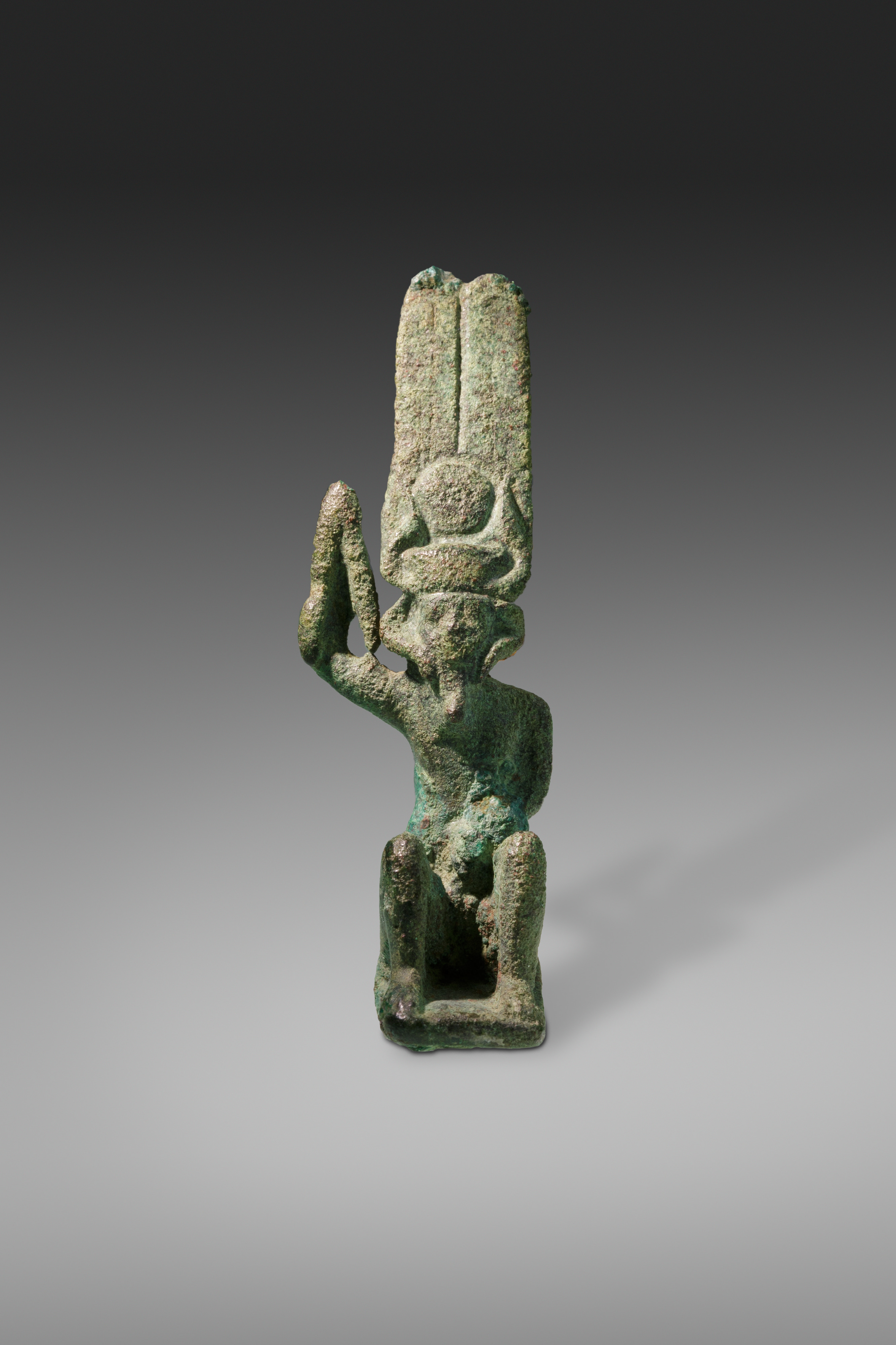
The Amulet of Min: A Heritage Analysis for Strategic Luxury Positioning
The Amulet of Min, rendered in bronze or copper alloy, represents one of the most potent and yet under-explored symbols of generative power in the ancient world. For Katherine Fashion Lab, this artifact is not merely a historical curiosity but a strategic asset—a bridge between primordial spiritual authority and the contemporary luxury consumer’s quest for authentic, meaningful adornment. This analysis deconstructs the amulet’s symbolic architecture, its historical role in bodily ornamentation, and its translation into a 2026 high-end strategy that prioritizes narrative depth over transient aesthetics.
Symbolic Power and Theological Foundations
The amulet’s iconographic core is the ithyphallic deity Min, a god of fertility, male potency, and the regenerative forces of the desert and harvest. In ancient Egyptian cosmology, Min was not merely a god of sexual virility but a cosmic principle of creation and renewal. The amulet, typically worn at the waist or suspended from a necklace, was a concentrated talisman of this principle. Its bronze or copper alloy base—metals associated with the planet Mars and the goddess Hathor's domain of love—amplified its apotropaic function, warding off impotence, sterility, and spiritual decay.
For the modern luxury consumer, the symbolic power of Min translates into a narrative of unapologetic vitality and creative genesis. In a market saturated with minimalist androgyny, the amulet offers a counter-narrative: a bold declaration of life force, agency, and the courage to generate—whether that be progeny, art, or capital. The strategic opportunity lies in repositioning this ancient symbol not as overtly sexual, but as a metaphor for entrepreneurial fecundity and the power to manifest one's will into tangible reality—a resonant message for the high-net-worth individual who views their acquisitions as extensions of their own creative energy.
Historical Adornment and Material Semiotics
Historically, the Amulet of Min was not an item of passive decoration. It was an active agent in the wearer’s daily ritual life. Bronze and copper alloy were chosen for their durability and their acoustic properties, producing a subtle chime when worn during processions—a sensory layer that engaged the wearer and those nearby in a shared spiritual frequency. The material’s patina over time was not considered degradation but a sacred accrual of power, a visual record of the amulet’s service to its owner.
This material semiotics offers a profound lesson for Katherine Fashion Lab’s 2026 collection. The luxury market is currently experiencing a pivot away from high-polish, sterile finishes toward textural authenticity and living surfaces. The amulet’s bronze alloy can be reimagined using modern metallurgical techniques that accelerate or preserve patina, creating pieces that are unique to each client. The strategy involves offering "pre-aged" finishes that mimic ancient wear, alongside pristine versions, allowing the client to choose their narrative: one of inherited history or of nascent power. This dual offering positions the brand as both a custodian of heritage and a facilitator of personal legacy.
Spiritual Meaning and the Neo-Ritual Consumer
The spiritual function of the Amulet of Min was prophylactic—it was worn to protect the wearer’s generative essence from external curses and internal doubt. In the context of 2026, the neo-ritual consumer is not seeking organized religion but personal talismanic efficacy. They desire objects that "do something"—that provide psychological armor against the anxieties of a volatile geopolitical and economic climate. The amulet’s historical role as a guardian of fertility can be strategically reframed as a guardian of personal bandwidth and creative output.
Katherine Fashion Lab can leverage this by developing a "Ritual of Activation" upon purchase—a branded unboxing experience that includes a historical dossier, a suggested meditation or affirmation, and instructions for "charging" the amulet through intention. This transforms a simple transaction into a spiritual acquisition event, differentiating the brand from competitors who sell inert jewelry. The amulet becomes a daily micro-ritual, a moment of self-affirmation that aligns with the consumer’s desire for mindfulness and intentionality in a fragmented world.
2026 High-End Luxury Strategy: The "Generative Dynasty" Collection
The integration of the Amulet of Min into a 2026 luxury strategy requires more than a simple reproduction. It demands a curatorial elevation that respects the artifact’s gravity while making it wearable and desirable for a contemporary elite. The proposed strategy is threefold:
1. Limited "Archaeological Resonance" Line
Produce a series of 100 numbered amulets cast from a digitally scanned replica of a museum-grade original. Each piece will be set with a single, ethically sourced, deep-red garnet—a stone historically associated with vitality and blood—to modernize the silhouette without diluting its power. The price point will be set at the ultra-luxury tier, justified by the artifact’s provenance and the labor-intensive casting process. This line is not for the casual buyer; it is for the collector of cultural capital who understands the difference between a fashion accessory and a relic.
2. Bespoke "Patina of Power" Commission Program
For the top 1% of the clientele, offer a private commission service where the amulet is cast in a custom alloy (including a proprietary blend of bronze, copper, and a trace of 24k gold). The client will collaborate with a master patinist to select the exact oxidation pattern, creating a one-of-one object. This program leverages the ancient belief that the amulet’s power grows with its bearer. The brand will provide a generational warranty, offering to re-patina or restore the amulet for the client’s heirs, thereby positioning the piece as a family heirloom with an ongoing service relationship.
3. Editorial and Narrative Campaign: "The Unbroken Line"
The marketing strategy will avoid overtly sexual imagery. Instead, the campaign will feature iconic, non-traditional leaders—a female CEO, a male artist, a non-binary founder—wearing the amulet over modern power suiting or minimalist athleisure. The visual narrative will emphasize the amulet as a source of inner resolve and creative stamina. The tagline, "Wear the source of your genesis," positions the product as a tool for self-actualization, not a relic of a bygone era. This campaign will be launched exclusively through a private, invitation-only digital salon, followed by a physical exhibition in a former industrial cathedral in Milan, aligning the brand with high culture and architectural heritage.
Conclusion: From Artifact to Archetype
The Amulet of Min, in its bronze and copper alloy form, is a masterclass in the fusion of material, meaning, and function. For Katherine Fashion Lab, its strategic value lies not in its antiquity but in its archetypal resonance. By treating this amulet with the reverence of a museum curator and the acumen of a private equity strategist, the brand can create a product that satisfies the 2026 consumer’s deepest unmet need: the need for a tangible anchor of power in an increasingly intangible world. The amulet is not a piece of jewelry; it is a portable origin story, and for the discerning client, that is the ultimate luxury.