The Architecture of Absence: Deconstructing Insertion in Global Heritage Couture
In the rarefied echelons of haute couture, where innovation often masquerades as disruption, Katherine Fashion Lab (KFL) presents a compelling counter-narrative with its latest standalone study: Insertion. This is not a garment in the conventional sense, nor is it a mere textile sample. It is a philosophical treatise rendered in thread, a meditation on the interstitial spaces that define both our physical forms and our cultural memories. By isolating the technique of bobbin lace—historically a subordinate, decorative element—and elevating it to a primary structural and conceptual protagonist, KFL challenges the very hierarchies of dressmaking.
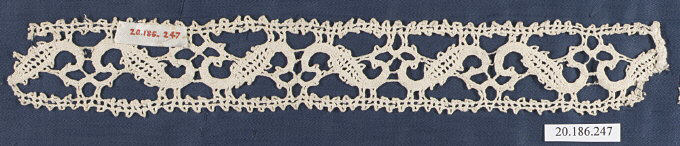
The term "insertion" in lacemaking traditionally refers to a narrow band of fabric sewn between two larger pieces of cloth, a functional seam that simultaneously conceals and reveals its own artistry. KFL subverts this utilitarian origin. In this study, insertion is not a bridge between two distinct entities; it is the entity itself. The work exists as a suspended, self-supporting panel, a ghostly architecture of negative space. The bobbin lace is not applied to a foundation; rather, it *is* the foundation, and the absence of fabric around it becomes the loudest statement in the room. This curatorial decision forces a radical re-evaluation: we are no longer looking at a dress with lace details, but at lace as a complete, autonomous universe.
Material Memory: The Global Lexicon of Bobbin Lace
To understand the profundity of this study, one must first appreciate the polyglot history of bobbin lace. Originating in 16th-century Europe, it rapidly became a global commodity, a silent trader of aesthetics and technique. From the flax fields of Flanders to the convents of Venice, and later adapted in the silk workshops of China and the cottage industries of South America, bobbin lace is a testament to cultural osmosis. KFL’s choice to frame this under "Global Heritage" is deliberate and incisive. The lab does not claim a single lineage; instead, it synthesizes the geometric precision of Milanese lace, the floral exuberance of Chantilly, and the airy, geometric grids of Torchon into a singular, cohesive language.
The material execution is where the study transcends mere craft. KFL’s atelier has employed extra-fine linen thread, a choice that speaks to sustainability and longevity, contrasting sharply with the synthetic fragility of fast fashion. Each twist of the bobbin is a deliberate act of resistance against industrial homogenization. The thread is not dyed; it retains its natural, ecru hue, allowing the play of light and shadow to become the primary chromatic agent. As the panel shifts, the lace appears to breathe, its organic, ivory tones evoking parchment, bone, and the patina of age. This is not a pristine, sterile white; it is a living, breathing artifact that acknowledges the passage of time.
Structural Innovation: Engineering the Void
The technical audacity of Insertion lies in its structural self-sufficiency. Traditional bobbin lace, for all its beauty, is inherently fragile and pliable, requiring a ground fabric for support. KFL’s research and development team has pioneered a novel stiffening technique, a proprietary blend of natural starches and micro-crystalline waxes, applied in successive, micro-thin layers. This is not a chemical plasticizing; it is an organic augmentation that allows the lace to hold a three-dimensional, architectural silhouette without visible armature.
The result is a study in controlled tension. The panel is organized into a series of concentric, elliptical forms, each one a variation on the theme of the open hole. These are not random apertures; they are meticulously calculated voids that create a rhythmic visual cadence. The densest areas of the lace—where the cloth stitch creates a solid, matte surface—act as the "bones" of the piece, while the open, half-stitch and gridwork areas function as the "skin," translucent and ethereal. The wearer, or the viewer, is invited to consider the body not as a volume to be covered, but as a field of energy that fills these voids. The garment becomes a lens, focusing attention on the space it occupies rather than the flesh it conceals.
Conceptual Resonance: The Politics of the Gap
Beyond its material and technical merits, Insertion operates as a potent conceptual metaphor. In an era of information overload and visual noise, KFL posits that meaning is often generated in the gaps, in the silences between words, in the pauses between notes. The "insertion" here is not a piece of fabric but an idea—an intervention into the relentless flow of visual stimuli. The lace’s openwork becomes a meditation on vulnerability and strength. The spaces are not weaknesses; they are the very source of the structure’s resilience, allowing it to flex and move without breaking.
Furthermore, the study interrogates the notion of labor and value. Bobbin lace is one of the most time-intensive crafts known to humanity; a single square inch can require hours of meticulous work. By presenting this work as a standalone study, devoid of commercial context or wearable function, KFL elevates the artisan’s labor to the status of high art. It is a direct critique of the disposable culture that dominates contemporary fashion. The piece demands patience from its audience, a slowing down of the gaze to appreciate the thousands of individual thread crossings. In this sense, Insertion is not merely an object; it is an act of quiet rebellion, a stand against the tyranny of speed.
Curatorial Framing: The Standalone as Specimen
The decision to present this as a standalone study is critical to its reception. It is not part of a collection, not a prototype for a future garment, and not an accessory to a larger look. It is a singular, isolated artifact, akin to a rare botanical specimen pinned under glass. This curatorial choice strips away all distractions, forcing a direct, unmediated dialogue between the viewer and the object. The absence of a mannequin is particularly striking. The lace panel is suspended in a custom, minimalist frame of brushed steel, allowing it to undulate gently in the air currents of the gallery. It becomes a living drawing, a three-dimensional sketch of light and shadow.
This isolation also allows for a deeper appreciation of the imperfections inherent in handcraft. Close inspection reveals the infinitesimal variations in thread tension, the subtle irregularities in the pattern repeat. These are not flaws; they are the fingerprints of the human hand, the evidence of a living process. In a world obsessed with digital perfection, KFL celebrates the beauty of the human error, the slight asymmetry that gives the work its soul. The study thus becomes a powerful argument for the irreplaceable value of artisanal knowledge in a technologically saturated landscape.
In conclusion, Katherine Fashion Lab’s Insertion is a masterclass in conceptual and material rigor. It reclaims a marginalized technique from the annals of decorative arts and repositions it as a leading voice in contemporary design discourse. By harnessing the global heritage of bobbin lace and pushing its structural boundaries, KFL has created a work that is at once deeply historical and radically futuristic. It is a testament to the power of restraint, the eloquence of absence, and the enduring relevance of the handmade. This is not fashion as clothing; it is fashion as philosophy, a delicate yet unyielding assertion that the spaces we leave open are often the most profound statements we can make.