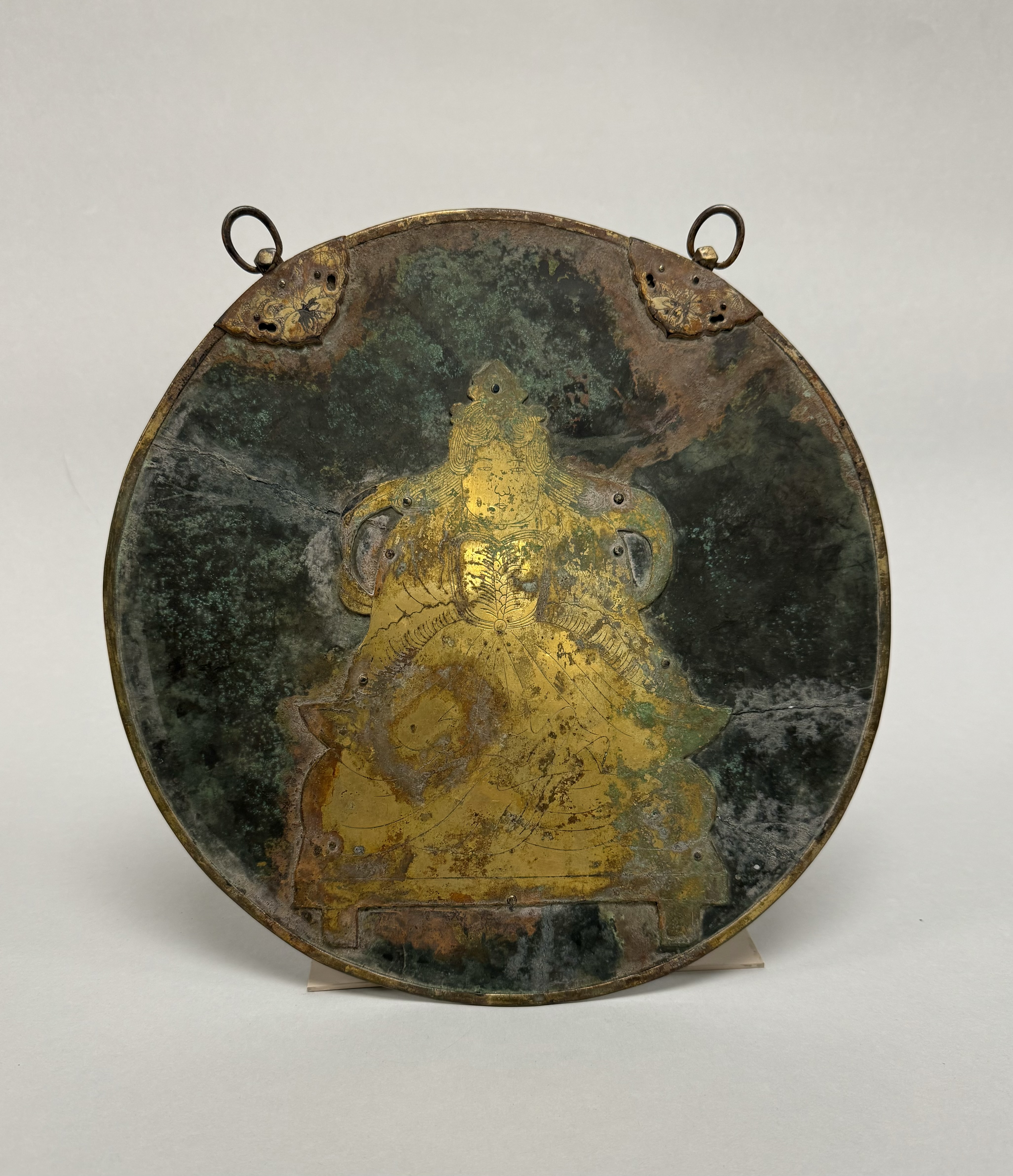
Executive Heritage Assessment: The Japanese Disk as a Symbolic and Strategic Asset
Katherine Fashion Lab’s exploration of the Japanese disk—rendered in gilt bronze and silver gilt—presents a compelling opportunity to bridge ancestral veneration with contemporary luxury narratives. This analysis moves beyond the object’s physical form to interrogate its layered significance: as a solar emblem, a marker of aristocratic authority, and a conduit for spiritual transcendence. For a 2026 high-end strategy, the disk is not merely a motif but a philosophical framework—one that demands a disciplined, material-first approach to storytelling, scarcity, and cross-cultural resonance.
Symbolic Power: The Disk as Cosmic and Temporal Authority
In Japanese material culture, the disk—particularly when fashioned in precious metals—operates on two symbolic registers: the celestial and the terrestrial. The circular form evokes the sun, specifically Amaterasu, the Shinto sun goddess from whom the imperial lineage claims descent. This is not a passive symbol; it is a claim to genealogical legitimacy and cosmic order. The gilt bronze surface, when polished, mirrors the sun’s radiance, transforming the wearer or holder into a living reflection of divine light. In a 2026 luxury context, this translates into a brand narrative of unassailable origin and luminous permanence—qualities that transcend seasonal trends.
Simultaneously, the disk’s flat, circular geometry signifies the ensō—the Zen circle of enlightenment, emptiness, and the void from which all form emerges. This duality is crucial: the disk is both a solar assertion of power and a Buddhist meditation on impermanence. For Katherine Fashion Lab, this offers a sophisticated brand tension: the object is opulent yet austere, commanding yet contemplative. The strategic use of silver gilt—a material that tarnishes and requires care—adds a performative dimension. Unlike gold’s static permanence, silver gilt demands ritual maintenance, aligning with the Japanese concept of kintsugi or repair as beauty. The disk becomes a living artifact that ages with its owner, a counter-narrative to disposable luxury.
Historical Adornment: From Courtly Regalia to Warrior Talisman
Historically, the disk in Japanese adornment served distinct hierarchical functions. During the Nara and Heian periods, gilt bronze mirrors—often circular—were not mere vanity items but sacred regalia, stored in shrines and used in Shinto rites to summon deities. The mirror’s reflective surface was believed to house the kami (spirit), making the disk a portable dwelling for the divine. When worn as a pendant or attached to ceremonial robes, it signaled not just wealth but ritual purity and political alliance with the imperial court.
By the Kamakura period, the disk’s symbolism shifted toward the warrior class. Small gilt bronze disks, often embossed with clan crests (mon), were affixed to armor or sword hilts. Here, the disk served as a protective talisman, its circularity representing a shield against malevolent forces and a reminder of the warrior’s duty to the celestial order. The silver gilt variant, with its brighter sheen, was reserved for high-ranking daimyō, signifying strategic alliance and martial prestige. For a modern luxury house, this historical layering provides a rich lexicon: the disk can be positioned as armor for the contemporary elite—a shield against cultural noise and a marker of disciplined taste.
The material choice of gilt bronze and silver gilt is not incidental. Bronze, an alloy of copper and tin, was historically associated with ritual vessels and temple bells, grounding the disk in sacred acoustics and metallurgical mastery. Gilding—the application of gold leaf or mercury-gilding—was a labor-intensive process reserved for imperial commissions. Silver gilt, by contrast, offered a brighter, more reflective surface, often used for ceremonial fans and mirror cases. The juxtaposition of these two metals in a single object creates a dialogue between warmth and coolness, tradition and innovation—a duality that can be harnessed in product line architecture.
Spiritual Meaning: The Disk as a Meditative and Protective Object
Beyond its political and martial roles, the Japanese disk carries profound spiritual weight. In Shinto, the circle represents the tama—the soul or spirit—and is often found in magatama (curved beads) and yata no kagami (the eight-handed mirror). The disk’s uninterrupted circumference signifies wholeness, cyclical renewal, and the absence of beginning or end. This aligns with the Buddhist concept of rinne (the cycle of rebirth), where the disk becomes a symbol of karmic continuity.
In esoteric Buddhist practice, the vajra and ghanta (bell) often feature disk-like elements, representing the union of wisdom and compassion. A gilt bronze disk worn close to the heart is thus not an ornament but a spiritual technology—a focal point for meditation and a reminder of one’s place in the cosmic order. For Katherine Fashion Lab, this spiritual dimension offers a differentiation strategy: the disk is not merely decorative but functional in its symbolism. It invites the wearer to engage in a private ritual, aligning with the 2026 luxury trend toward mindful consumption and inner transformation.
The silver gilt surface adds another layer: silver has long been associated with the moon, intuition, and the feminine principle in Japanese lore, while gold is solar and masculine. The combination of both metals in a single disk creates a harmonized yin-yang energy, appealing to a modern audience seeking balance and holistic well-being. This is not a superficial nod to spirituality but a materially grounded philosophy that can be communicated through craftsmanship, packaging, and unboxing rituals.
2026 High-End Luxury Strategy: Positioning the Disk for the Discerning Collector
As the luxury market shifts toward heritage-driven, object-based storytelling, the Japanese disk offers Katherine Fashion Lab a strategic asset that is both culturally specific and universally resonant. The 2026 consumer is increasingly skeptical of overt branding; they seek covert status symbols that require cultural literacy to decode. The disk, with its subtle circularity and historical depth, is precisely such an object. It does not shout; it whispers in the language of ancient courts.
Product Architecture: The Disk as a Modular Motif
Strategically, the disk can be deployed across multiple categories—fine jewelry, leather goods, and hard luxury—without diluting its integrity. A gilt bronze disk pendant with a silver gilt reverse, for instance, can serve as a signature amulet, while a smaller disk motif embossed on a leather bag clasp creates a brand code of circularity. The key is to maintain strict material discipline: only gilt bronze and silver gilt are permitted, ensuring material authenticity that cannot be replicated by competitors.
Limited editions should be tied to historical epochs—for example, a Heian-inspired collection with oxidized bronze patinas, or a Kamakura-inspired line with hammered textures. Each piece should be accompanied by a certificate of symbolic provenance, detailing the specific historical and spiritual references, elevating the purchase from transaction to acquisition of cultural capital.
Pricing and Scarcity: The Economics of the Sacred
Pricing must reflect the disk’s dual nature as art object and spiritual tool. Rather than competing on cost-per-gram, Katherine Fashion Lab should adopt a value-per-symbolism model. A disk amulet, priced at the upper tier of fine jewelry, is justified by its ritual function—the buyer is not purchasing metal but access to a lineage of imperial and monastic power. Scarcity should be engineered through annual releases of no more than 100 pieces per design, with each disk individually numbered and inscribed with a kanji character denoting its spiritual intention (e.g., kagami for mirror, tama for soul).
Brand Narrative and Communication: Silent Authority
Marketing should avoid overt explanations. Instead, use visual poetry and material close-ups—the glint of gilt bronze, the soft patina of silver—accompanied by short, evocative texts referencing Amaterasu, the ensō, and the warrior’s shield. Collaborations with contemporary Japanese artisans who practice traditional gilding techniques can provide authenticating third-party validation. For the 2026 launch, a private exhibition in Kyoto, followed by a select trunk show in Paris, would position the disk as a bridge between Eastern ritual and Western luxury, appealing to collectors who value cross-cultural fluency.
Conclusion: The Disk as a Timeless Strategic Investment
The Japanese disk, in gilt bronze and silver gilt, is far more than a historical artifact. It is a concentrated repository of solar authority, martial protection, and spiritual introspection. For Katherine Fashion Lab, it offers a rare opportunity to create a unified luxury philosophy—one that rejects loud branding in favor of material silence, historical depth, and ritual engagement. By positioning the disk as a modern talisman for the discerning elite, the brand can transcend the cyclical nature of fashion and enter the realm of permanent cultural value. The 2026 strategy should therefore treat the disk not as a trend to be exploited but as a sacred inheritance to be honored—a decision that will resonate with collectors seeking meaning, permanence, and beauty in an increasingly transient world.