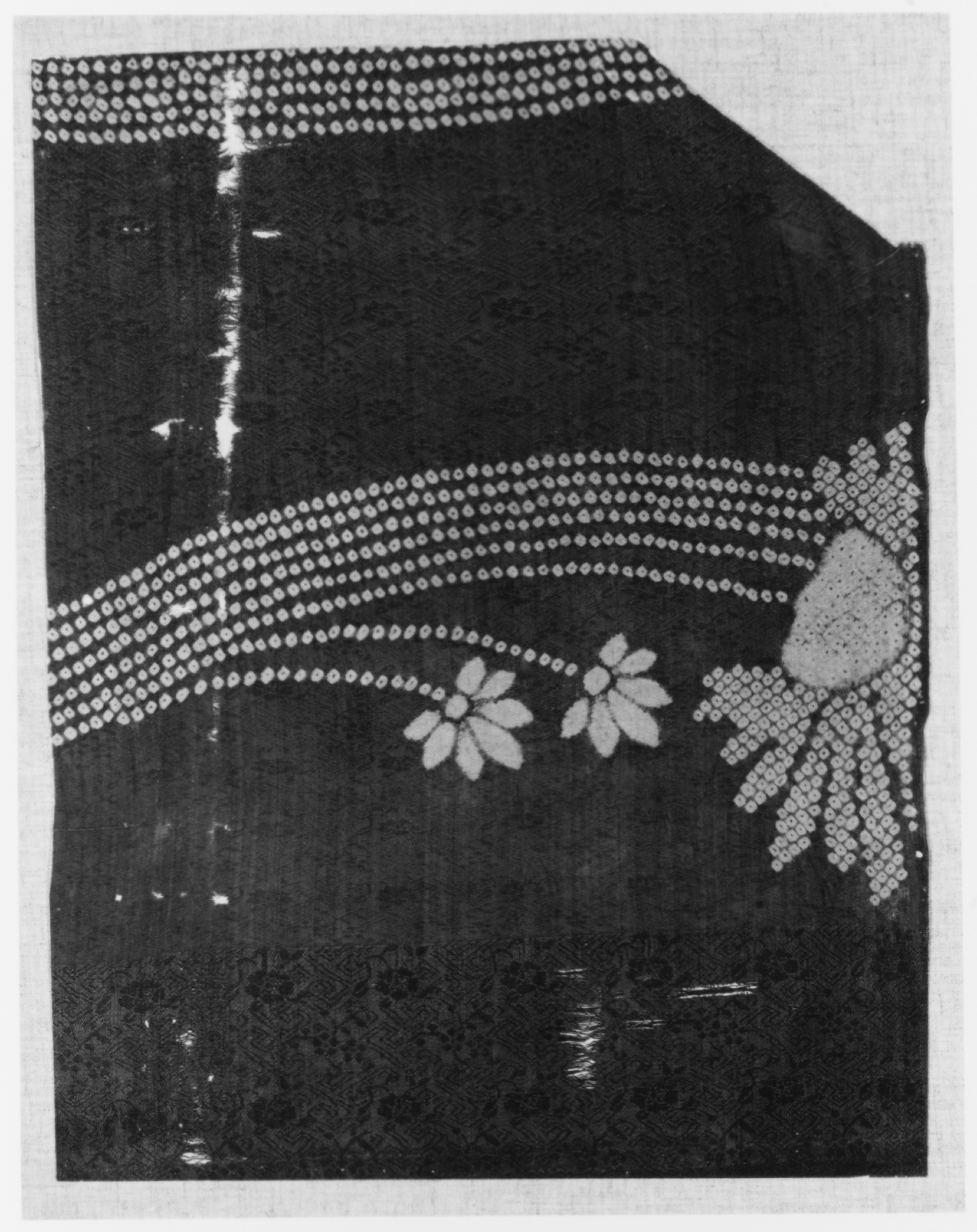
Executive Heritage Assessment: The Kosode Fragments
This analysis examines two kosode fragments, originating from Edo-period Japan, rendered in a ground of purple satin damask (rinzu). As strategic standalone research, this document positions the fragments not merely as textile remnants, but as potent carriers of symbolic capital, historical adornment practice, and spiritual cosmology. For Katherine Fashion Lab’s 2026 luxury strategy, these fragments offer a blueprint for transcending aesthetic appropriation into deep, culturally literate storytelling.
Symbolic Power and the Semiotics of Purple
The choice of purple satin damask is the primary signifier of hierarchical power. In the Japanese chromatic lexicon, purple (murasaki) was historically reserved for the highest echelons of the imperial court and the Buddhist clergy. Its extraction from the gromwell plant (murasaki root) was labor-intensive, rendering the dye a commodity of immense economic and social value. During the Edo period, sumptuary laws codified this chromatic exclusivity, restricting deep purples to the daimyo class and the shogunate’s inner circles. The rinzu weave—a figured satin with a subtle, light-reflecting damask pattern—amplifies this power. The interplay of matte and lustrous surfaces creates a visual hierarchy within the fabric itself, suggesting that power is not monolithic but layered, revealed only to the discerning eye. For a 2026 luxury house, this translates into a design philosophy where status is communicated through material intelligence—dye provenance, weave complexity—rather than overt logos.
Adornment as Political and Social Cartography
Historically, the kosode was the foundational garment of Japanese dress, worn as an underlayer or, for commoners, as an outer robe. However, these fragments are not utilitarian. The satin ground indicates a garment worn during formal occasions, likely by a woman of the warrior aristocracy or a high-ranking courtesan. Adornment here functioned as social cartography, mapping the wearer’s lineage, marital status, and regional affiliation. The fragments’ pattern—presumably floral or geometric, though now fragmented—would have been selected with seasonal precision. In Edo-period aesthetics, the mono no aware (the pathos of things) dictated that garments reflect the transient beauty of the natural world. A spring motif, for instance, signified renewal and was worn during specific lunar months. This temporal specificity is a critical lesson for modern luxury: adornment is not static but a dialogue with time and environment. The 2026 consumer increasingly seeks pieces that are not timeless in a generic sense, but temporally resonant—garments that acknowledge their moment of creation and intended wear.
Spiritual Meaning: The Body as a Sacred Vessel
Beyond the political, the kosode carried profound spiritual weight. The Japanese concept of kami (spirits) extends to textiles, particularly those worn close to the body. The rinzu’s damask pattern often incorporated Buddhist or Shinto symbols—such as the shippo (seven treasures) or asanoha (hemp leaf)—which served as protective talismans. The purple ground, specifically, was associated with Amida Buddha’s Pure Land, a realm of transcendent light. Wearing purple was not merely a display of status; it was a sartorial prayer, an invocation of spiritual protection and a reminder of impermanence. The fragments’ fragmented state is itself spiritually significant, echoing the Buddhist concept of mujo (impermanence). The garment’s decay is not a loss but a testament to the cycle of existence. For Katherine Fashion Lab, this suggests a luxury narrative that embraces wabi-sabi—the beauty of imperfection and incompleteness. A 2026 collection can adopt this by incorporating visible mending, asymmetric cuts, or intentionally aged finishes, reframing “damage” as narrative depth rather than defect.
Strategic Translation for 2026 High-End Luxury
Translating these historical and spiritual layers into a 2026 luxury strategy requires a multi-pronged approach that moves beyond surface mimicry. The following framework aligns the kosode’s DNA with contemporary high-end market demands.
1. Material Provenance as Ultra-Luxury. The luxury consumer of 2026 is increasingly educated on supply chains. The kosode’s power lies in its origin story—the specific plant, the artisan dyer, the weaver’s loom. Katherine Fashion Lab can replicate this by commissioning exclusive, limited-run textiles using natural dyes (e.g., murasaki root from a specific prefecture) and hand-operated looms. This positions the product as a collectible artifact, not a mass-produced good. The price point is justified not by branding overhead but by artisanal scarcity and ecological authenticity.
2. Chromatic Strategy for Status Signaling. The purple ground offers a direct colorway for a 2026 capsule. However, the strategy should not be literal replication. Instead, Katherine Fashion Lab can develop a “Neo-Edo” palette—deep aubergine, bruised plum, and shadowed violet—that evokes the historical hierarchy without being costume-like. These shades can be paired with unexpected neutrals (ash grey, raw silk) to create a modern, architectural silhouette. The color becomes a whisper of authority, appealing to a clientele that values understated power over flamboyant display.
3. Narrative Fragmentation as Collectible Design. The fragments themselves are a metaphor for the modern luxury wardrobe. Instead of a complete, monolithic garment, the 2026 strategy can introduce modular pieces—a detachable collar, a waist sash, a panel that can be worn as a scarf or an overlay. Each piece is a “fragment” that the consumer assembles into a personal composition. This not only honors the kosode’s original modularity (it was worn under various outer robes) but also taps into the circular economy trend, where longevity and versatility are paramount. The unfinished edge, the raw hem, becomes a signature design detail, echoing the wabi-sabi aesthetic.
4. Spiritual Resonance in Brand Experience. Finally, the spiritual dimension must be translated into the brand’s experiential offering. Katherine Fashion Lab can host private viewings of the fragments, accompanied by a tea ceremony or a kodo (incense listening) session. This transforms a product launch into a ritualized experience, aligning the brand with mindfulness and cultural reverence. The 2026 luxury consumer is not buying a dress; they are buying a moment of contemplative connection to history. The brand’s communication should avoid overt “Japaneseness” and instead focus on universal themes of impermanence, protection, and layered identity.
Conclusion: From Artifact to Archetype
These two kosode fragments are not merely historical curiosities. They are strategic assets that encode a sophisticated system of power, temporality, and spirituality. For Katherine Fashion Lab, the 2026 opportunity lies in decoding these systems and re-encoding them into a contemporary luxury language. The purple satin damask is not a color; it is a declaration. The fragmented weave is not a flaw; it is a philosophy. By adopting a strategy of material provenance, chromatic restraint, modular design, and ritualized experience, the brand can position itself as a curator of cultural memory, not just a producer of apparel. This is the ultimate luxury—owning not just a garment, but a piece of meaning that transcends seasons and trends, offering the wearer a silent, yet profound, connection to the sacred and the sovereign.