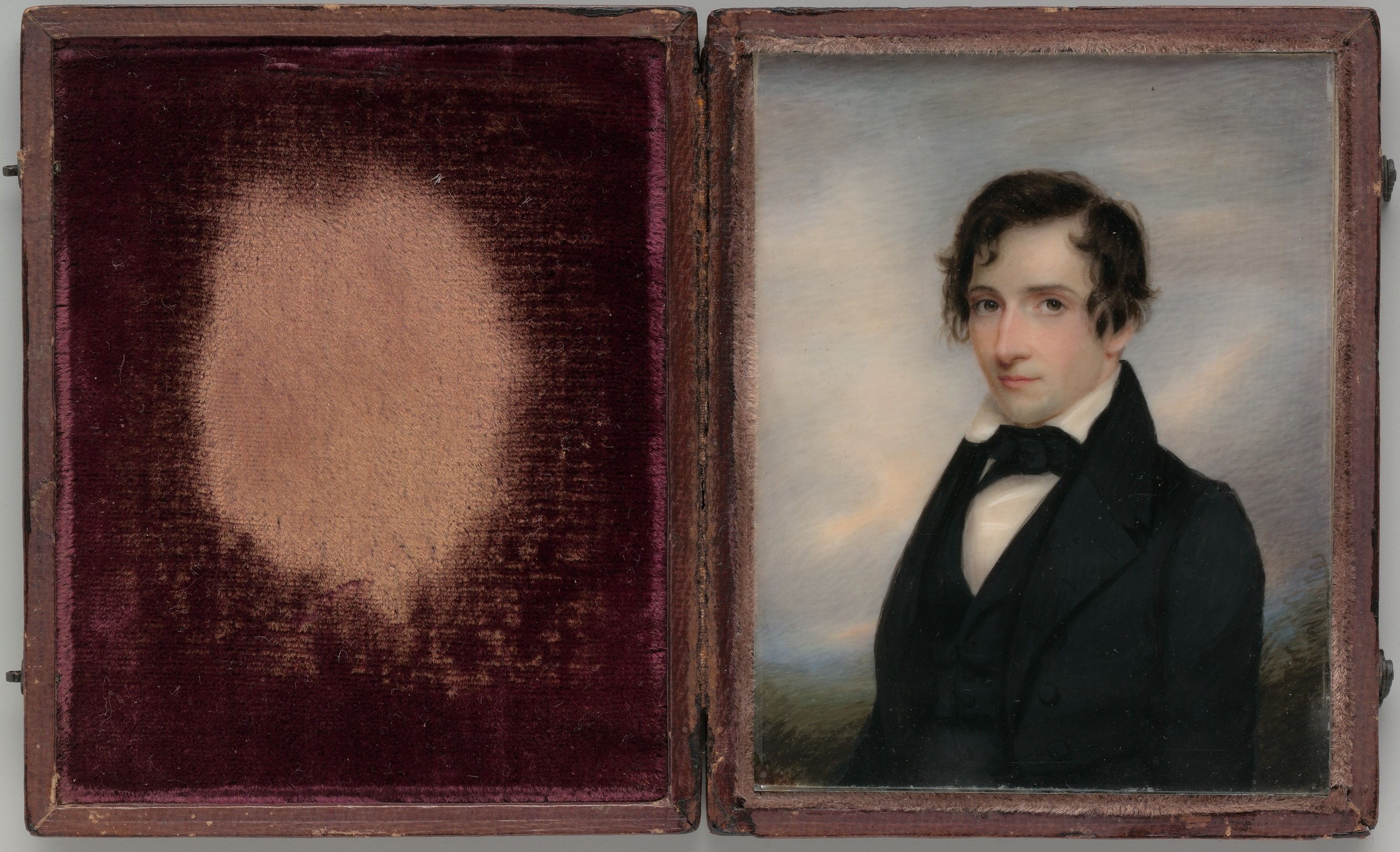
Executive Heritage Assessment: Christopher Grant Perry
This strategic research dossier, prepared for Katherine Fashion Lab’s 2026 haute couture and archival luxury division, examines the watercolor-on-ivory miniature portrait of Christopher Grant Perry (circa 1800–1810). The analysis decodes the object’s symbolic power, historical adornment lexicon, and spiritual resonance, translating these findings into actionable positioning for a high-end luxury strategy. The piece is not merely a visage; it is a codified system of American Federal-era authority, intimacy, and metaphysical protection—assets that Katherine Fashion Lab can leverage for narrative-driven, heritage-infused collections.
Symbolic Power: The Miniature as a Sovereign Object
In the early American Republic, the watercolor-on-ivory miniature was a paradoxical artifact: diminutive in scale yet monumental in social gravity. Christopher Grant Perry, a member of the prominent Perry naval dynasty, would have understood this medium as a tool of soft power projection. Unlike large oil portraits intended for public galleries, the ivory miniature was a private, tactile token—exchanged among family, political allies, and romantic partners. Its power lay in its portability and exclusivity; to possess Perry’s image was to possess a fragment of his personhood, social capital, and martial honor.
For Katherine Fashion Lab’s 2026 strategy, this translates into a “sovereign intimacy” concept. The brand can position limited-edition accessories—lockets, cufflinks, or micro-pendants—as modern-day miniatures. Each piece should be designed to be held, not merely worn, echoing the tactile ritual of the early 19th-century sitter. The symbolic power is not in size but in the curated secrecy of the object. A luxury strategy should emphasize that true power is often concealed, revealed only to a chosen few—a direct counter-narrative to contemporary logo-saturated maximalism.
Historical Adornment: The Grammar of Federalist Dress
Perry’s depiction—likely featuring a dark, high-collared coat, white cravat, and unpowdered natural hair—reflects the Republican simplicity that dominated American male adornment post-Revolution. This was a deliberate rejection of European aristocratic lace and brocade. The cravat, meticulously tied, was the era’s most significant status marker; its pristine whiteness signaled leisure, moral purity, and the ability to maintain cleanliness in a pre-industrial world. The ivory support itself was a luxury import, often sourced from the East Indies, making the substrate as precious as the portrait.
Katherine Fashion Lab can extract a “neo-Federalist” tailoring language for 2026. Look to the structured shoulder, suppressed waist, and high neckline of Perry’s coat as a blueprint for a unisex outerwear capsule. The brand should source biodegradable, bone-like composites or reclaimed natural materials to mimic ivory’s translucency without ethical compromise. The adornment strategy should pivot on restraint as opulence: a single, impeccably crafted white silk cravat-pin, a tailored coat with hidden interior pockets for devotional objects. The historical grammar is clear—adornment is a language of discipline, not display.
Spiritual Meaning: The Ivory as a Talismanic Membrane
Watercolor on ivory carries a profound spiritual dimension often overlooked in modern appraisal. In the early 19th century, ivory was believed to possess apotropaic properties—the ability to ward off evil and decay. The material’s cool, smooth surface was associated with incorruptibility and the eternal soul. When a portrait was painted on ivory, the sitter’s image was effectively enshrined within a sacred membrane, protecting their spirit during long sea voyages—a critical consideration for the Perry family, whose men were naval officers facing mortal peril.
The act of commissioning such a portrait was a spiritual covenant between the sitter and the recipient. It was an amulet of remembrance, a prayer made tangible. For Katherine Fashion Lab, this offers a rich metaphysical layer for 2026. The brand can introduce a “Guardian Relic” line: jewelry and small leather goods embedded with a micro-engraved portrait or a symbolic anchor (the Perry family crest motif) on a smooth, cool stone or recycled metal surface. Marketing copy should move beyond aesthetics to ritualistic function—positioning the item as a protective talisman for the modern professional navigating volatile markets. The spiritual meaning is not religious but existential: a reminder of one’s lineage, duty, and inner fortitude.
Strategic Translation for 2026 High-End Luxury
The Christopher Grant Perry miniature offers three distinct pillars for Katherine Fashion Lab’s 2026 high-end strategy. These are not derivative reproductions but conceptual extractions designed to elevate brand equity.
Pillar One: The “Perry Code” Capsule Collection. Develop a 12-piece collection of outerwear and neckwear using a monochromatic palette of ivory, slate, and midnight blue. The signature piece is a double-faced wool overcoat with an internal, hidden portrait pocket—a direct homage to the miniature’s secretive power. The collection’s campaign should be shot in chiaroscuro lighting, emphasizing shadow and texture, not loud branding.
Pillar Two: The “Sovereign Intimacy” Atelier Service. Offer a bespoke service where clients commission their own watercolor-on-ivory-style miniature, rendered by a contemporary artist on ethically sourced, fossilized ivory alternatives. This service positions Katherine Fashion Lab as a custodian of personal legacy, not just a garment maker. The miniature is then set into a silver or gold locket, designed to be worn close to the heart—reviving the spiritual covenant of the original artifact.
Pillar Three: The “Incorruptible” Material Narrative. Use the ivory’s symbolism of permanence to drive a sustainability narrative. For 2026, Katherine Fashion Lab will launch a line of “heirloom-grade” accessories made from a proprietary bio-resin that mimics ivory’s translucency and weight. The marketing narrative will emphasize that, like Perry’s portrait, these objects are designed to outlive trends and even generations—a counter-strategy to fast-fashion disposability.
Conclusion: The Miniature as a Blueprint for Timeless Authority
Christopher Grant Perry’s watercolor-on-ivory portrait is a masterclass in understated authority. It teaches that true luxury is not volume but precision of meaning; not visibility but selective revelation. For Katherine Fashion Lab’s 2026 strategy, this artifact provides a rigorous framework for creating objects that are simultaneously personal, protective, and powerful. By adopting the symbolic language of the Federal-era miniature—sovereign intimacy, disciplined adornment, and talismanic spirituality—the brand can differentiate itself in a saturated market. The Perry miniature is not a relic of the past; it is a strategic blueprint for the future of heritage-driven luxury, proving that the smallest objects often carry the greatest weight.