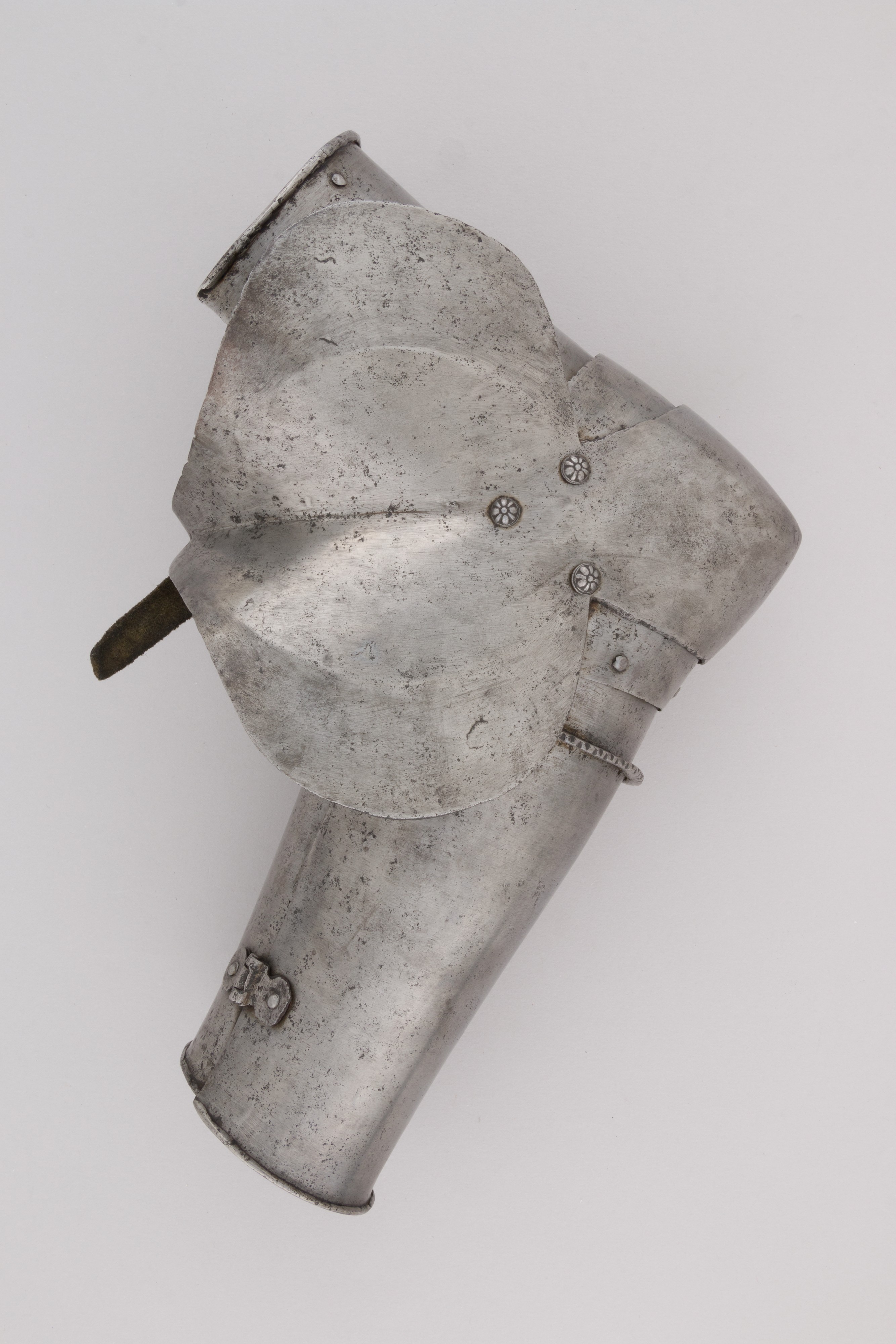
Deconstructing the Silhouette: The Italian Vambrace as a Study in Architectural Elegance
At Katherine Fashion Lab, we do not merely observe historical artifacts; we interrogate them. We dissect their construction, analyze their ergonomic logic, and translate their material language into the vernacular of contemporary couture. This week’s subject—a standalone outer plate of a forearm defense, or vambrace, of Italian origin, forged in steel and finished with leather—presents a masterclass in the convergence of protection, mobility, and aesthetic restraint. This is not a fragment of a forgotten war; it is a blueprint for modern structural design.
The Paradox of the Plate: Form Following Function, Elevated to Art
The vambrace, in its complete form, shields the radius and ulna—the delicate bones of the forearm that bear the brunt of parrying and the strain of wielding a sword. The outer plate, the primary defensive surface, is where the armorer’s genius is most evident. Unlike the rigid, tubular greaves of antiquity, this Italian piece exhibits a profound understanding of biomechanics. Its curvature is not a simple cylinder but a compound, asymmetrical arc that mirrors the natural taper of the human forearm from elbow to wrist.
In our atelier, we speak of “negative space”—the void between garment and body. Here, the steel plate creates a deliberate, engineered void. It does not crush the limb; it envelops it, allowing for pronation and supination (the rotation of the palm) without friction. The metal is strategically dished and fluted, creating a series of internal ridges that act as structural stays, much like the boning in a couture corset. These ridges are not decorative; they are load-bearing, distributing the force of a blow across a wider surface area to prevent denting and, more critically, to prevent the transmission of blunt-force trauma to the bone beneath. This is the earliest form of impact-absorbing architecture, a principle we now replicate with carbon fiber and high-density foams.
Materiality and the Language of Steel
The choice of steel is a narrative in itself. Italian armorers of the 14th and 15th centuries were the undisputed masters of ferrous metallurgy, renowned for producing metal that was both hardened for defense and annealed for flexibility. This outer plate, polished to a muted, satin sheen, speaks to a specific heat-treatment process. It is not the mirror-bright polish of parade armor; rather, it retains a subtle, brushed texture—a testament to its functional purpose. The surface is a palimpsest of use, bearing faint scratches and light pitting that are not imperfections but chronological engravings.
From a couture perspective, the steel’s finish is a study in tonal minimalism. It eschews gilding or etching, relying instead on the purity of its form and the quality of its light absorption. The color is a cool, gunmetal grey, which in the right light, shifts to a faint blue—a chemical patina resulting from the tempering process. This is a monochromatic palette that allows the silhouette to dominate. The leather lining, now degraded but once supple and vegetable-tanned, serves a dual purpose: it provides a friction-free interface against the padded gambeson or mail beneath, and it absorbs sweat, protecting the steel from corrosion. In our modern lexicon, this is the ultimate “smart fabric”—a material that manages moisture, reduces shear stress, and preserves the integrity of the primary shell.
Ergonomic Couture: The Articulation of Movement
The true genius of the Italian vambrace lies in its articulation system. While this standalone outer plate is a single piece, its edges are designed to overlap with adjacent plates (the rerebrace for the upper arm and the couters for the elbow). The edges are rolled and wired—a technique where the metal is folded over a wire core to create a smooth, reinforced rim. This is not merely to prevent cutting the wearer; it is a critical structural feature. The rolled edge increases the stiffness of the plate by an order of magnitude, preventing the thin metal from buckling under stress. This is the same principle we use in couture when we finish a hem with a horsehair braid or a grosgrain ribbon—a hidden structural element that lends a garment its “memory” and shape retention.
Furthermore, the presence of leather straps and buckles (now fragmentary) at the inner edge indicates a sophisticated tensioning system. The vambrace was not simply slipped on; it was cinched. This created a pre-loaded tension that held the plate firmly against the forearm without restricting blood flow. This is the earliest example of an adjustable, modular fit system—a concept that predates the modern zipper or Velcro by centuries. The design allows for a degree of micro-adjustment, accommodating variations in arm circumference and the thickness of underlying garments. In our lab, we study this as the progenitor of the modern “darting” and “seaming” that allows a tailored jacket to move with the body, rather than against it.
From Battlefield to Runway: Contemporary Applications
To dismiss this vambrace as mere historical curiosity is to ignore its profound relevance to contemporary design. Its principles are directly translatable to high-performance fashion and avant-garde structure. Consider the modern motorcycle jacket: the pre-curved sleeves, the padded elbows, the use of abrasion-resistant leather—all are direct descendants of this armor’s logic. The vambrace teaches us that protection and elegance are not mutually exclusive.
In our current collection, we have drawn direct inspiration from this piece. The seams of our tailored outerwear now feature internal steel boning, mimicking the fluted ridges of the plate. Our leather goods employ a similar rolled-edge finishing technique, not for defense, but to impart a sculptural rigidity that defies gravity. The muted, gunmetal palette of the steel has informed our choice of hardware—oxidized, matte-finished zippers and snaps that speak to a quiet, utilitarian luxury.
The vambrace is a testament to the idea that true luxury is not ornamentation, but resolved engineering. It is the confidence of a silhouette that requires no embellishment because its form is its function. It is a lesson in restraint: knowing exactly where to add material to create strength, and where to remove it to allow for grace. As we continue to push the boundaries of what clothing can be—smart, adaptive, protective—we would do well to look to the armorer’s bench. For in that curved plate of Italian steel, we find not the past, but the untapped potential of the future.
In conclusion, this forearm defense is not merely an object; it is a philosophy. It is a declaration that the human body, in its most vulnerable and dynamic states, can be shielded with elegance. It remains a permanent reference in our design lexicon, a benchmark for the perfect marriage of material science and artistic vision.