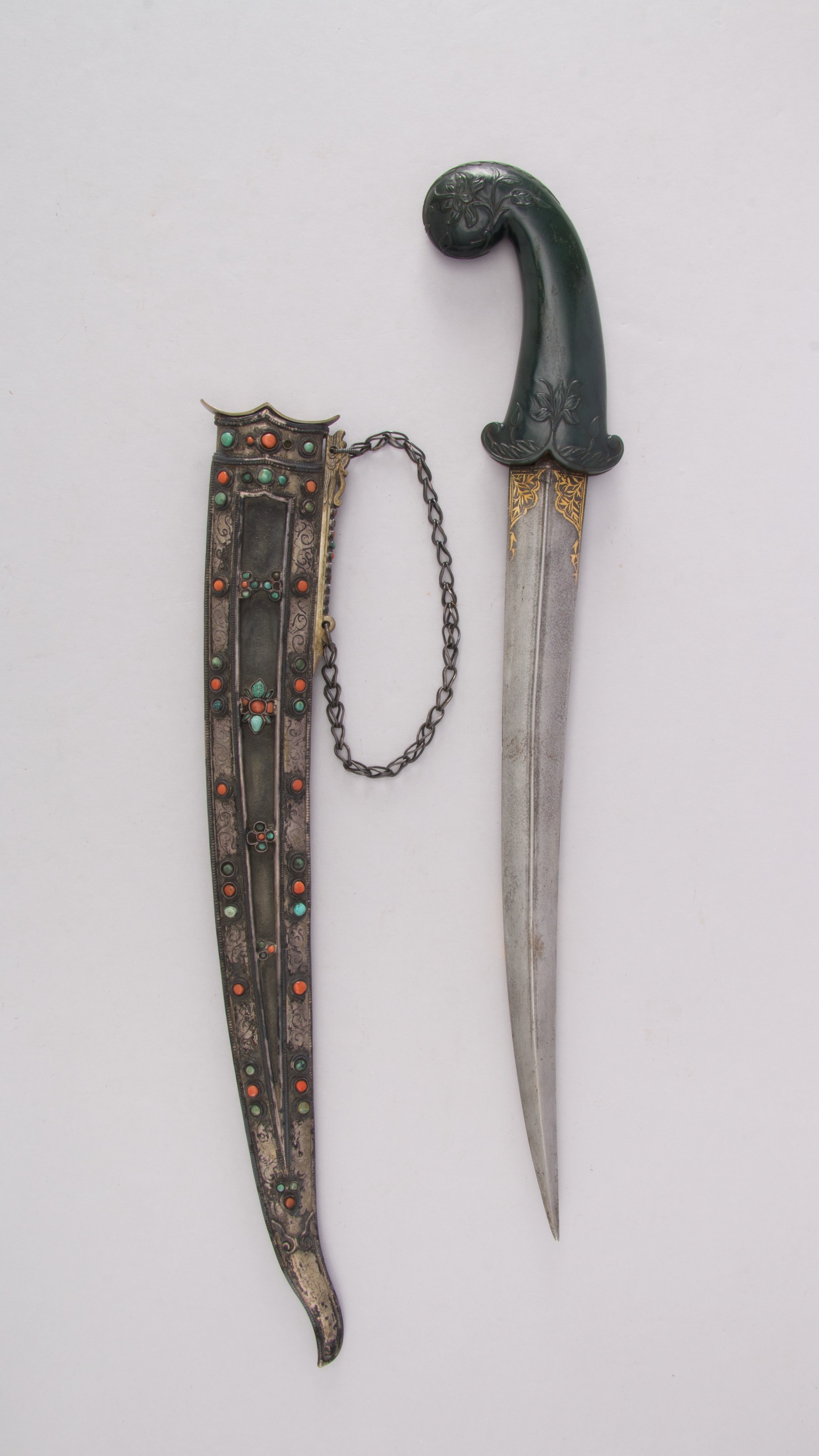
The Dagger as Sovereign Object: A Heritage Analysis for Katherine Fashion Lab
The dagger with sheath, originating from the Mughal court and augmented by Tibetan material culture, is far more than a historical weapon. For Katherine Fashion Lab, this object serves as a strategic artifact—a lens through which we can decode the semiotics of power, the artistry of adornment, and the spiritual architecture of a bygone era. In an age where luxury is increasingly defined by narrative depth and cultural provenance, this dagger offers a masterclass in translating symbolic capital into commercial relevance. This analysis dissects the object’s layered meanings and proposes a 2026 high-end luxury strategy that leverages its heritage without descending into mere pastiche.
I. Symbolic Power: The Dagger as Political Theology
In the Mughal world, the dagger—or katar and jambiya variants—was not a utilitarian tool but a prosthetic extension of imperial will. Its presence at the waist signified rank, martial readiness, and the divine right to enforce order. The steel blade, often watered with damask patterns, was a testament to metallurgical mastery, but its symbolic weight lay in its duality: it could take life, yet its presence deterred conflict. This is the paradox of sovereign power—visible lethality as a guarantor of peace.
The inclusion of jade in the hilt elevates this object from weapon to icon. In Mughal iconography, jade—particularly the pale, nephrite variety—was associated with the farr, or divine glory, a concept borrowed from Persian kingship. The stone’s cool, translucent quality evoked purity and eternity, while its hardness suggested incorruptibility. For a modern luxury house, this translates into a brand principle: true power is not aggressive but poised, not ostentatious but reserved. The dagger’s symbolic power lies in its restraint—a lesson for 2026 collections that prioritize quiet confidence over loud branding.
The Sheath: A Study in Protective Aesthetics
The sheath, possibly Tibetan, introduces a cross-cultural dialogue. Its leather and wood core, overlaid with silver and gold, and embellished with coral and turquoise, is not merely functional. In Tibetan Buddhist practice, these materials are apotropaic—they ward off negative energies and anchor the wearer to protective deities. Turquoise, in particular, is a sky stone, bridging the earthly and the celestial. Coral, conversely, is a sea stone, representing vitality and the life-giving forces of the ocean. Together, they create a microcosm of elemental balance.
Strategically, this fusion of Mughal and Tibetan elements signals a luxury market increasingly hungry for hybridity. The contemporary high-net-worth consumer does not seek monocultural artifacts but objects that tell stories of exchange, trade, and spiritual syncretism. The sheath thus becomes a metaphor for the brand’s ability to curate diverse heritages into a cohesive, elevated narrative.
II. Historical Adornment: The Body as a Canvas of Status
Historical adornment in the Mughal court was governed by a strict grammar of materials. Gold signified the sun and the emperor’s unchallenged sovereignty; silver denoted lunar cycles and administrative authority; jade was reserved for the highest elite, often as a gift from the emperor himself. The dagger, worn at the waist, was a focal point of the silhouette—a deliberate interruption of the flowing robes that drew the eye to the wearer’s center of gravity. This was a statement of embodied power, not merely decorative.
The craftsmanship is telling. The steel blade would have been forged with a specific curvature and balance, tested for perfect weight distribution. The jade hilt, carved with floral motifs or calligraphic inscriptions, required hours of patient abrasion with quartz sand. The silver and gold work on the sheath, likely repoussé or chiseled, demanded a master artisan’s steady hand. This level of bespoke production is the historical antecedent of modern haute couture—where every stitch, every seam, and every clasp is a signature of the maker.
For Katherine Fashion Lab, this suggests a return to artisanal scarcity. The 2026 luxury consumer is fatigued by mass-produced “limited editions” that are anything but. The dagger’s historical value rests on its singularity—each piece was commissioned, not manufactured. A strategic response would be to offer a limited number of objects (e.g., 100 pieces worldwide) that incorporate traditional techniques, even if reimagined in contemporary materials. This is not nostalgia; it is a re-assertion of the value of human time and skill.
III. Spiritual Meaning: The Dagger as a Ritual Mediator
Beyond politics and aesthetics, the dagger held profound spiritual significance. In Sufi traditions, the blade was a metaphor for the nafs—the ego—which must be sharpened and controlled. The act of drawing the dagger was a symbolic severance of attachment to the material world. In Tibetan Vajrayana, the phurba (ritual dagger) is used to pin down negative forces, not to destroy them but to liberate them from their delusion. The presence of such a weapon in a personal collection was thus a daily reminder of one’s spiritual obligations.
The materials reinforce this sacrality. Turquoise is believed to change color with the wearer’s health, acting as a diagnostic tool. Coral is associated with the lifeblood of the earth, a gift from the ocean’s depths. Jade, in Chinese-influenced Tibetan thought, is a stone of the heart chakra, promoting clarity and compassion. The dagger, therefore, is not an object of aggression but a mediator between the wearer and the cosmos—a tool for inner alignment.
This spiritual dimension offers a powerful counter-narrative to the secular materialism of contemporary luxury. In 2026, the high-end market is increasingly drawn to “conscious luxury”—products that facilitate mindfulness, intention, and self-actualization. A brand that can position its offerings as tools for personal sovereignty—not just status—will capture a significant share of the reflective affluent segment.
IV. 2026 High-End Luxury Strategy: From Artifact to Archetype
The dagger with sheath is not a product to be replicated; it is a design archetype to be translated. Below is a strategic framework for Katherine Fashion Lab’s 2026 positioning.
1. The “Sovereign Object” Collection
Launch a capsule collection of unisex accessories—belt buckles, cufflinks, pendant necklaces, and small leather goods—that echo the dagger’s silhouette and material logic. Use blackened steel, pale jade, and oxidized silver. Each piece should carry a laser-engraved serial number and a certificate of provenance, referencing the historical object. The marketing narrative should emphasize “power in reserve,” not overt aggression.
2. The Ritual of Acquisition
Transform the purchase experience into a ceremonial event. Offer private appointments where clients are presented with a dagger replica (non-functional) in a wooden box lined with raw silk. The presentation ritual—unveiling, handling, and reflection—mirrors the historical act of receiving a royal gift. This creates a memory anchor that elevates the transaction to a transformative experience.
3. Cross-Cultural Collaborations
Partner with contemporary Tibetan and Indian artisans to produce a limited run of sheaths for modern tech accessories (e.g., laptop sleeves, tablet covers). This honors the original’s hybridity and provides a living income to traditional craftspeople. The collaboration should be documented in a short film, positioning Katherine Fashion Lab as a cultural steward, not a cultural appropriator.
4. Spiritual Wellness Sub-Line
Develop a sub-brand, “Farr,” named after the divine glory concept. Offer meditation tools—jade worry stones, turquoise prayer beads, and a scented candle with notes of sandalwood and saffron—inspired by the dagger’s materials. Position these as “tools for inner sovereignty,” aligning with the 2026 wellness economy. The packaging should reference the sheath’s protective function, using leather and brass closures.
5. Editorial and Content Strategy
Produce a quarterly digital journal, The Sheath, featuring essays by historians, material scientists, and contemporary designers. Each issue explores a single material (steel, jade, coral) through multiple lenses—metallurgy, geology, and symbolism. This positions the brand as a thought leader, not merely a product purveyor.
Conclusion: The Dagger as a Mirror for Modern Luxury
The Mughal dagger with Tibetan sheath is a condensed universe of meaning—political, aesthetic, and spiritual. For Katherine Fashion Lab, it is not a relic to be displayed but a strategic compass. The object teaches us that luxury is not about excess but about intentionality—every material, every curve, every joint is a decision. In 2026, the high-end consumer will reward brands that offer depth, provenance, and a sense of the sacred. By channeling the dagger’s sovereign energy into modern artifacts, Katherine Fashion Lab can redefine what it means to adorn the body: not to impress, but to empower.