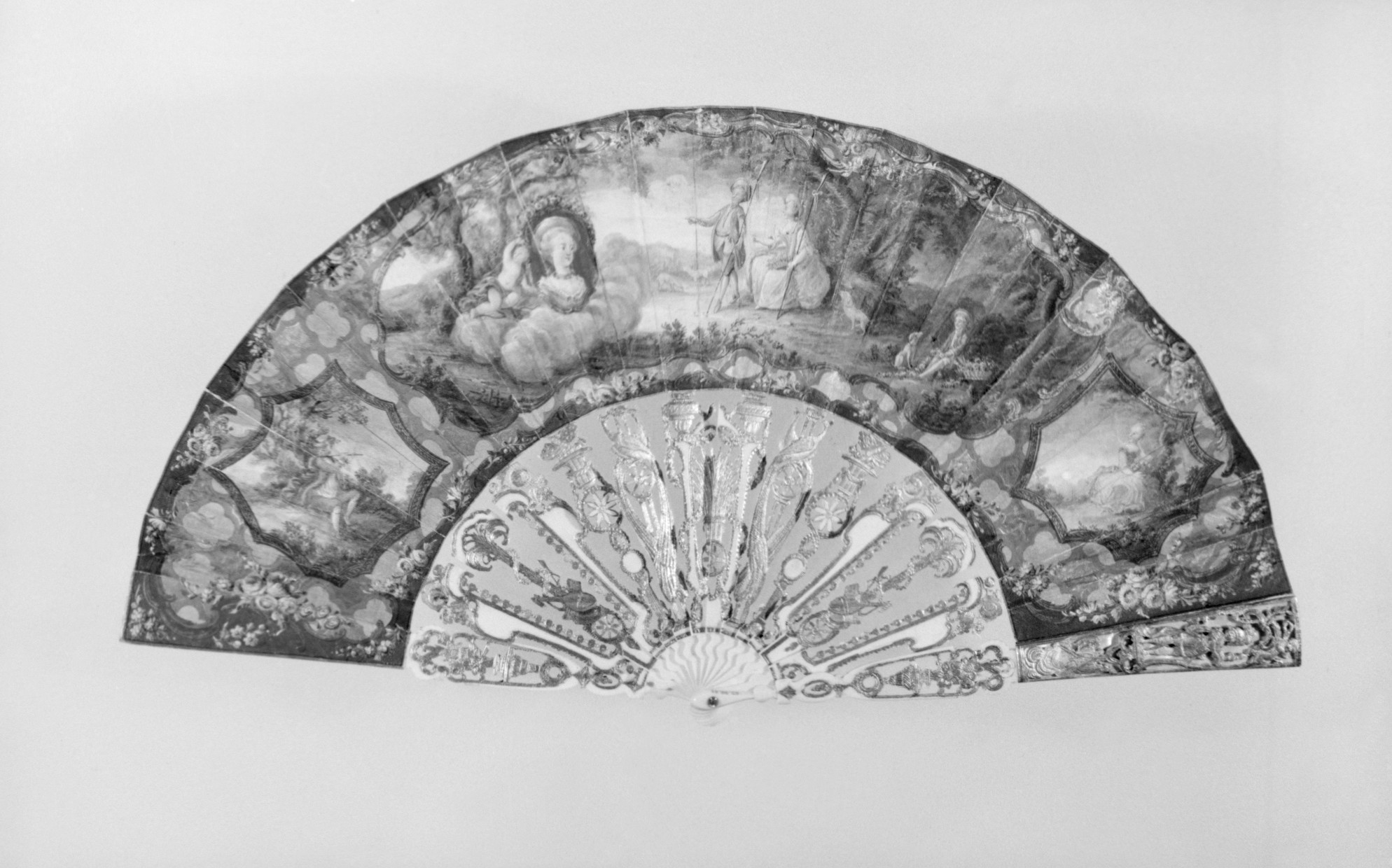
The Fan as Sovereign Artifact: A Heritage Analysis for Katherine Fashion Lab
The fan, in its earliest manifestations across ancient civilizations, was never a mere instrument of comfort. It was a language of power, a choreography of presence, and a portable sanctuary of the divine. For Katherine Fashion Lab, a maison that trades in narrative as much as needlework, the ancient fan offers a profound strategic lexicon for 2026. This analysis transcends the object’s utilitarian origins to decode its symbolic power, historical adornment, and spiritual resonance, concluding with a high-luxury strategy that positions the fan not as an accessory, but as a sovereign artifact.
Symbolic Power: The Geometry of Authority
In ancient Egypt, the fan was the exclusive insignia of pharaonic dominion. The flabellum, or ceremonial fan, was not held by the monarch but by a designated bearer, creating a visual halo that separated the divine ruler from the mortal throng. Crafted from ostrich feathers mounted on ivory or gold, its sweeping arc mirrored the sun’s trajectory—a cosmic claim to solar authority. The fan’s motion was not to cool, but to command the air itself, symbolizing the ruler’s ability to manipulate the elements and, by extension, the fate of nations. This iconography of vertical hierarchy is critical for a luxury house. In 2026, Katherine Fashion Lab can deploy the fan as a structural metaphor—not a folded paper toy, but a rigid, architectural statement that frames the wearer’s face like a cartouche. The strategic implication is clear: the fan must be engineered to create negative space, a deliberate void that draws the eye to the wearer’s profile, echoing the ancient belief that the fan’s primary function was to establish the boundary between the sacred and the profane.
The Ivory and Paper Dialectic
The material dichotomy of ancient fans—ivory for the handle, paper or woven reed for the leaf—is a study in dualism. Ivory, sourced from the tusks of elephants, represented permanence, memory, and the unyielding nature of ancestral law. Paper, in its earliest Chinese form, was a fragile vessel for the transient breath of life. Together, they formed a philosophical object: the immutable holding the ephemeral. For Katherine Fashion Lab, this dialectic offers a material strategy that rejects monolithic luxury. The 2026 collection should juxtapose cold, polished ivory (or its ethically sourced, fossilized equivalent) with delicate, hand-laid washi paper, each fold a deliberate crease in a narrative of time. This is not nostalgia; it is a material philosophy that speaks to the contemporary collector’s desire for objects that contain contradiction—hardness and softness, permanence and fragility, control and release.
Historical Adornment: The Fan as Mobile Jewelry
Beyond its ceremonial role, the fan functioned as an extension of the body’s jewelry system. In ancient Rome, folding fans of parchment and peacock feathers were affixed to belts, their painted surfaces serving as miniature galleries of mythological scenes. In Han Dynasty China, fans were adorned with jade pendants and silk tassels, transforming them into kinetic ornaments that chimed with each gesture. The historical record demonstrates that the fan was not carried; it was worn. Its hinges, rivets, and guard sticks were opportunities for goldsmithing, enamelwork, and gem-setting. This principle of adornment-through-mechanism is a strategic goldmine for Katherine Fashion Lab. The 2026 strategy should treat the fan’s mechanical components as the primary site of high-jewelry intervention. A fan’s pivot pin, traditionally hidden, can be reimagined as a cabochon sapphire. The guard sticks can be carved from obsidian or damascened with silver filigree. By elevating the invisible mechanics to the level of haute joaillerie, the house creates a new category: the functional jewel that demands a second glance to decode its complexity.
Gesture as Adornment
Historical fans also adorned through choreography. The Japanese sensu, used in court dances and tea ceremonies, was not a static object but a performer. Its opening was a deliberate pause, its closure a punctuation mark. In this context, adornment is not what the fan carries, but what the fan does to the body—it elongates the wrist, elevates the elbow, and creates a silhouette of controlled grace. Katherine Fashion Lab’s 2026 strategy must therefore include a bespoke movement language. This is not a marketing gimmick; it is a return to the fan’s original function as a tool for social semaphore. By commissioning choreographers to develop a signature “Katherine gesture”—a specific way of unfolding that reveals the inner leaf’s artwork—the house transforms the fan from a passive object into an active performance, one that can be filmed, shared, and recognized as a house signature in the digital arena.
Spiritual Meaning: The Fan as Conduit
In ancient Mesopotamia and later in Byzantine Christianity, fans were used in liturgical processions to represent the fluttering wings of seraphim. They were not decorative; they were apotropaic, warding off evil spirits with their rhythmic motion. The fan’s breeze was believed to carry prayers upward, making it a physical conduit between the earthly and the celestial. This spiritual dimension is the most potent, yet most delicate, asset for a modern luxury house. In a secular age, the spiritual is often reduced to the aesthetic. However, Katherine Fashion Lab can reclaim the fan’s sacrality by embedding it with intention. For 2026, the strategy should involve a limited series of “ritual fans,” each one blessed or consecrated through a specific creative process—perhaps a hand-painted prayer in gold leaf on the inner leaf, or a single seed embedded in the paper that germinates when the fan is discarded. This approach positions the fan as a talisman for the self-care era, an object that offers not just cooling, but clearing—a mental and emotional filter for the noise of contemporary life.
2026 High-Luxury Strategy: The Fan as Legacy Asset
The strategic recommendation for Katherine Fashion Lab is to position the fan not as a seasonal accessory, but as a legacy asset—comparable to a high-complication watch or a bespoke handbag. The 2026 launch should be structured around three pillars: Provenance, Patronage, and Performance.
Provenance: The Archaeological Narrative
Each fan in the collection should be accompanied by a “heritage dossier” that traces its design lineage to a specific ancient civilization—whether the solar arcs of Egypt, the philosophical folds of China, or the liturgical wings of Byzantium. This is not a historical reprint, but a reinterpretation that uses the ancient as a springboard for radical innovation. The dossier should be embedded with NFC technology, allowing the owner to unlock a digital archive of the fan’s design process, including sketches, material sourcing, and the artisan’s signature. This transforms the fan into a collectible with a verifiable chain of custody, appealing to the investment-minded luxury buyer.
Patronage: The Commission Model
Rather than a mass-produced line, Katherine Fashion Lab should offer a commission-only service, where clients work directly with the house’s atelier to select materials, motifs, and mechanisms. This echoes the ancient patronage system, where a pharaoh or emperor would commission a fan from a master craftsman. The result is a bespoke object that cannot be replicated, with a lead time of six months and a price point that reflects its singularity. This scarcity is not artificial; it is a return to the pre-industrial logic of the object’s origin.
Performance: The Digital Choreography
Finally, the 2026 strategy must integrate the fan into the digital realm without diluting its physicality. The house should launch a cinematic campaign that features the fan in motion—slow-motion openings, macro shots of ivory against paper, and the sound of the leaf rustling. This is an ASMR approach to luxury, appealing to the sensory-seeking consumer. Additionally, a partnership with a major ballet or opera house could stage a performance where dancers use Katherine Fashion Lab fans as extensions of their bodies, creating a live, shareable moment that cements the fan’s status as a cultural artifact, not a mere commodity.
In conclusion, the ancient fan is a masterclass in symbolic economy. It teaches that power is not held but performed, that adornment is not additive but transformative, and that the spiritual is not separate from the material. For Katherine Fashion Lab, the fan is not a nostalgic nod to the past; it is a strategic blueprint for a future where luxury is measured by meaning, not volume. By treating the fan as a sovereign artifact—with its own language, materiality, and ritual—the house can create a 2026 offering that is both timeless and urgently contemporary, an object that commands the air, the eye, and the legacy of its owner.