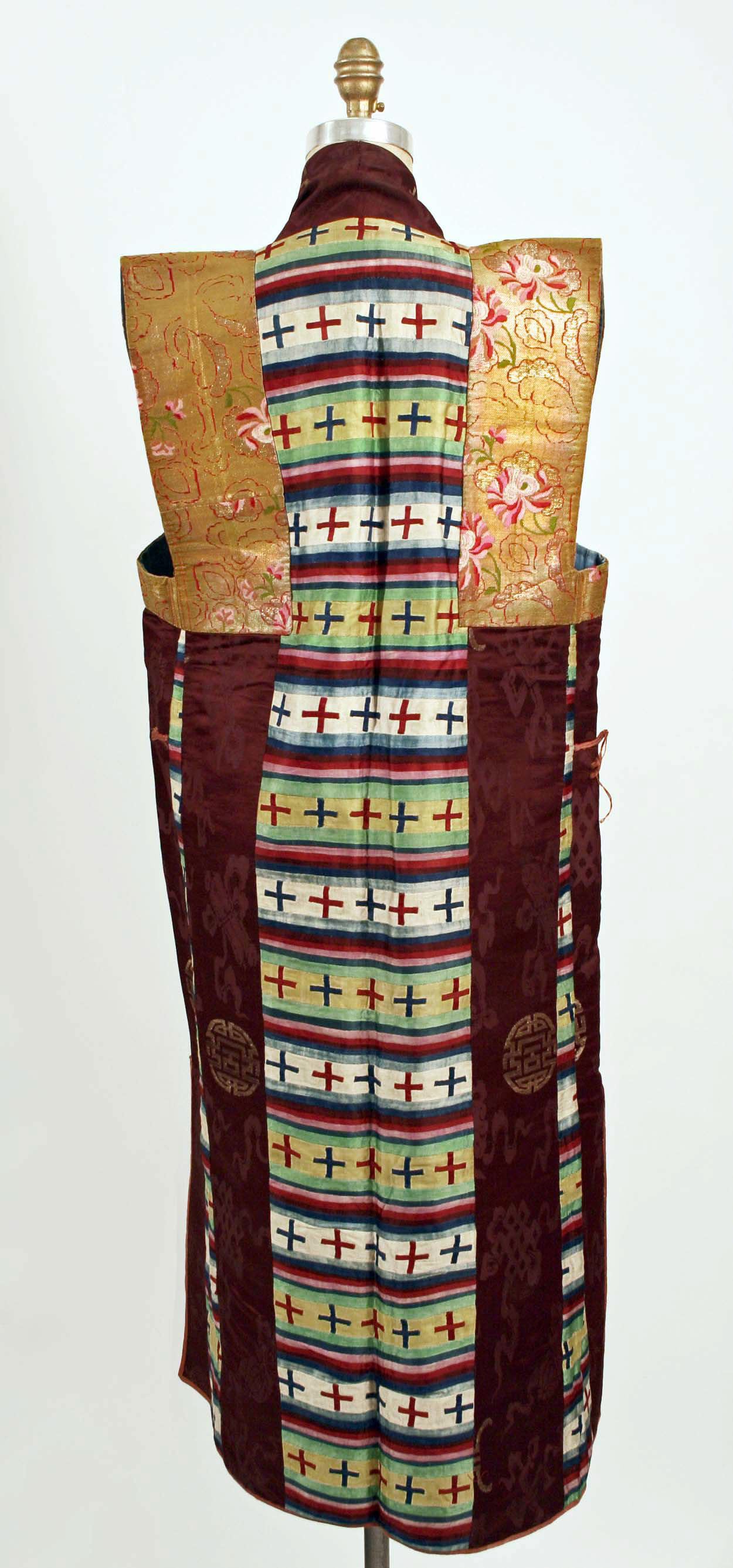
The Imperial Threshold: Deconstructing the Tibetan Wedding Robe at Katherine Fashion Lab
Within the hushed, ivory-toned galleries of Katherine Fashion Lab, the standalone study of a Tibetan wedding robe transcends mere garment analysis. It becomes a meditation on materiality, geography, and the sacralization of a life transition. This is not a piece of ephemeral bridal wear; it is a heirloom-grade artifact, a wearable architecture of blessing, and a testament to the profound sophistication of Himalayan textile traditions. The robe, composed of lustrous silk and punctuated by the rigid opulence of metal, offers a compelling counter-narrative to Western notions of bridal delicacy, instead presenting a vision of marriage as a formidable, protective, and radiant covenant.
Material Dialectics: Silk as Soft Power, Metal as Sacred Armor
The primary dialogue within this garment is the tension between its two foundational materials. The silk, likely a wild or cultivated variety sourced through ancient trade routes from the plains of China or Assam, provides a fluid, luminous base. Its drape is not one of passive softness but of controlled movement, catching light in undulating waves that suggest the shifting landscapes of the Tibetan plateau. The silk’s chromatic depth—often a deep burgundy, saffron, or indigo, depending on regional and familial lineage—serves as a canvas for symbolic intent. In the context of a wedding, this silk is not merely decorative; it is the physical manifestation of prosperity, of the family’s ability to procure a material that was historically more valuable than gold by weight in high-altitude economies.
In stark opposition, the metal elements—typically silver, brass, or even gilded copper—function as structural and spiritual reinforcement. These are not sequins or delicate filigree. Instead, they appear as substantial discs, repoussé-worked medallions, or conch-shell-shaped buttons, often sewn in dense, symmetrical patterns along the lapels, cuffs, and hem. This is where the robe’s true genius lies. The metal acts as a form of apotropaic armor, a physical barrier against malevolent spirits and the "evil eye" that is believed to covet a bride’s happiness. The metallic weight also anchors the garment, preventing the silk from billowing in the harsh plateau winds, thereby grounding the bride physically and spiritually. This is a masterclass in functional symbolism: the metal is simultaneously a status marker, a protective talisman, and a practical counterweight.
Construction and Silhouette: An Architecture of Dignity
Unlike the corseted, hourglass forms of Western bridal couture, this Tibetan robe—often referred to as a chuba in its most formal iteration—is constructed to efface the individual silhouette in favor of a monumental, columnar presence. The cut is voluminous, with wide, hanging sleeves that are often left empty, signifying the bride’s transition from her natal family to her husband’s. The sleeves, when worn, are folded back to reveal a contrasting lining, creating a visual flash of color that is both playful and deliberate. The robe is secured at the waist with a long, woven silk sash, which is then wrapped multiple times. This cinching creates a high-waisted, almost empire-line effect, elongating the torso and emphasizing the garment’s verticality.
The construction details are where the artisanal mastery becomes evident. The seams are not simple straight stitches; they are often reinforced with intricate, hand-rolled piping in a contrasting color, a technique that requires immense patience and precision. The metal buttons are not sewn on with thread alone but are often affixed to a leather or felt backing to prevent them from tearing the delicate silk. This attention to structural integrity suggests a garment designed for centuries of use, for multiple generations of weddings, and for the rigors of ceremonial storage. It is couture in the truest sense—bespoke, hand-finished, and built to outlast its initial wearer.
Symbolic Iconography: Reading the Metalwork
A closer examination of the metal ornaments reveals a complex lexicon of Tibetan Buddhist and Bon iconography. The most prominent motifs are the Eight Auspicious Symbols, or Ashtamangala. You will find the Eternal Knot, a geometric intertwining that represents the interconnectedness of all phenomena and the unending cycle of love and compassion; the Golden Fish, symbolizing happiness and freedom from the constraints of samsara; and the Victory Banner, denoting the triumph of wisdom over ignorance. Each medallion is not randomly placed but is positioned to align with the body’s energy centers, or chakras, creating a protective mandala across the bride’s torso.
Furthermore, the metallic discs often bear embossed images of the Four Dignities—the Garuda, the Dragon, the Snow Lion, and the Tiger. These are not merely decorative; they are the guardians of the four directions. The Dragon (East) brings thunderous power, the Garuda (South) dispels poison and negativity, the Tiger (West) provides courage, and the Snow Lion (North) embodies fearlessness and joy. By wearing these symbols, the bride is not just adorned; she is animated with the qualities of these celestial beings. She is not walking down an aisle; she is entering a sacred arena, fortified by the collective spiritual power of her ancestors and her region.
Contextualizing the Standalone Study: Beyond the Ceremony
In a standalone study, divorced from the cacophony of a wedding procession, the robe invites a deeper meditation on its role as a receptacle of memory. The slight wear on the inner collar, the faint sheen on the silk from countless oil lamps burned in its presence, the patina on the silver—these are not flaws but biographical data. This robe is a palimpsest, inscribed with the hopes of mothers, the blessings of lamas, and the silent tears of brides leaving their childhood homes. It is a portable altar, a piece of home that the bride carries into her new life.
From a curatorial perspective, the robe challenges the contemporary fashion industry’s obsession with novelty and disposability. Its design is not trend-driven but tradition-bound, yet it achieves a timeless modernity through its bold material contrasts and sculptural volume. The use of metal on silk prefigures, by centuries, the avant-garde experiments of designers like Paco Rabanne or Issey Miyake, yet its purpose is infinitely more profound. It is not a shock tactic but a spiritual necessity.
Ultimately, this Tibetan wedding robe is a masterwork of functional transcendence. It is a garment that protects, empowers, and elevates. It speaks to a culture that understands clothing not as superficial adornment but as a critical interface between the self, the community, and the cosmos. At Katherine Fashion Lab, this robe is not merely preserved; it is given a platform to speak, and its voice is one of resounding, elemental power. It is a reminder that true couture is not about the designer’s ego, but about the wearer’s soul, and the enduring, metallic truth of a promise made under an infinite sky.