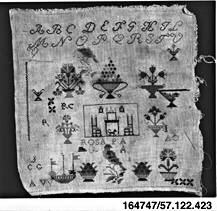
The Sampler: A Cartography of Cultural Memory in Silk and Cotton
In the rarefied echelons of haute couture, where novelty often masquerades as innovation, Katherine Fashion Lab’s “The Sampler” presents a radical counter-narrative. This standalone study, drawn from a vast reservoir of Global Heritage, is not merely a garment or an accessory; it is a meticulously rendered thesis on the politics of ornament, the resilience of handcraft, and the transliteration of folk vernacular into a contemporary luxury lexicon. Executed in silk and cotton on canvas, the piece functions as a cartographic document—a stitched atlas mapping the migratory patterns of technique and symbol across continents.
Deconstructing the Material Dialectic
The choice of substrate and fiber is the first act of intellectual defiance. The cotton canvas base, traditionally relegated to the utilitarian realm of workwear and preparatory sketching, is elevated here to a venerated ground. It is a deliberate rejection of the precious, glossy silks that dominate evening wear. Instead, the canvas provides a matte, tactile topography—a neutral, absorbent field that absorbs both pigment and narrative. Upon this humble ground, the silk is deployed not as a primary surface but as a structural and chromatic agent. Silk threads, varying in gauge from gossamer filament to dense, twisted cord, are couched, satin-stitched, and woven into the canvas. This creates a profound material dialectic: the soft, lustrous, and ephemeral nature of silk is locked in permanent tension with the sturdy, opaque, and grounded cotton. The result is a surface that shimmers with internal light but never glares—a metaphor for the quiet dignity of inherited knowledge.
Iconography as a Global Lexicon
What elevates “The Sampler” beyond mere textile craft is its iconographic program. The composition eschews a central focal point in favor of a democratic, all-over grid, reminiscent of a pedagogical sampler from a 19th-century European schoolroom. Yet, within this familiar framework, the Lab has inserted a dizzying array of cross-cultural motifs. Here, a Mughal-inspired paisley (buta) morphs seamlessly into a Scandinavian eight-petal rose; a Japanese seigaiha wave pattern collides with the geometric rigor of a Kente cloth strip. The stitches themselves are a polyglot: hardanger from Norway, sashiko from Japan, chikan from Lucknow, and broderie anglaise from England.
This is not cultural appropriation but cultural curation. Each motif is rendered with technical accuracy, yet placed in a new syntactic relationship. The viewer is forced to abandon the comfort of a single cultural lens. The eye travels not in a linear fashion but in a series of leaps and pauses, recognizing a familiar shape only to find it executed in an unfamiliar stitch or scaled to an unexpected proportion. This deliberate dislocation creates a powerful intellectual frisson—a reminder that “heritage” is not a static artifact but a living, breathing, and hybridizing force. The Lab’s genius lies in its refusal to authenticate one tradition over another; instead, it presents a pluralistic republic of threads.
The Labor of Precision and the Imperfection of the Hand
In an era of algorithmic production, the physical labor embedded in “The Sampler” is its most potent luxury. The piece demands a forensic examination to fully appreciate its technical bravura. The silk threads are not merely stitched; they are sculpted. In certain quadrants, the silk is padded with cotton wadding beneath the canvas, creating a bas-relief effect that casts delicate shadows across the surface. In others, the silk is drawn through the canvas in a pulled-thread technique, creating openwork lattices that reveal the bare, unadorned cotton beneath—a gesture of vulnerability and structural honesty.
The deliberate inclusion of micro-imperfections is a signature of the Lab’s philosophy. A single stitch that sits slightly off-grid, a thread that catches the light at an irregular angle—these are not errors but evidence of the human hand. They function as a quiet protest against the sterile perfection of machine-made goods. The canvas itself is treated with a subtle, irregular pigment wash, suggesting the patina of age and the passage of time. This is a garment that does not pretend to be new; it pretends to be remembered.
Standalone Study: The Object as an Intellectual Proposition
The contextual framing as a “standalone study” is crucial to its reception. It is not a prototype for a collection, nor a component of a larger look. It exists as a complete, self-referential object—a museological artifact that demands to be read, not worn. This positioning liberates the piece from the constraints of wearability and commercial viability. It allows the Lab to push the boundaries of density and complexity to a degree that would be impractical in a production garment. The viewer is invited to approach it as one would approach a painting or a sculpture: with patience, intellectual curiosity, and a willingness to be transformed by the encounter.
This standalone status also amplifies its commentary on the current state of fashion. By isolating the sampler as a pure object of contemplation, Katherine Fashion Lab critiques the industry’s relentless churn of seasonal trends. “The Sampler” is anti-trend. It exists outside the temporal logic of the fashion calendar, referencing centuries of craft rather than months of social media cycles. It is a slow object for a fast world, a meditative counterpoint to the cacophony of visual noise.
Conclusion: A Wearable Archive
Ultimately, “The Sampler” succeeds as a profound meditation on the meaning of luxury in the 21st century. It argues that true opulence lies not in the cost of raw materials alone, but in the density of meaning that can be embedded within a square foot of cloth. The silk and cotton on canvas are not mere materials; they are the ink and parchment of a global memory. The piece is a wearable archive, a tactile library, and a quiet manifesto. It does not shout for attention; it whispers with the accumulated wisdom of generations of anonymous artisans. In its intricate stitches, we find a universal language of human creativity, one that transcends borders and epochs. Katherine Fashion Lab has not simply created a garment; it has created a reliquary for the collective unconscious of global craft, and in doing so, has redefined the very parameters of what couture can mean. It is a masterpiece of intellectual and material synthesis, a benchmark for a more thoughtful, more connected, and more humane practice of fashion.