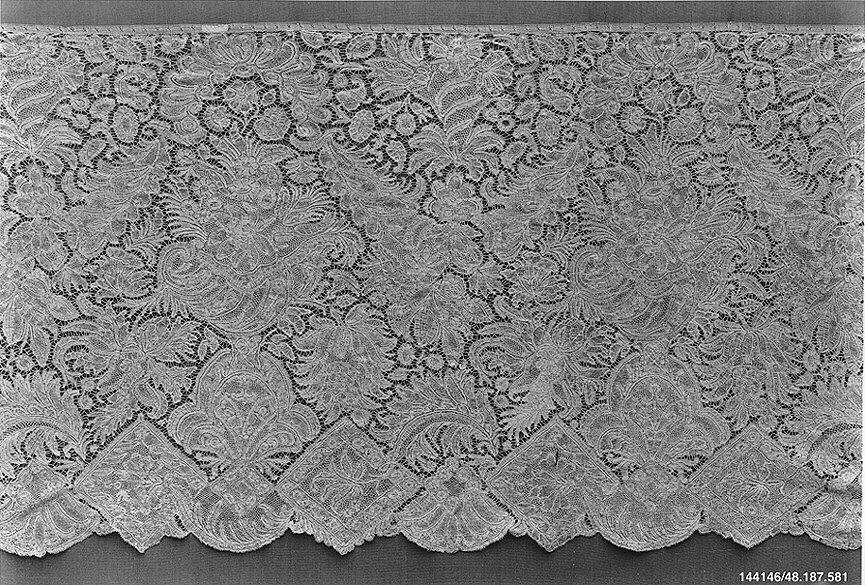
The Flounce in Bobbin Lace: A Heritage Analysis for Katherine Fashion Lab
The flounce, rendered in the demanding medium of bobbin lace, represents one of the most sophisticated dialogues between structural engineering and symbolic expression in the history of adornment. For Katherine Fashion Lab, this is not merely a decorative trim but a repository of ancient power dynamics, spiritual protection, and artisanal mastery. This analysis deconstructs the flounce’s journey from ancient civilization to its strategic positioning within the 2026 high-end luxury market, arguing that its inherent tension—between rigid geometric structure and fluid, cascading motion—offers a unique narrative of controlled chaos that resonates with contemporary desires for authenticity and transcendence.
Symbolic Power and Historical Adornment in Ancient Contexts
To understand the flounce’s power, one must first strip away its modern association with frivolity. In ancient civilizations—particularly within the late Roman Empire and Byzantine courts—the flounce was not an afterthought but a deliberate statement of hierarchical dominance. The precursor to bobbin lace, the clavi and segmenta, were woven or embroidered bands that adorned the tunics of senators and emperors. However, the true flounce—a gathered or pleated strip of fabric, later evolved into openwork—signified a different kind of authority: the ability to command space.
In ancient Mesopotamia and Egypt, pleated and fluted linens were reserved for the priestly class and the pharaoh’s inner circle. The flounce’s vertical fall created a visual rhythm that mimicked the cascading waters of the Nile or the rays of the sun god Ra. This was not accidental. The flounce functioned as a mobile hieroglyph, encoding the wearer’s proximity to divine order. When bobbin lace emerged in the 16th century, it inherited this ancient grammar. The lace flounce, with its intricate toilé (solid ground) and réseau (mesh ground), became a mathematical meditation on the cosmos. Each twist of the bobbin was a prayer; each picot, a protective knot. The flounce thus carried the spiritual weight of an amulet, warding off evil and channeling celestial favor through its repetitive, symmetrical patterns.
The Material Theology of Bobbin Lace
Bobbin lace is unique among textiles because it is constructed, not embroidered. The process involves dozens of wound bobbins, a heavy pillow, and a pattern pricked onto parchment. The artisan works in a state of intense concentration, often for months, to produce a single yard of flounce. This labor is fundamentally sacrificial. The medium itself—fine flax or silk thread—is fragile, yet the finished structure is remarkably durable. This paradox mirrors the ancient understanding of spiritual power: strength born from vulnerability.
For Katherine Fashion Lab, the strategic implication is profound. The bobbin-lace flounce is not a product; it is a relic. In ancient civilizations, relics were not merely displayed but were believed to emanate mana—a supernatural force that transferred to the bearer. A 2026 luxury client is not buying a garment; they are acquiring a conduit of that force. The flounce’s historical role as a marker of the elite—those who could afford the thousands of hours of human labor—must be foregrounded. Unlike machine-made lace, which is repetitive and flat, hand-made bobbin lace possesses an irregular, organic rhythm. This irregularity is the fingerprint of the human soul, a direct line to the artisan’s intent. In a world saturated with AI-generated perfection, this human flaw is the ultimate symbol of authenticity and, therefore, of power.
Spiritual Meaning and the Architecture of Movement
The spiritual dimension of the flounce extends beyond its amuletic origins. In ancient dance and ritual, the flounce was an instrument of kinetic worship. The flamen dancers of Rome wore flounced aprons (limus) that swayed with specific, prescribed movements to honor Mars. The flounce’s movement was not random; it was choreographed to create a visual representation of the wind, the breath of the gods. This kinetic spirituality is the flounce’s most potent asset for modern luxury.
Katherine Fashion Lab should position the 2026 flounce as an architectural garment that performs for the wearer. The bobbin-lace flounce, with its open holes and dense motifs, interacts with light differently than solid fabric. It casts shadows that shift with every step, creating a halo effect. This is not mere decoration; it is a personal aura made physical. The strategic narrative must emphasize that the flounce is a tool for presence. When a woman enters a room wearing a Katherine Fashion Lab bobbin-lace flounce, she is not just wearing a dress—she is activating an ancient ritual of spatial conquest. The lace’s openwork allows the skin to breathe and glimpse through, creating a tension between concealment and revelation, which has historically been the domain of the seductive and the sacred. The flounce becomes a veil, and the veil is always a threshold between the mundane and the divine.
Strategic Positioning for 2026 High-End Luxury
The 2026 luxury market is characterized by a paradox: hyper-accelerated digital consumption and a concurrent craving for slowness and provenance. The bobbin-lace flounce is the ultimate antidote to fast fashion. Its strategic value lies in three pillars: Scarcity, Provenance, and Performativity.
First, scarcity. A single master lacemaker can produce roughly one square inch of fine bobbin lace per hour. A full flounce of 40 inches requires over 1,000 hours of labor. This is not a cost; it is an investment in time. Katherine Fashion Lab should limit production to a maximum of 12 pieces per season, each numbered and accompanied by a certificate of the artisan’s name, hours worked, and the historical pattern’s origin (e.g., a recreation of a Byzantine clavi motif). This transforms the flounce into a collectible, akin to a numbered print or a haute horlogerie timepiece.
Second, provenance. The narrative must connect the flounce to its ancient roots explicitly. The 2026 collection should be titled “Hieroglyph of Motion” or “Ritual Ground”, with each piece referencing a specific civilization—e.g., a flounce inspired by the pleated kilts of Egyptian pharaohs, or the fluted stola of Roman matrons. This is not cultural appropriation but cultural veneration. Katherine Fashion Lab must partner with European ateliers in Bruges or Binche, where bobbin lace techniques are preserved by UNESCO. The marketing collateral should include short films of the lacemakers at work, emphasizing the meditative, almost monastic quality of the craft. This aligns with the luxury consumer’s desire for meaningful consumption—purchasing an object that carries the weight of history and the dignity of human hands.
Third, performativity. The 2026 flounce must be designed for the experience economy. It should not be confined to evening wear. A bobbin-lace flounce can be integrated into a tailored trouser hem, a detachable collar, or a cape’s edge. The key is movement. The flounce must be engineered to catch air, to billow, to create a silhouette that is simultaneously structured and ethereal. In a high-end strategy, this is the “quiet luxury” redefined—not minimalism, but maximalism with a soul. The flounce’s spiritual meaning is its ability to transform the wearer’s gait. It forces a slower, more deliberate pace. This is the posture of royalty, the cadence of the priestess. By wearing the flounce, the client is not following a trend; they are assuming a role in a timeless drama.
Conclusion: The Flounce as a Luxury Imperative
For Katherine Fashion Lab, the bobbin-lace flounce is a strategic asset that transcends seasonal trends. It is a bridge between ancient spiritual technology and contemporary high-end consumption. The flounce’s symbolic power—rooted in divine hierarchy, protective amulets, and kinetic worship—offers a narrative of depth that synthetic fabrics cannot replicate. The historical adornment of the elite is not a relic of the past but a blueprint for the future of luxury. By investing in bobbin lace, Katherine Fashion Lab is not merely producing garments; it is curating a legacy of human excellence.
In 2026, the luxury client will not ask, “Is this fashionable?” They will ask, “Does this hold power?” The flounce, with its thousand hours of human devotion, its ancient grammar of protection, and its ability to sculpt light and shadow, answers affirmatively. It is the ultimate expression of adornment as authority. Katherine Fashion Lab’s strategic move is to claim this authority, to elevate the flounce from a trim to a talisman, and to position the brand as the guardian of a craft that connects the modern elite to the timeless forces of the cosmos. The flounce is not a detail; it is the message.