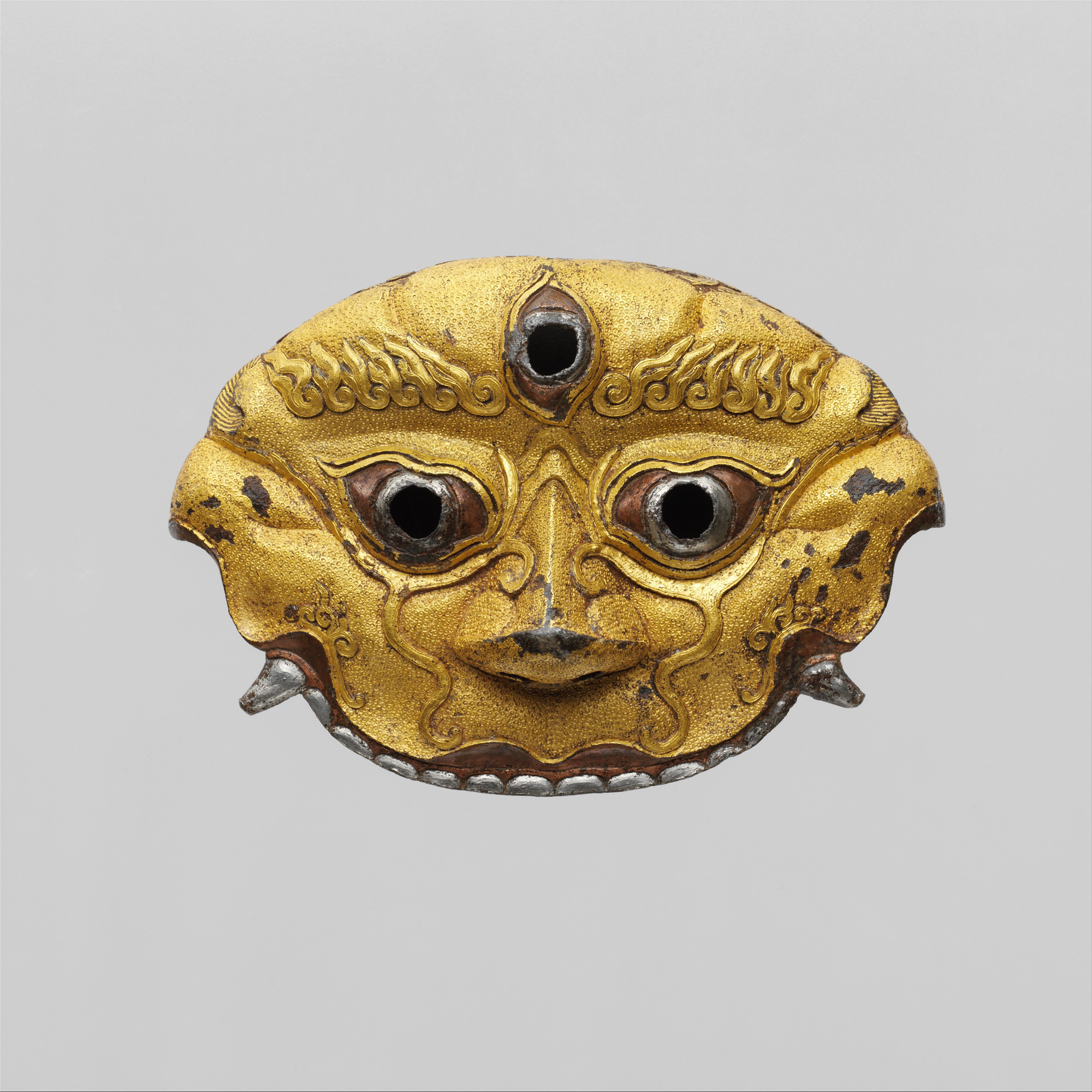
Heritage Analysis: The Sword Guard as a Conduit of Power and Prestige
Within the canon of historical adornment, few objects condense symbolic authority as potently as the sword guard, or tsuba in the Japanese tradition, though the Tibetan and Chinese iterations present a distinct lexicon of power. For Katherine Fashion Lab, the sword guard is not merely a relic of martial history; it is a masterclass in the semiotics of status, a tangible intersection of metallurgy, cosmology, and aristocratic identity. This analysis deconstructs the object’s layered heritage—from its functional genesis to its spiritual resonance—and translates those findings into a strategic blueprint for a 2026 luxury collection that commands authority through material narrative rather than overt branding.
I. Symbolic Power: The Guard as a Microcosm of Dominion
In Tibetan and Chinese contexts, the sword guard (dhog in Tibetan, ge shou in Chinese) was engineered to do far more than protect the wielder’s hand. It was a portable emblem of sovereignty, a declaration of the bearer’s place within a cosmic and social hierarchy. The circular or oval form, often mirroring the mandala in Tibetan Buddhism, signified totality and the cyclical nature of power—life, death, and rebirth. For a Tibetan warrior-monk or a Chinese general, the guard was a compressed universe: the central opening (where the blade passes) represented the axis mundi, the point where terrestrial authority met celestial mandate.
The materials themselves encoded rank. Iron, the base substrate, spoke to the earth’s raw strength and the unyielding nature of martial duty. Yet, it was the overlay of gold, silver, and copper that elevated the object from tool to insignia. Gold, in both cultures, was not mere wealth; it was the metal of the sun, of imperial blood, and of enlightenment. Silver denoted lunar purity and the discerning clarity of a leader’s judgment. Copper, with its warm, blood-like hue, represented vitality and the life force (prana or qi) that the warrior channeled. A guard that combined all three was not decorative—it was a deliberate alchemical statement, suggesting the bearer possessed a tripartite mastery over body, mind, and spirit. For a 2026 luxury strategy, this translates into a rejection of minimalist restraint in favor of layered material opulence, where the value is not in a single precious metal but in the orchestrated tension between them.
II. Historical Adornment: From Functional Necessity to Courtly Artifact
Historically, the evolution of the sword guard mirrors the shift from battlefield pragmatism to courtly connoisseurship. Early Chinese guards from the Han and Tang dynasties were robust, unadorned iron discs, designed for brutal efficacy. However, by the Ming and Qing dynasties, and particularly within Tibetan aristocratic circles, the guard became a canvas for imperial workshops. The surface was no longer smooth; it was chased, chiseled, and inlaid with motifs of dragons, clouds, and the vajra (thunderbolt scepter). The dragon, a ubiquitous emblem in Chinese iconography, signified imperial vigilance and the control of natural forces. The vajra, in Tibetan practice, represented indestructible truth and the unbreakable nature of enlightened power.
This transformation is critical for luxury positioning. The guard’s journey from utilitarian object to collectible art mirrors the modern evolution of high-end accessories from functional goods (watches, handbags) to investment-grade heirlooms. The historical guard was often commissioned as a diplomatic gift or a ceremonial offering, its value exceeding that of the blade itself. This precedent validates a 2026 strategy where the hardware—the clasp, the buckle, the closure—becomes the hero element of a garment or accessory, not a secondary afterthought. Katherine Fashion Lab can position its 2026 line as “wearable regalia,” where each metal component is treated with the same reverence as a museum-grade artifact.
III. Spiritual Meaning: The Guard as a Protective Talisman
Beyond secular power, the sword guard carried profound apotropaic functions. In Tibetan Vajrayana Buddhism, the sword is the attribute of Manjushri, the Bodhisattva of Wisdom, who severs ignorance with a flaming blade. The guard, therefore, was not just a physical barrier but a spiritual threshold. It was believed to deflect not only steel but also negative energies, malevolent spirits, and the “poison arrows” of envy and malice. The intricate inlay work—often featuring the endless knot or the eight auspicious symbols—was not merely decorative; it was a coded prayer, a silent mantra that the wearer carried into every confrontation.
In Chinese Daoist practice, the guard’s circular form echoed the taiji, the supreme ultimate, from which yin and yang emerge. The central aperture was the void (wu), the space of potential from which all action springs. This spiritual dimension offers a profound differentiation for a 2026 luxury narrative. Modern luxury consumers, particularly in the post-pandemic era, are not merely purchasing status; they are purchasing protection and intentionality. A collection inspired by the sword guard can be marketed not as aggressive armor but as a shield for the self—a talismanic object that guards one’s mental clarity, personal brand, and emotional equilibrium in a volatile world. The design language should whisper of ritual, not warfare.
IV. 2026 High-End Luxury Strategy: Translating Heritage into Demand
To leverage this heritage effectively, Katherine Fashion Lab must avoid literal reproduction. The 2026 strategy should embrace a concept we term “Metallic Sovereignty.” This is not a historical costume line; it is a philosophical and aesthetic translation. The strategy rests on three pillars:
1. Material Alchemy as Signature
The use of iron, gold, silver, and copper should be re-engineered for modern wearability. Instead of a heavy steel disc, imagine a sculptural leather corset with a central oxidized iron clasp, inlaid with a geometric pattern of 24-karat gold and fine silver wire. The copper can be used as a subtle underlay, visible only in the patina of the edges, evoking the sense of age and authenticity. This is not about gilding; it is about compositional tension. The luxury client of 2026 is a collector of materials, and the story of the four metals—earth, sun, moon, and blood—provides a rich, tactile narrative that synthetic materials cannot replicate.
2. The “Talismanic” Marketing Narrative
The campaign should pivot away from aggressive power dressing. Instead, the messaging should frame the collection as “Ancestral Armor for the Modern Psyche.” Each piece will be presented with a “guardian” story—a reference to the specific protective motif used (dragon, vajra, or endless knot). This transforms a purchase from a transaction into an initiation. The unboxing experience should mimic the unveiling of a relic, using heavy, textured paper, dark lacquered boxes, and a certificate detailing the symbolic meaning of the metal composition. This approach commands a premium not based on scarcity alone, but on semantic depth.
3. Limited-Edition “Guardian” Series
To capture the historical exclusivity of commissioned guards, the 2026 line should feature a “Sovereign’s Commission” program. Only 100 pieces globally will be produced, each with a unique serial number and a micro-engraving of the buyer’s astrological or spiritual sign, echoing the personalization of historical armor. The price point should be positioned at the apex of the market, competing with haute joaillerie rather than ready-to-wear. This scarcity is justified by the hand-finishing process, which should take a minimum of 40 hours per piece, replicating the slow, meditative labor of the original artisans.
Conclusion: From Artifact to Archetype
The Tibetan and Chinese sword guard is a profound study in how humanity encodes power into matter. It teaches us that true luxury is not the absence of function, but the transcendence of it. For Katherine Fashion Lab, this heritage is not a nostalgic reference but a strategic imperative. By adopting the guard’s principles—material hierarchy, symbolic density, and spiritual protection—the 2026 collection can offer a form of power that is both ancient and urgently contemporary. In a market saturated with ephemeral trends, the sword guard provides a foundation of permanence, transforming a fashion house into a purveyor of portable heirlooms designed to outlast the season and the self.