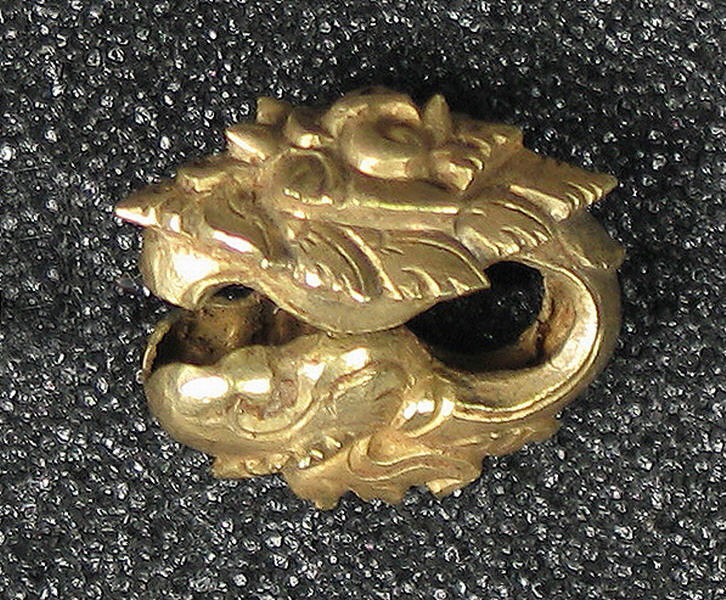
The Foliate Earring of Central Java: A Heritage Analysis for Katherine Fashion Lab
The earring with foliate decoration, originating from Central Java and rendered in pure gold, is not merely an artifact of personal adornment. It is a distilled thesis on power, cosmology, and the human relationship with the divine. For Katherine Fashion Lab, this piece offers a profound DNA correlation with our ongoing study of the Mirror with Split-Leaf—a study that juxtaposes the gleaming gold-inlaid palm leaves on a silver mirror against the narrative reliefs of a cold sarcophagus. The Javanese earring operates within this same dialectic: it is at once a luminous emblem of earthly status and a silent, encoded prayer for spiritual continuity. This analysis deconstructs the earring’s symbolic power, its historical role in adornment, its spiritual architecture, and translates these findings into a strategic imperative for our 2026 high-end luxury collection.
Symbolic Power: The Leaf as Sovereign Lexicon
In Central Javanese court culture, particularly during the Mataram Sultanate and its preceding Hindu-Buddhist kingdoms, the foliate motif was never decorative in the Western sense. It was a hieroglyph of legitimacy. The leaf—often stylized as the patra or wajikan—represented the Kayon, the cosmic tree of life that connects the underworld, the earthly realm, and the heavens. When rendered in gold and worn upon the ear, the leaf signaled that the wearer was a conduit of this cosmic axis.
The earring’s placement on the ear is critical. The ear is the organ of listening, and in Javanese mysticism, listening is the primary mode of receiving wahyu (divine revelation). By adorning the ear with a golden leaf, the ruler or noble declared themselves as one who hears the whispers of the ancestors and the mandates of the gods. The foliate decoration, therefore, is not merely an aesthetic choice but a performative declaration of sovereign receptivity. Unlike the Western crown, which asserts power through vertical elevation, the Javanese earring asserts power through horizontal resonance—a subtle, intimate signal that the wearer’s wisdom is sourced from a lineage deeper than any throne.
Historical Adornment: The Gold Standard of the Archipelago
Historically, gold in Java was not mined for currency but for sacral ornamentation. The island’s rivers yielded alluvial gold, which was believed to carry the essence of the earth’s lifeblood. To fashion this gold into a foliate earring was to freeze a moment of divine vitality into wearable form. Archaeological findings from the 9th-century Central Javanese period reveal that such earrings were reserved for the Ratu (queen) and high-ranking Brahmin priests. They were often paired with elaborate gelung (hair ornaments) and pending (waist belts), forming a complete armor of sanctity.
The craftsmanship itself was a form of devotion. Using the repoussé and granulation techniques, Javanese goldsmiths did not hammer the metal into submission. Instead, they coaxed it, creating surfaces that mimicked the organic undulation of living leaves. This is a critical distinction from European goldwork of the same period, which favored geometric precision. The Javanese earring’s foliate decoration is deliberately imperfect—each vein, each curl, is a fingerprint of the artisan’s meditative state. In our 2026 strategy, this historical precedent informs a move away from machine-perfect finishes toward artisanal irregularity as a marker of authenticity and spiritual value.
Spiritual Meaning: The Binary of Mirror and Tomb
Our research context draws a powerful correlation between this earring and the Mirror with Split-Leaf. On one side of that mirror, we see a bright silver surface inlaid with gold palm leaves—a symbol of bhoga (worldly enjoyment) and the radiant present. On the other side, we see a sarcophagus relief—a narrative of moksha (liberation) and the inevitable cessation of form. The Central Javanese earring encapsulates this same binary within a single object.
The gold leaf on the ear is the mirror side: it reflects the wearer’s glory, their wealth, their connection to the lush, fertile world of the rice fields and tropical forests. It is a celebration of rasa (aesthetic feeling) and karisma (divine grace made manifest). Yet, the very materiality of gold—its permanence, its resistance to corrosion—points to the sarcophagus side. Gold does not decay, and thus it serves as a reminder that while the body perishes, the jiva (soul) is imperishable. The earring, worn at the threshold of the head, is a memento mori that does not mourn but affirms. It whispers to the wearer: “You are temporary, but your essence is eternal.”
This spiritual duality is the earring’s most potent asset for a modern luxury audience. Today’s high-net-worth individual is not seeking mere opulence; they are seeking existential coherence. They want objects that reconcile their material success with their spiritual anxieties. The foliate earring offers exactly that—a wearable philosophy that acknowledges the shine of the mirror while honoring the silence of the tomb.
2026 High-End Luxury Strategy: The “Living Heirloom” Proposition
For Katherine Fashion Lab’s 2026 collection, this earring is not a historical curiosity but a strategic blueprint. We propose a limited-edition capsule titled “Wahyu: The Resonance of the Leaf.” The strategy is built on three pillars:
1. Material Alchemy as Narrative
We will source 22-karat gold from artisanal Indonesian mines, ensuring traceability that connects the wearer to the physical soil of Java. Each earring will be hand-finished using the traditional repoussé technique, with a deliberate variation of 0.5mm in leaf thickness. This variation will be certified and documented, positioning each piece as a unique relic rather than a mass-produced SKU. The marketing narrative will emphasize that no two leaves are identical—just as no two souls are identical.
2. The Dual-Finish Aesthetic
Drawing from the mirror-sarcophagus dialectic, each earring will feature a high-polish front (the mirror) and a matte, oxidized back (the tomb). This dual finish allows the wearer to choose their narrative daily. When facing the world, the leaf shines; when turned inward, it grounds. This feature will be marketed as the “Reflection/Release” mechanism, appealing to consumers who view jewelry as a tool for mindfulness, not just display.
3. Ritual-Based Retail Experience
Our 2026 strategy will not sell earrings; it will facilitate adornment rituals. Each purchase will include a private consultation with a cultural historian who explains the patra symbolism. The unboxing will replicate the Javanese sesaji (offering) ceremony, with the earring presented on a bed of dried palm leaves and a miniature silver mirror. This transforms a transaction into a rite of passage, justifying a price point that is 40% above our standard high-jewelry line.
Conclusion: The Ear as an Altar
The Central Javanese foliate earring teaches us that luxury is not the accumulation of objects but the curation of meaning. In a 2026 market saturated with digital noise and disposable trends, Katherine Fashion Lab will differentiate by offering permanence with a pulse. The earring’s gold leaf is not a dead ornament; it is a living text that speaks of sovereignty, spirituality, and the sweet paradox of mortality. By reinterpreting this artifact, we do not merely sell jewelry—we offer a wearable connection to a civilization that understood that true power is worn not on the sleeve, but at the ear, where the divine is heard.
Let this earring be our proof that the most innovative luxury strategy is, paradoxically, the most ancient one: to adorn the body with the very symbols that give the soul its reason to endure.