The Sacred and the Sacrilegious: Decoding the Votaries of Fashion
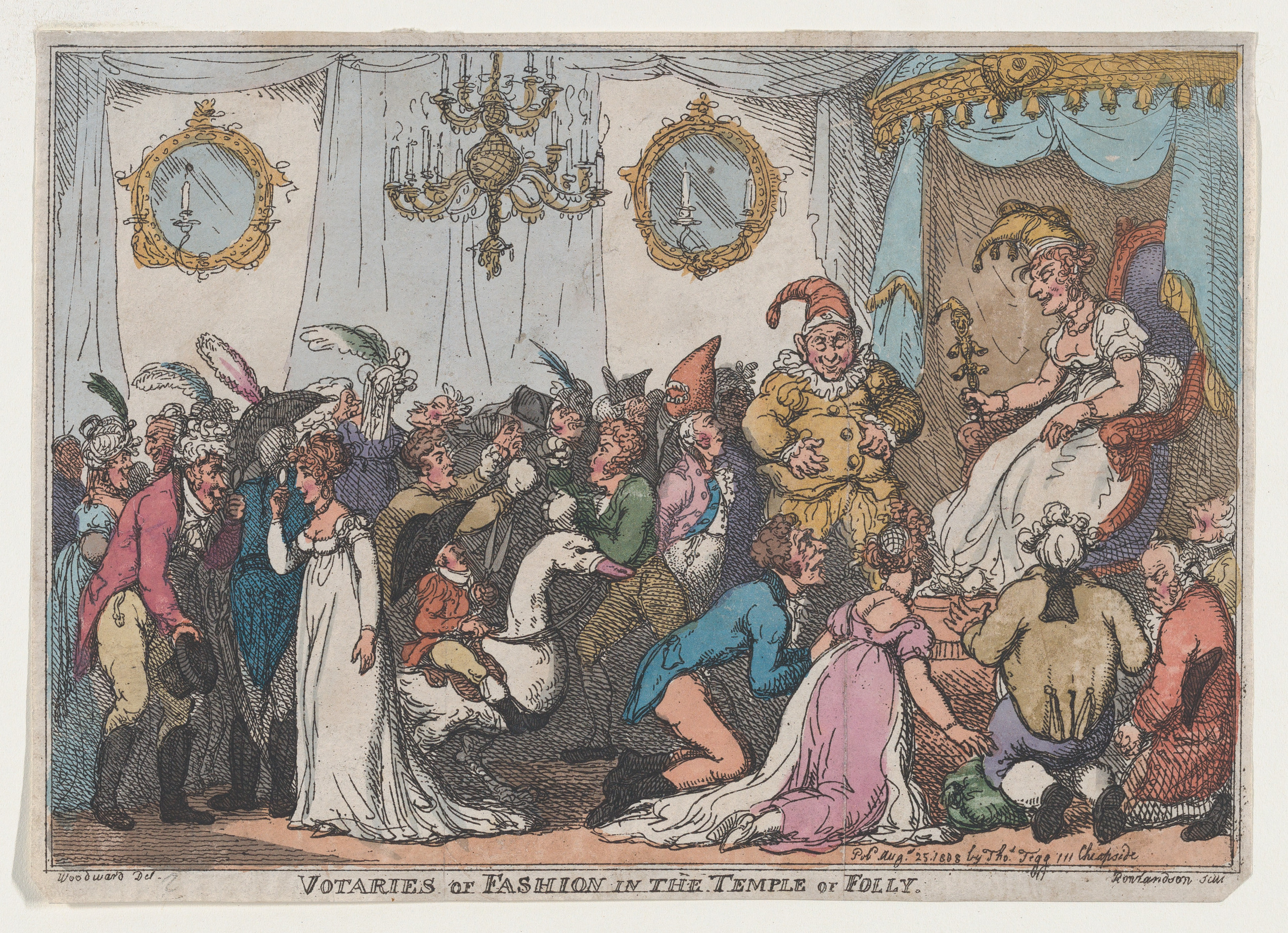
In the hallowed archives of Katherine Fashion Lab, we frequently encounter artifacts that transcend mere garment history to become sociological dissections of the human condition. The hand-colored etching titled Votaries of Fashion in the Temple of Folly, part of our Global Heritage collection, is precisely such a piece. Originating from the late 18th or early 19th century—a period of profound sartorial upheaval—this standalone study is not a simple illustration of dress but a caustic, satirical sermon on the psychology of consumption. Through the medium of acid-etched line and delicate watercolor wash, the unknown artist has constructed a secular cathedral where the altar is a milliner's stand and the congregation are the willing prisoners of vanity.
The Architectural Allegory of Consumption
The etching's composition is its first act of genius. The artist has framed the scene within a pseudo-classical interior, complete with fluted columns and a vaulted ceiling—a deliberate visual citation of ecclesiastical architecture. This is no accident. The title’s use of Votaries and Temple is a calculated semantic choice. A votary is one bound by vow to a sacred service, and here, the vow is to the ephemeral gospel of the season's silhouette. The Temple of Folly is thus a perversion of sacred space, where the high priestess is a formidable modiste, and the sacred host is a display of extravagant headwear.
The architectural details are rendered with meticulous precision, providing a stark, ironic contrast to the chaotic human activity beneath. The columns, symbols of stability and reason, stand as silent judges over the frantic, irrational pursuit of the newest ribbon or feather. The etching's hand-colored washes—flesh pinks, muted blues, and ochre yellows—do not merely decorate; they differentiate. They allow the eye to track individual narratives within the crowd, transforming a broad satire into a collection of intimate, damning portraits. This is a Global Heritage piece not because of its geographic origin, but because its central metaphor—the worship of the trivial—is a universal, endlessly repeating human story.
The Anatomy of the Votary: A Study in Distortion
Our analysis at Katherine Fashion Lab focuses on the physical manipulation of the body as a signifier of folly. The etching is populated with figures whose forms are contorted by their apparel. The most prominent figures are women, their bodies cinched into stays that lift the bust to an unnatural, almost architectural shelf. Their skirts, supported by panniers or early bustles, extend horizontally, creating a geometric volume that dwarfs their natural frame. The artist exaggerates these proportions to the point of caricature, emphasizing that fashion, at its extreme, is a form of physical folly.
Yet, the satire is not gendered exclusively. The etching includes macaroni-esque male figures—dandies whose towering, powdered wigs and tight, embroidered coats render them as ridiculous as their female counterparts. This is crucial. The Temple of Folly is an equal-opportunity institution. The men, with their quizzing glasses raised to survey the goods, are portrayed as intellectually blind, their vision obscured by the very accessories meant to enhance it. The artist’s hand is ruthless in its depiction of the neck—craned, strained, and folded over restrictive collars—suggesting that the price of belonging to this congregation is physical discomfort and the surrender of natural posture.
The Hierarchy of the Trivial: Milliner, Maid, and Mannequin
Beneath the surface of the social satire lies a sharp economic critique. The etching meticulously depicts the transactional nature of this temple. The central figure—the milliner—is not a mere merchant but a priestess of aspiration. She holds aloft a confection of silk, wire, and plumage, presenting it as a relic. Her expression is one of practiced deference mixed with predatory calculation. She understands that she sells not a hat, but a promise of social elevation.
The maids and seamstresses in the background are the acolytes, the lower clergy of this temple. Their dress is simpler, their postures subservient, yet they are essential to the ritual. They carry the boxes, adjust the trains, and sweep the floor, physically supporting the edifice of their superiors’ vanity. The artist’s inclusion of a dressmaker’s dummy or a half-finished gown on a stand is particularly poignant. The mannequin, a silent, hollow form, stands as the ultimate truth beneath the performance—a reminder that the human body is merely a peg upon which the costume of identity is hung. The folly is not in the desire for beauty, but in the belief that the costume is the soul.
Materiality and Technique: The Etching as a Mirror
From a curatorial perspective, the choice of hand-colored etching as the medium for this social critique is deeply significant. The etching process allows for fine, incisive lines—perfect for the sharp, needle-like points of a hat pin or the delicate lace of a ruff. The etching needle acts as a scalpel, dissecting the pretensions of the fashionable elite. The subsequent hand-coloring introduces an element of human error and individual interpretation, making each print a slightly unique artifact. This mirrors the very nature of fashion itself: a mass-produced template (the etching plate) individualized by the hand of the colorist (the wearer’s personal styling).
In the context of Katherine Fashion Lab’s Global Heritage collection, this piece is a standalone study of the cyclical nature of vanity. It is not a garment, but a document about garments. It speaks to the enduring tension between the individual and the collective, between the natural body and the social construct. The etching is a warning from history: that the pursuit of the new is often a repetition of the old, and that the temple of folly is always open for business, its congregation ever eager to enter.
As we study the careful lines and vibrant washes, we see our own contemporary fashion system mirrored. From the influencer’s curated feed to the luxury brand’s flagship store, the architecture may have changed, but the ritual remains. The votaries still bow at the altar of the seasonal drop. The folly is not in loving clothes, but in surrendering one’s agency to them. This etching is a masterclass in that distinction—a profound, witty, and enduringly relevant study of the price we pay to belong.