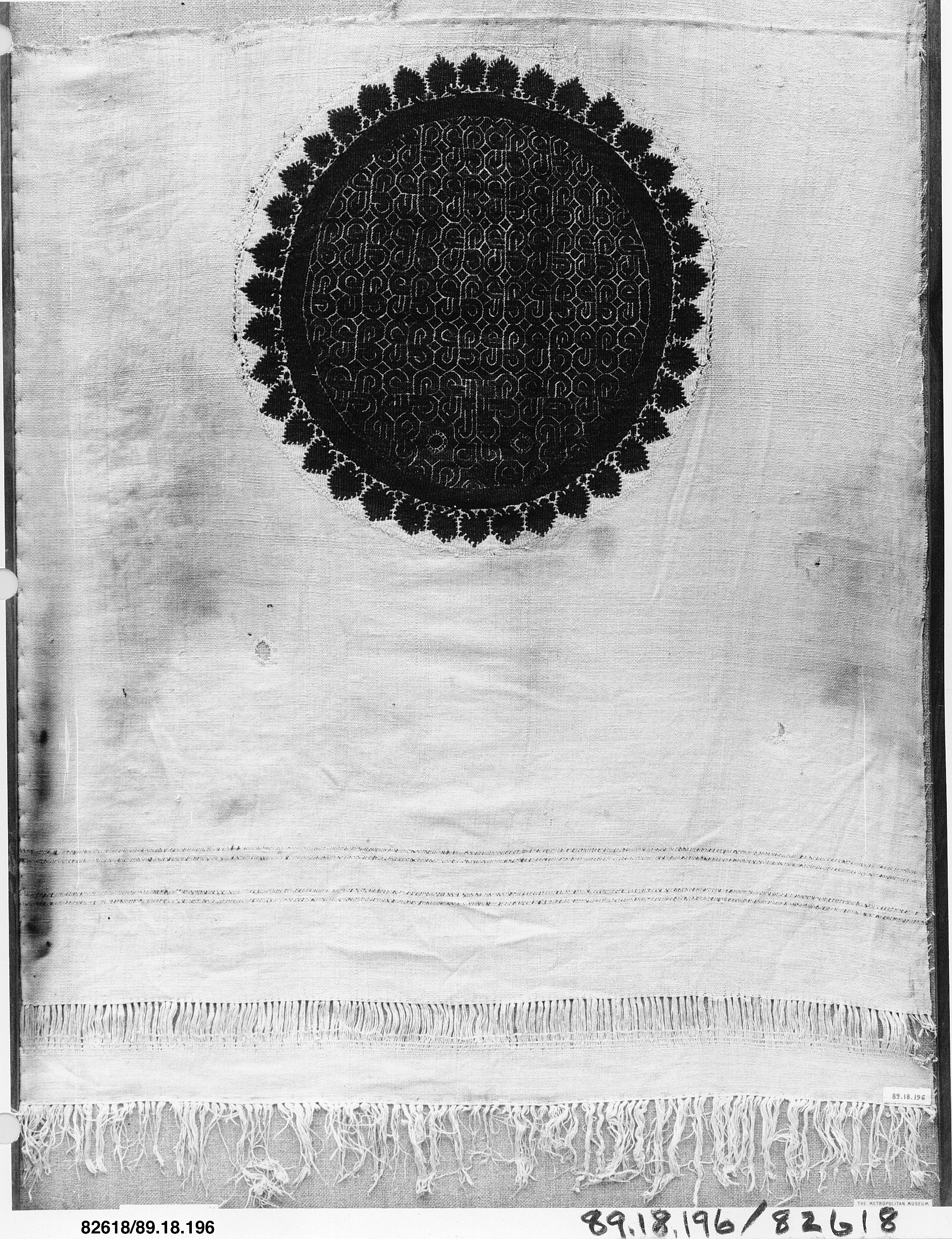
Executive Heritage Analysis: The Interlace Medallion Fragment
This analysis presents a strategic investigation into the cultural and commercial value embedded within the textile fragment featuring an interlace medallion bordered by vine leaves. Executed in wool and linen through plain and tapestry weaves, this artifact from an ancient civilization offers a profound narrative that transcends its material composition. For Katherine Fashion Lab, this fragment is not merely a historical object; it is a blueprint for a 2026 high-end luxury strategy rooted in authenticity, symbolic depth, and artisanal mastery. The following research delineates the fragment’s symbolic power, its role in historical adornment, its spiritual significance, and the actionable pathways for integrating these insights into a modern luxury brand architecture.
Symbolic Power and Visual Lexicon
The interlace medallion is a masterclass in geometric and organic synthesis. In the context of ancient civilizations, the interlace pattern—comprising continuous, looping bands—held a universal connotation of eternity, interconnectedness, and the cyclical nature of existence. Unlike a static emblem, the interlace suggests perpetual motion, a visual metaphor for the unbroken thread of life, lineage, or divine order. The medallion’s central placement within the fragment serves as a focal point, a microcosm of cosmic order imposed upon a textile surface. This is not decorative whimsy; it is a deliberate encoding of power.
The border of vine leaves, rendered in contrasting wool and linen, introduces a secondary layer of symbolism. The vine, historically associated with fertility, abundance, and seasonal rebirth, anchors the abstract interlace to the tangible world. In ancient economies, vine cultivation was a marker of settled agricultural wealth and, in certain cultures, a sacred attribute of deities linked to transformation and ecstatic experience. The juxtaposition of the geometric (interlace) with the organic (vine) creates a dialectical tension: order versus growth, permanence versus renewal. For a modern luxury house, this dialectic translates into a brand narrative that balances heritage with innovation, structure with fluidity—a potent positioning for the discerning consumer of 2026.
Historical Adornment and Material Agency
The choice of wool and linen is itself a statement of hierarchical value. Linen, derived from flax, required intensive labor for retting, spinning, and weaving, making it a fiber of prestige. Wool, while more common, offered a superior ground for tapestry weave, allowing for intricate color shifts and textural depth. The combination of both in a plain weave base with tapestry-woven motifs indicates a high-status object, likely produced in a specialized workshop or for an elite patron. This fragment was not a utilitarian cloth; it was an adornment designed to demarcate social standing, possibly used as a tunic panel, a mantle border, or a ceremonial hanging.
In historical adornment, textiles functioned as a second skin of identity. The interlace medallion, positioned over the chest or back, would have acted as a visual declaration of the wearer’s connection to a specific cosmological or political system. The tactile quality of the weave—the slight irregularities of hand-spun yarn, the density of the tapestry—imparted a sensory authority that machine-made fabrics cannot replicate. This haptic dimension is crucial for Katherine Fashion Lab’s strategy. The modern luxury consumer is increasingly fatigued by mass-produced sameness; they crave objects that carry the "hand of the maker." The fragment’s material agency—its ability to communicate status through touch and sight—offers a template for product development that prioritizes artisanal integrity over industrial efficiency.
Spiritual Meaning and Ritual Context
Beyond its social function, the fragment likely possessed profound spiritual significance. The interlace medallion, in many ancient belief systems, was a protective symbol—a woven amulet meant to ward off malevolent forces or to ensure safe passage in the afterlife. The circular form, unbroken and self-referential, is a universal sign of the divine sphere, the sun, or the soul’s journey. The vine leaves, particularly in cultures with Dionysian or Osirian traditions, were associated with resurrection and the promise of eternal life. Thus, the textile was not merely worn; it was inhabited with intention.
This spiritual dimension elevates the fragment from a craft object to a relic. For a 2026 luxury strategy, this suggests a move beyond "sustainability" as a buzzword toward a deeper concept of "sanctity." Katherine Fashion Lab can position its products as modern talismans—objects that offer the wearer a sense of protection, grounding, and connection to a larger narrative. This is particularly resonant in an era of digital fragmentation and existential uncertainty. By evoking the spiritual gravity of the original fragment, the brand can create a value proposition that is emotional and metaphysical, not just aesthetic or functional.
Strategic Translation for 2026 High-End Luxury
The translation of this heritage analysis into a 2026 luxury strategy requires a multi-pronged approach. First, product architecture must incorporate the fragment’s design DNA. This does not imply literal replication, but rather a process of abstraction. The interlace motif can be reimagined in jacquard knits, laser-cut leather appliqués, or embroidered metallic threads. The vine border can be interpreted through fluid, organic draping or botanical-inspired hardware. The key is to maintain the tension between geometric precision and organic fluidity, creating pieces that are instantly recognizable as "Katherine" yet deeply rooted in historical precedent.
Second, brand storytelling must leverage the fragment’s provenance. The narrative should not be a dry museum lecture but a cinematic immersion. Consider a campaign that presents the fragment in situ—on a sun-drenched archaeological dig, in a dimly lit treasury—then cuts to a modern silhouette wearing a contemporary interpretation. The story should emphasize the "unbroken thread" from ancient weaver to modern artisan, positioning Katherine Fashion Lab as a custodian of endangered skills. This narrative requires a commitment to transparent sourcing and documented craftsmanship, which can be communicated through digital passports or limited-edition certificates of authenticity.
Third, pricing and positioning must reflect the fragment’s scarcity. The original was a bespoke, labor-intensive object. The 2026 luxury strategy should therefore prioritize small-batch production, made-to-order services, and a client relationship model akin to private couture. The price point should be justified not by material cost alone but by the embodied knowledge—the hours of hand-weaving, the historical research, the design innovation. This positions Katherine Fashion Lab not as a fashion brand but as a cultural institution that happens to produce wearable art.
Finally, experiential retail should be designed to communicate the fragment’s spiritual and tactile qualities. Flagship stores can feature "tactile libraries" where clients handle raw wool and linen, view loom demonstrations, and touch swatches that mimic the original’s texture. Augmented reality can overlay the fragment’s original context onto the garment, allowing the client to see the piece as an ancient priest or noble might have. This elevates the purchase from a transaction to a ritual, reinforcing the brand’s claim to heritage and meaning.
Conclusion: A Strategic Imperative
The fragment with an interlace medallion bordered by vine leaves is a testament to the enduring power of textile symbolism. Its interlace speaks to eternity, its vine to vitality, and its materiality to prestige. For Katherine Fashion Lab, this object is not a static artifact but a strategic asset. By decoding its symbolic power, honoring its historical adornment, and respecting its spiritual meaning, the brand can construct a 2026 luxury strategy that is intellectually rigorous, emotionally resonant, and commercially viable. In a market saturated with ephemeral trends, this fragment offers a path to permanence—a way to weave meaning into every thread, and thereby, to secure a legacy as enduring as the ancient weaver’s own.