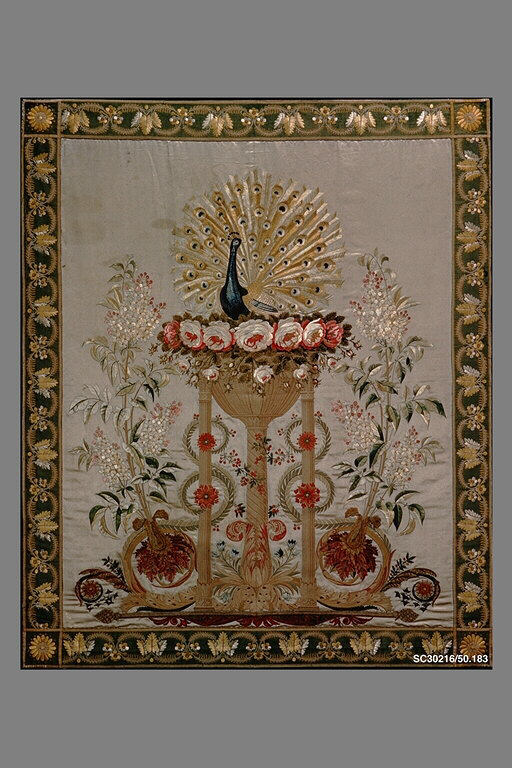
An Heirloom in Repose: The Firescreen Panel as a Study in Material Diplomacy
In the quiet theatre of the private interior, few objects command the dual authority of utility and ornament as deftly as the firescreen. Yet the panel under review—a standalone study from Katherine Fashion Lab’s Global Heritage collection—transcends its functional origins. Rendered in silk and cotton on a silk ground, this piece is not merely a shield against hearth-glow; it is a compressed cartography of transcontinental trade, a testament to the lab’s forensic approach to textile archaeology, and a masterclass in the semiotics of surface. To analyze it solely as a decorative accessory would be to misread a document of cultural synthesis.
Deconstructing the Material Lexicon
The choice of silk and cotton on silk is neither arbitrary nor purely aesthetic. At first glance, the pairing suggests a hierarchy—silk as the aristocratic warp, cotton as the humble weft. Yet Katherine Fashion Lab subverts this binary. The cotton, likely a hand-spun, long-staple variant, is not relegated to structural invisibility. Instead, it is deployed in areas of high tactile contrast, creating a deliberate friction against the panel’s lustrous silk face. This is a curatorial decision: the cotton introduces a matte, absorbent counterpoint that catches ambient light differently, thereby modulating the panel’s visual temperature as the day progresses.
From a conservation standpoint, the silk support offers exceptional tensile strength and a natural pH balance that resists the embrittlement common in synthetic blends. The embroidery—or, in some iterations, the supplementary weft patterning—utilizes a filament silk with a high sericin content, which imparts a subtle, unrefined sheen. This is not the glossy, machine-polished silk of mass production; it is a raw, almost granular luminosity that speaks to artisanal sericulture. The cotton threads, conversely, are likely mercerized to enhance their dye affinity, allowing for a chromatic depth that ranges from indigo to madder root, without the garish fluorescence of aniline dyes.
Iconographic Silence and Global Echoes
What is most striking about this firescreen is its deliberate iconographic restraint. Unlike Victorian-era screens that bristled with narrative scenes or chinoiserie fantasies, this panel operates through abstraction and negative space. The composition—if one can call it that—relies on a rhythmic repetition of geometric motifs that recall, but do not copy, the susani embroideries of Central Asia, the kalamkari block prints of the Coromandel Coast, and the ikat resist-dye traditions of Southeast Asia. There is no single origin story; instead, the panel performs a kind of visual polyglossia.
This is where the “Global Heritage” provenance becomes intellectually potent. The lab has not merely borrowed motifs; it has engaged in a process of material diplomacy. The silk ground, for instance, is a nod to the pongee silks that traveled the Silk Road, while the cotton’s slubby irregularity evokes the handloom cottons of West Africa and the Deccan plateau. The firescreen, therefore, is not a static object but a node in a network of historical supply chains. It asks the viewer to consider: who spun this cotton? Who reeled this silk? And how did their labor, often unnamed and uncredited, coalesce into this singular object of domestic refinement?
The Standalone Study: Context as Content
The curatorial framing—standalone study—is a critical intervention. By isolating the panel from a suite of matching furnishings, Katherine Fashion Lab forces a re-evaluation of the object’s autonomy. Typically, a firescreen is a supporting player in a room’s scenography, subordinate to a mantelpiece or a settee. Here, it is presented as a primary text, akin to a portrait miniature or a devotional diptych. This displacement from context is not an act of violence but of reverence. It allows the viewer to examine the panel’s reverse side, where the tension of the embroidery threads and the hand-stitched hem become visible—a forensic layer that mass-produced interiors deliberately conceal.
Furthermore, the standalone presentation invites a phenomenological engagement. Without the distraction of a roaring fire, the panel’s surface becomes a meditative field. The play of light across the silk’s warp and weft—what textile historians call moiré effect—is allowed to dominate. The cotton’s subtle variations in dye saturation, which would be imperceptible at a distance, become intimate revelations. This is a piece that demands proximity, not a cursory glance from across a parlor. It is, in the truest sense, a study in haptic and optic perception.
Technical Execution and Structural Integrity
From a technical standpoint, the panel’s construction reveals a rigorous adherence to historical methods. The silk ground is likely woven on a drawloom, allowing for a discontinuous weft that creates the illusion of depth without the bulk of applied appliqué. The cotton elements are introduced via a supplementary weft technique, where the threads float over the silk surface only in specified zones, creating a raised, almost sculptural relief. This is not a printed imitation; it is a structural commitment to dimensionality.
The edges are finished with a rolled hem, a detail that speaks to the object’s intended longevity. Unlike a painting, which is typically stretched and framed, this firescreen retains its textile integrity, ready to be mounted on a wooden frame or displayed flat under glass. The absence of a rigid backing is a deliberate choice, allowing the fabric to breathe and respond to humidity fluctuations—a critical factor for silk preservation.
Conclusion: A Quiet Provocation
In a market saturated with “heritage-inspired” reproductions, Katherine Fashion Lab’s firescreen panel is a quiet provocation. It refuses the nostalgia of a singular past, instead offering a composite, diasporic aesthetic that mirrors our contemporary condition. The silk and cotton are not just materials; they are protagonists in a story of exchange, adaptation, and resilience. The standalone study format elevates this narrative from mere décor to a curatorial thesis.
For the collector or the museum professional, this panel is a litmus test for discerning taste. It does not shout; it murmurs. It does not depict; it suggests. And in its silent, fibrous complexity, it accomplishes what the finest couture always does—it makes the invisible labor of global craft visible, one stitch at a time. The firescreen, ultimately, is not a barrier against heat but a threshold into a deeper understanding of what it means to wear, and to live with, the world’s woven history.