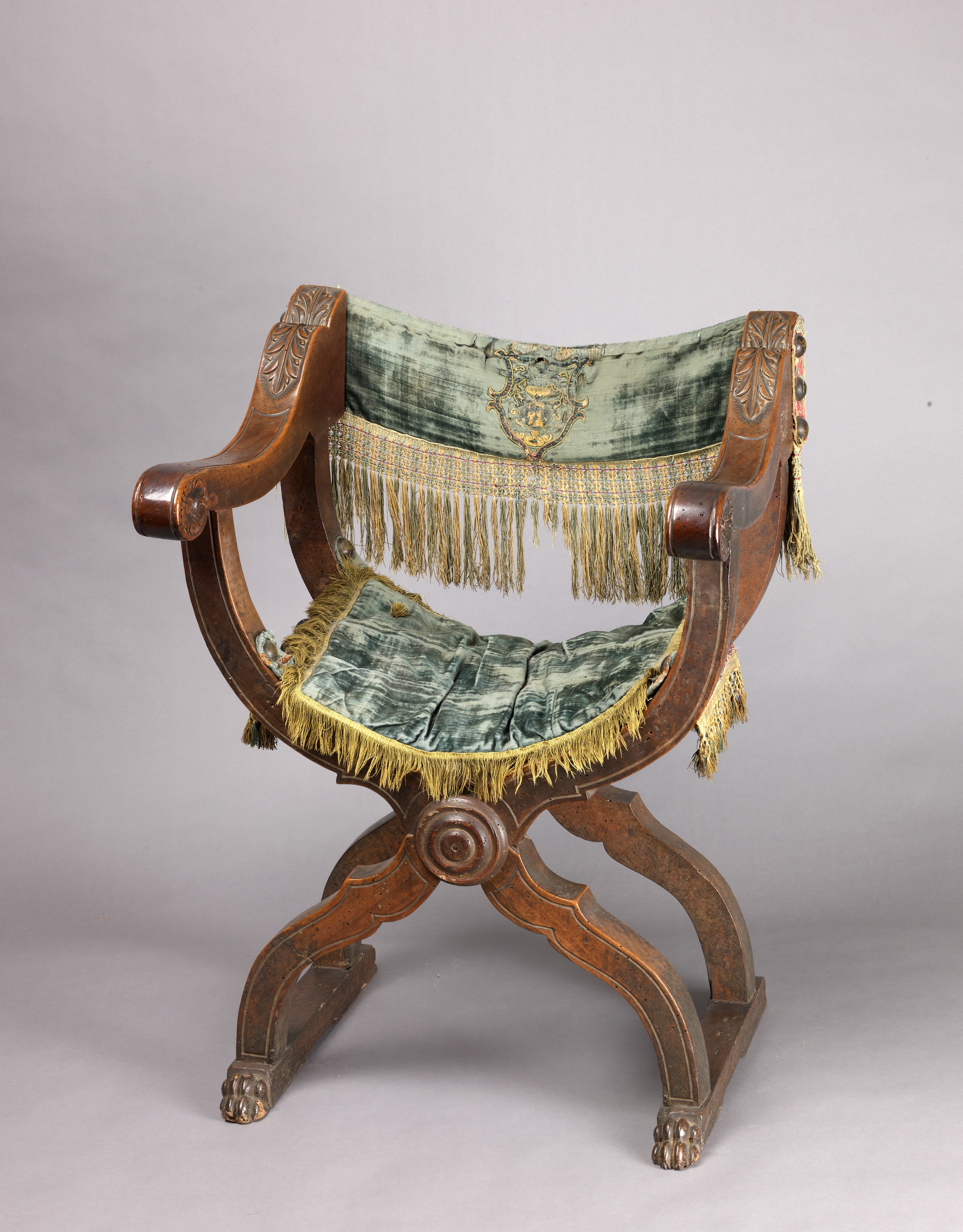
An Anatomical Allegory: The Dantesca Armchair as Couture Silhouette
Within the hallowed archives of decorative arts, object number 1975.1.1971 a,b presents not merely as a seat of repose but as a profound sartorial statement. This Italian Dantesca-type hip-joint armchair, circa 1971, crafted from carved walnut and adorned with silk velvet embroidery and metal, demands analysis through the lens of haute couture. To the Katherine Fashion Lab, it is not furniture; it is a wearable architecture of power, a study in structured silhouette, and a masterclass in the dialogue between rigid form and seductive texture. Its very nomenclature—"hip-joint"—invites us to consider the corporeal, to see in its articulated limbs the boning of a corset, in its embroidered velvet the lush decay of a baroque gown. This standalone study deconstructs the chair as one would a legendary garment, revealing the principles of balance, articulation, and contrast that define transformative fashion.
Structural Couture: The Skeleton of Walnut
The foundational ethos of this piece is its architectural integrity, directly analogous to the underpinnings of couture. The carved walnut frame acts as the internal corsetry and boning of a formidable gown. The "hip-joint," a technical pivot point, is the sartorial equivalent of a gusset or a precisely placed seam—an engineered articulation that allows for movement and posture while maintaining an imposing form. The robust, scrolling curves of the walnut are not mere decoration; they are load-bearing curves, distributing weight and defining space just as the structured shoulders of a Thierry Mugler jacket or the hyperbolic hip of a Charles James skirt create an exoskeleton for the body. This is fashion that refuses to drape passively; it constructs an identity. The dark, polished wood offers a severe, almost masculine counterpoint to the softness it supports, mirroring the couture technique of juxtaposing hard and soft elements within a single silhouette to create tension and drama.
Textile Narrative: The Embodied Velvet
If the walnut is the skeleton, the silk velvet embroidery is the flesh, the skin, and the narrative. Velvet, historically associated with nobility and ecclesiastical power, is a fabric of profound depth and light absorption. Here, it is not simply upholstery but a field of embroidered narrative, likely featuring the dense, scrolling foliate or grotesque motifs typical of the Dantesca style (named for its revival of Dante's era). This embroidery is the chair’s surface ornamentation, its brocade, its passementerie. In couture terms, this represents the meticulous, hand-forged labor that elevates an object from commodity to art. Each stitch is a decision, each metallic thread a point of light against the void of the velvet, comparable to the intricate beadwork on a Lesage masterpiece for Chanel or the surrealist embroideries of Schiaparelli.
Furthermore, the velvet’s function is inherently couture: it interfaces directly with the body. It is the point of contact, the sensory experience. Its nap changes with touch, its coolness yields to warmth, creating a personal, lived-in patina. This mirrors the relationship between a exquisite garment and its wearer—the way silk crepe de Chine molds to the body, or a wool bouclé retains its shape while embracing movement. The embroidery, while fragile in appearance, must withstand this use, speaking to the couture paradox of creating breathtaking beauty that is simultaneously resilient.
The Metal Accent: The Defining Hardware
The inclusion of metal—whether as nails, studs, or structural braces—provides the final, crucial accent. This is the couture hardware: the grommets on a Versace bondage dress, the silver buckle on a Hermès belt, the metallic thread woven through a lamé. It is the element of sharp contrast, the punctuation mark in a complex sentence. Metal against walnut and velvet introduces a tertiary texture and sheen, breaking the monologue of organic materials into a dialogue. It hints at armor, at protection, at a fusion of the martial and the luxurious. In a fashion context, this small detail often defines the entire aesthetic, moving the silhouette from purely romantic to romantically severe, from soft to powerfully adorned. It is a reminder that even the most opulent forms require precise, unyielding points of connection.
Context as Runway: The Standalone Study
The designation of this object as a "standalone study" is perhaps its most couture-quality. It is not part of a suite; it is a singular prototype, a piece of wearable art meant for contemplation. In the atelier of fashion, such a study would be the premier modèle, the one-of-a-kind showpiece that defines a collection's theme and technical ambition before it is translated (if ever) into more wearable iterations. This chair exists to articulate an idea—a specific relationship between the human form, support, ornamentation, and historical reference. Its value lies in its conceptual purity and execution, much like the iconic, often unwearable pieces that open a couture show, setting a narrative that the subsequent looks will interpret. It commands its space as a model commands the runway, an isolated focus of crafted intensity.
In conclusion, the Dantesca hip-joint armchair is a cipher for the principles of high fashion. Its walnut frame provides the foundational architecture, its embroidered velvet offers the tactile, narrative luxury, and its metal details deliver the defining contrast. Together, they create a holistic study in silhouette, texture, and presence. For Katherine Fashion Lab, this object reinforces that couture is not confined to the garment rack. It is a philosophy of construction, an obsession with material dialogue, and the pursuit of a powerful, embodied form. This chair does not simply invite one to sit; it invites one to be adorned, framed, and transformed—the ultimate objective of any great piece of fashion.