The Cartography of Couture: Deconstructing Identity in *Mercatoris Belgae Eiusque Coniugis Vestitus*
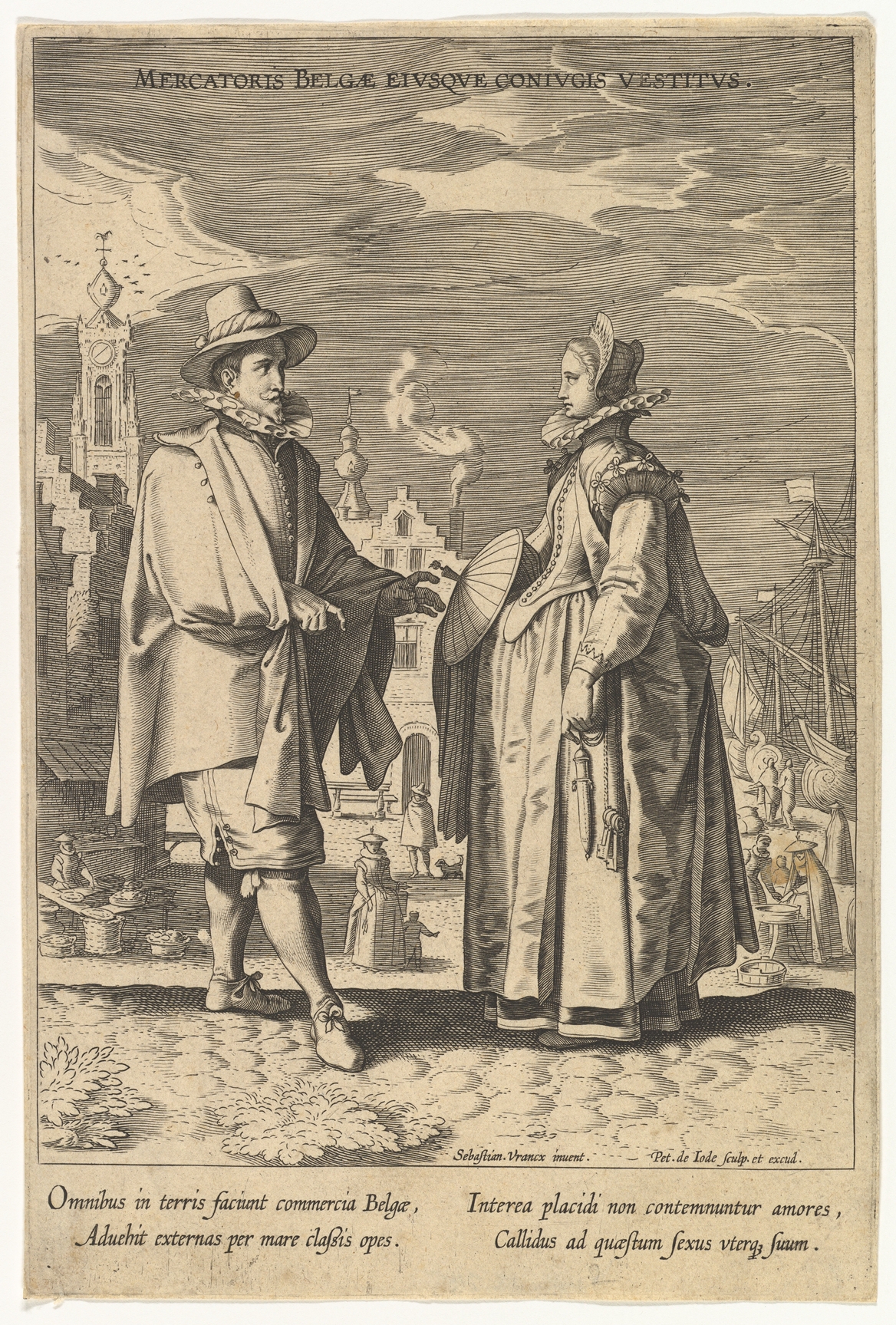
In the rarefied arena of fashion history, the printed image often holds as much authority as the garment itself—a frozen negotiation between maker, wearer, and observer. Katherine Fashion Lab’s current curatorial focus on Mercatoris Belgae Eiusque Coniugis Vestitus, a first-state engraving from the seminal series Fashions of Different Nations, offers a masterclass in sartorial semiotics. This is not merely a costume plate; it is a geopolitical statement etched in copper, a cartographic exercise where the human form becomes a territory to be mapped, classified, and ultimately, consumed by the Western gaze. As a standalone study, the work transcends its documentary function to become a profound meditation on commerce, conjugal unity, and the construction of national identity through cloth.
The Merchant’s Mantle: Wealth Rendered in Wool and Fur
The engraving’s title immediately anchors us in a specific socioeconomic stratum: the Belgian merchant. This is no idle aristocrat, but a member of the burgeoning burgher class whose power derived not from blood, but from trade. The artist’s meticulous rendering of the male figure’s attire speaks to this ascendant capitalism. Observe the generous volume of the outer mantle—a heavy, full-length gown with voluminous sleeves, likely of dense wool or broadcloth, edged with a sumptuous fur trim. This is not mere decoration; it is a liquid asset statement. In an era predating banking networks, fur and fine cloth were portable wealth, a tangible declaration of solvency that could be read across any European trading floor.
The cut itself is telling. The garment’s structured silhouette, with its high collar and rigid, almost architectural folds, suggests a deliberate distancing from the fluid, organic lines of agrarian dress. This is the uniform of the counting house—a garment designed to project stability, sobriety, and calculable worth. The fur, likely sable or lynx, functions as a thermal and symbolic barrier, insulating the merchant from the chill of the marketplace while simultaneously elevating him above the common fray. In this first state, before any later re-engraving softened the lines, the burin work is sharp, almost aggressive in its delineation of the fabric’s weight. Each stroke reinforces the material’s density, making the merchant’s physical presence synonymous with the immovable solidity of his capital.
The Coniugis: The Spouse as Mirror and Counterweight
If the merchant is a monument to public commerce, his coniugis (spouse) is a study in complementary, yet distinct, domestic power. Her costume is a complex layering of social signals, meticulously rendered to reflect her husband’s status while asserting her own role as keeper of the household’s moral and aesthetic standards. The engraver captures a high-waisted gown beneath a structured bodice, the fabric likely a rich silk or velvet, its surface animated by intricate slashing or embroidery—details that would have required the viewer’s close inspection and rewarded their knowledge of textile luxury.
Her headdress is the focal point of her ensemble, a towering construction of starched linen and wire that frames her face like a sacred icon. This is not merely a fashion choice; it is a marker of marital honor and civic virtue. The complexity of the headdress—its precise pleats and rigid geometry—mirrors the merchant’s structured mantle, creating a visual rhyme that binds the couple in a shared aesthetic language of discipline and order. Yet, where his garment projects outward toward the world, hers encloses inward, shielding her body and, by extension, the private sphere she governs. The engraving’s first state captures this dialectic with remarkable clarity: he is the column, she is the capital; together, they form a complete architectural unit of bourgeois respectability.
First State, First Principles: The Burin’s Authority
From a curatorial and connoisseurial standpoint, the designation of a “first state” is paramount. In printmaking, a first state signifies the earliest impression pulled from the plate, before any revisions, corrections, or wear. For the fashion historian, this is the closest we come to the artist’s original intent, unmediated by later commercial considerations. The lines here are crisp, the cross-hatching deep and deliberate, creating a dramatic chiaroscuro that lends the figures a sculptural gravitas lost in subsequent printings. The absence of later-added background details, common in later states to appeal to a broader market, focuses our attention entirely on the human subjects. This isolated presentation is not a lack, but a choice—a deliberate foregrounding of the sartorial subject as the sole object of study.
This first state also preserves the raw energy of the engraver’s hand. The texture of the fur is rendered with a series of short, flicking strokes that suggest movement and life, while the merchant’s face, though conventional, carries a subtle tension in the jawline—a hint of the anxieties beneath the composed exterior. The spouse’s expression, similarly, is not serene but watchful, her eyes directed slightly off-axis as if assessing a potential customer or a household servant. These micro-details, so easily lost in later, flatter impressions, are the lifeblood of the couture analysis. They remind us that fashion is not static; it is worn, performed, and observed in real time.
Global Heritage, Local Gaze: The Politics of the Plate
The series’ title, Fashions of Different Nations, situates this engraving within a broader Enlightenment project of ethnographic classification. Yet, as a standalone study, it resists easy categorization. The “Global Heritage” origin is a double-edged sword. On one hand, it acknowledges the plate’s role in a transnational visual economy, where images of distant peoples circulated widely, shaping perceptions of national character. On the other, it implicates the work in a colonialist gaze that flattened complex identities into picturesque types. The Belgian merchant is not a universal “Belgian”; he is a specific archetype—the trader—whose costume is a calculated performance for an international audience.
Katherine Fashion Lab’s analysis must therefore resist the temptation to treat this as a simple document of “what Belgians wore.” Instead, we read it as a strategic self-fashioning. The merchant and his wife are not passive subjects; they are active participants in a visual dialogue with the world. Their clothing is their argument, their proof of belonging to a pan-European class of commercial elites who shared more in common with their counterparts in Antwerp, Venice, or London than with the rural peasantry of their own hinterland. The engraving, in its first state, preserves this argument in its most potent form—a crisp, unapologetic declaration of identity through attire.
Conclusion: The Fabric of Legacy
Mercatoris Belgae Eiusque Coniugis Vestitus is far more than an antiquarian curiosity. It is a sophisticated piece of visual rhetoric that interrogates the relationship between cloth, commerce, and conjugal identity. The first state’s technical brilliance allows us to appreciate the engraver’s skill while simultaneously decoding the sartorial codes embedded in every fold and seam. The merchant’s woolen bulk and the spouse’s starched geometry are not mere garments; they are instruments of social navigation, wielded with the precision of a ledger entry or a diplomatic dispatch.
For the contemporary viewer, the plate offers a resonant lesson. In an age of fast fashion and globalized uniformity, this engraving reminds us that clothing has always been a language of aspiration and distinction. The Belgian merchant’s fur-trimmed mantle and his wife’s intricate headdress speak to a fundamental human desire: to be seen, to be valued, and to be remembered. Katherine Fashion Lab’s standalone presentation of this first-state print allows us to listen to that conversation with unprecedented clarity, hearing the whispers of a world where the cut of a coat was a matter of national and personal honor. The plate endures not as a relic, but as a living text—one that continues to inform our understanding of how we dress, why we dress, and what our clothes say before we ever utter a word.