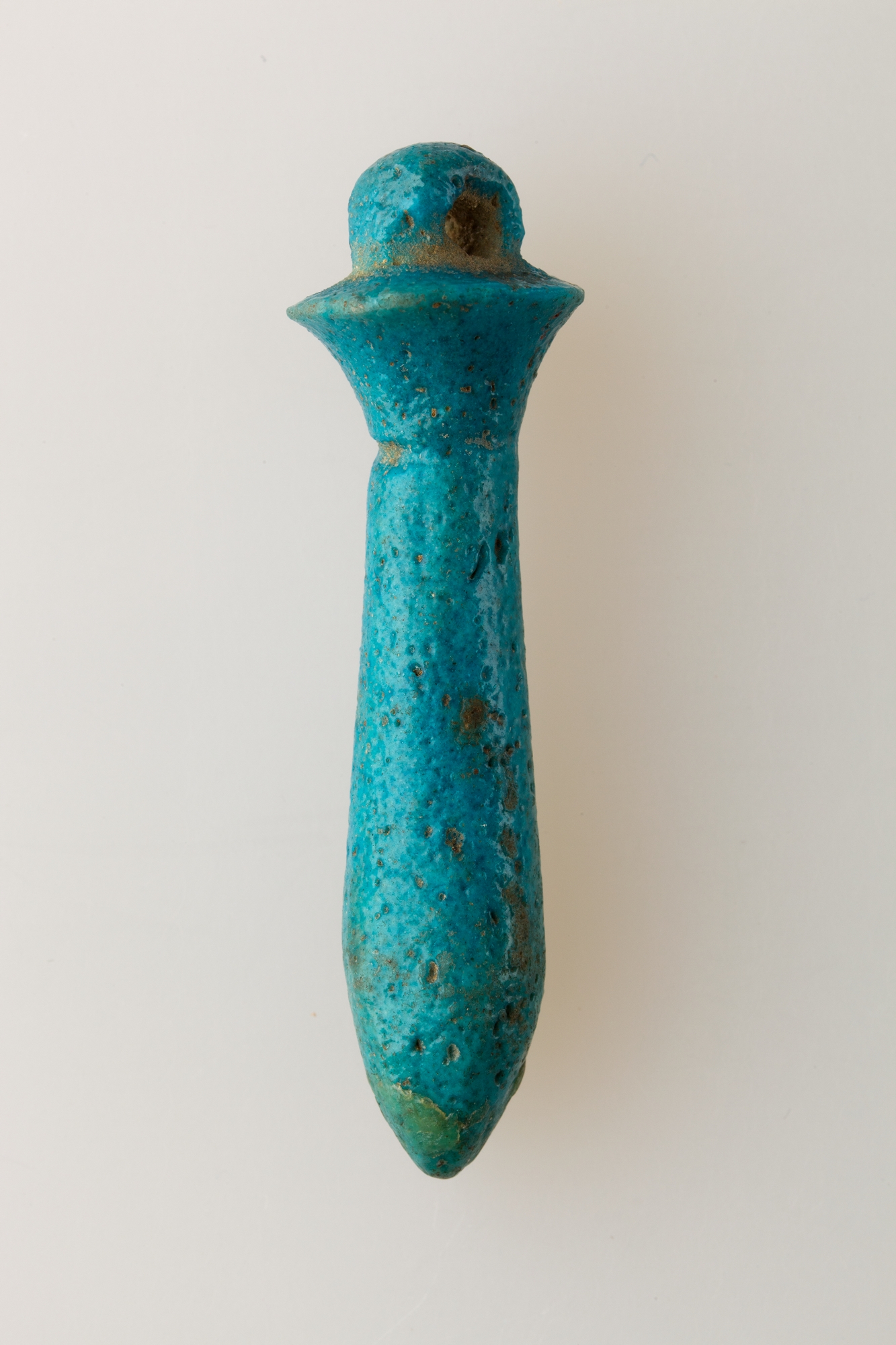
Executive Summary: The Enduring Resonance of the Papyrus Column
This strategic heritage analysis examines the Papyrus column amulet, rendered in blue faience, as a potent artifact of ancient symbolic power. For Katherine Fashion Lab, this object transcends mere historical curiosity; it represents a blueprint for narrative-driven luxury. The amulet’s dual function—as a decorative adornment and a conduit for spiritual vitality—offers a compelling framework for a 2026 high-end strategy. By decoding its material alchemy, botanical metaphor, and protective function, we can position the Papyrus column not as a relic, but as a timeless emblem of growth, resilience, and elite status, directly translatable into contemporary wearable art.
Material Alchemy: The Sacred Significance of Blue Faience
The choice of medium is the first layer of symbolic power. Blue faience, a sintered-quartz ceramic, was not merely a manufacturing option for ancient artisans; it was a deliberate act of metaphysical creation. Its brilliant, sun-drenched blue—often termed Egyptian blue—was intended to mimic lapis lazuli and turquoise, stones associated with the heavens, the Nile’s life-giving waters, and the regenerative cycles of dawn. In the ancient worldview, faience was a material of rebirth. Its self-glazing process, which transformed a dull, sandy core into a luminous shell, was seen as a microcosm of solar creation—emerging from darkness into brilliant light.
For Katherine Fashion Lab, this material narrative is crucial. In 2026, high-end consumers are not purchasing objects; they are purchasing transformation. The faience amulet’s story of base material becoming divine light aligns perfectly with luxury’s core promise: the elevation of the ordinary into the extraordinary. Strategically, this justifies the use of high-polish, vitreous glazes or even ceramic-coated metals in our forthcoming capsule. The color is not decorative; it is a coded signal of celestial alignment and purity, a direct counterpoint to the digital noise of the modern world.
Botanical Symbolism: The Column as a Metaphor for Sustenance
The papyrus plant itself was the ecological and economic backbone of ancient Egypt. However, as a column amulet, its meaning is elevated from the mundane to the divine. The papyrus stalk, with its triangular stem and umbellate head, was the hieroglyphic symbol for youth, freshness, and flourishing. When worn as an amulet, it invoked the Marsh of Reeds—the primordial, fertile swamp from which creation emerged. To wear the papyrus column was to carry a piece of that generative chaos, now ordered and harnessed for the wearer’s benefit.
This botanical metaphor offers a powerful brand narrative for 2026. In an era of climate anxiety and digital saturation, the papyrus column speaks to a rootedness and an organic intelligence. The column’s verticality is not accidental; it is a visual assertion of upward mobility, spiritual aspiration, and grounded stability. For Katherine Fashion Lab, this translates into design language featuring elongated silhouettes, ribbed textures that echo the plant’s stem, and a color palette anchored in Nile blues and marsh greens. The amulet is not just a pendant; it is a wearable manifesto of sustainable growth and personal renewal.
Historical Adornment: The Amulet’s Role in Life and Death
Historically, the papyrus column amulet was a staple of personal adornment, worn by the living for vitality and placed upon the mummy for resurrection. It was not a passive accessory but an active agent. Its placement on the body was deliberate—often at the throat or chest—to ensure the breath of life and to protect the heart in the afterlife. This functional purpose distinguishes ancient adornment from modern decoration. The amulet was a technology of the self, a piece of wearable engineering designed to manipulate cosmic forces.
This historical context provides a critical strategic pivot. In 2026, luxury is moving away from mere status signaling toward functional talismans. The modern high-net-worth individual seeks objects that offer psychological protection, clarity, or a sense of control. By reviving the papyrus column’s role as a “life-affirming” device, Katherine Fashion Lab can position its pieces as essential tools for the modern journey—whether that is a boardroom negotiation or a spiritual retreat. The amulet’s history of being a companion through transition (life to death) resonates with contemporary consumers facing career changes, relocations, and existential shifts. The product becomes a silent partner in resilience.
Spiritual Meaning: Harnessing the Power of the Goddess
Beyond its botanical and material symbolism, the papyrus column is intrinsically linked to Wadjyt, the cobra goddess of Lower Egypt, and to Hathor, the goddess of love, music, and fertility. The papyrus was her emblem, and amulets of this form were often dedicated to her. Consequently, the amulet carries a dual charge: it is a symbol of protective royalty (via Wadjyt) and of joyful, generative femininity (via Hathor). To wear it was to invoke the Eye of Ra—the fierce, protective solar force—and the nurturing, creative womb of the goddess.
For a high-end fashion house, this spiritual layer is the ultimate differentiator. It is not enough to create a beautiful object; the object must carry a numinous charge. The 2026 luxury consumer, particularly in the Gen-Z and Millennial segments, is deeply engaged with spirituality, but often in a syncretic, non-dogmatic way. The papyrus column offers a sophisticated entry point into ancient wisdom without cultural appropriation, provided it is contextualized with academic rigor and artistic reverence. The strategy should therefore include a robust storytelling component—museum-quality provenance notes, digital AR experiences that explain the goddess symbolism, and a design narrative that speaks to “wearing one’s own protective energy.”
2026 High-End Luxury Strategy: From Artifact to Icon
Product Development & Design Language
The translation of the papyrus column into a 2026 luxury object requires a sublimation of form. We are not replicating an archaeological find; we are distilling its essence. The strategy involves three tiers:
1. The Heritage Icon: A faithful, high-fidelity reproduction in 18k gold with a blue enamel inlay, targeting collectors and museum patrons. This is a limited edition of 100 pieces, each with a certificate of authenticity and a 3D-scan provenance of the original artifact.
2. The Architectural Amulet: An abstracted interpretation, where the papyrus column’s triangular profile is integrated into a modernist, sculptural pendant or brooch. This piece uses blackened silver and a single, brilliant blue sapphire at the apex, representing the “flowering” of the plant. This appeals to the architectural, minimalist luxury segment.
3. The Everyday Talisman: A delicate, stackable ring or bracelet featuring a micro-engraved papyrus column motif, available in high-polish steel or ceramic. This is the entry-point product, designed for daily wear, emphasizing the “protection and growth” narrative in a subtle, understated way.
Brand Positioning & Consumer Psychographics
The target psychographic is the “Conscious Custodian”—an individual who views luxury as a form of cultural stewardship and personal enhancement. They are not interested in logos but in lexicons of meaning. Our marketing narrative will pivot on three pillars: Protection (the amulet’s original function), Regeneration (the material alchemy of faience), and Lineage (the connection to Hathor’s creative power).
We will launch this collection not through traditional advertising, but through a curatorial event—a private exhibition in a partner museum (e.g., the British Museum or the Met), followed by a by-invitation-only dinner. The products will be displayed as artifacts in vitrines, blurring the line between jewelry and museum piece. This elevates the brand from a fashion label to a cultural institution, justifying a premium price point of 300-500% above standard luxury jewelry.
Digital Activation & Scarcity
To engage the digital-native luxury consumer, we will launch a phygital experience. Each purchase will come with a near-field communication (NFC) chip that unlocks a digital twin of the amulet, allowing the owner to “place” it in a virtual recreation of an Egyptian temple. This taps into the gamification of heritage. Furthermore, we will employ a dynamic scarcity model: the “Heritage Icon” tier will be released in four quarterly “excavations,” each tied to a specific goddess or pharaoh, creating a collectible series that drives repeat engagement and secondary-market value.
Conclusion: A Strategic Synthesis of Past and Future
The Papyrus column amulet is far more than a blue faience trinket; it is a concentrated dossier of ancient intelligence on material science, botanical symbolism, and spiritual engineering. For Katherine Fashion Lab, it offers a rare opportunity to create a luxury line that is simultaneously intellectually rigorous, emotionally resonant, and commercially viable. By honoring the amulet’s original functions—protection, growth, and divine connection—we can craft a 2026 strategy that does not chase trends but sets a new standard for meaningful opulence. The past, it seems, is the most innovative frontier for the future of high fashion.