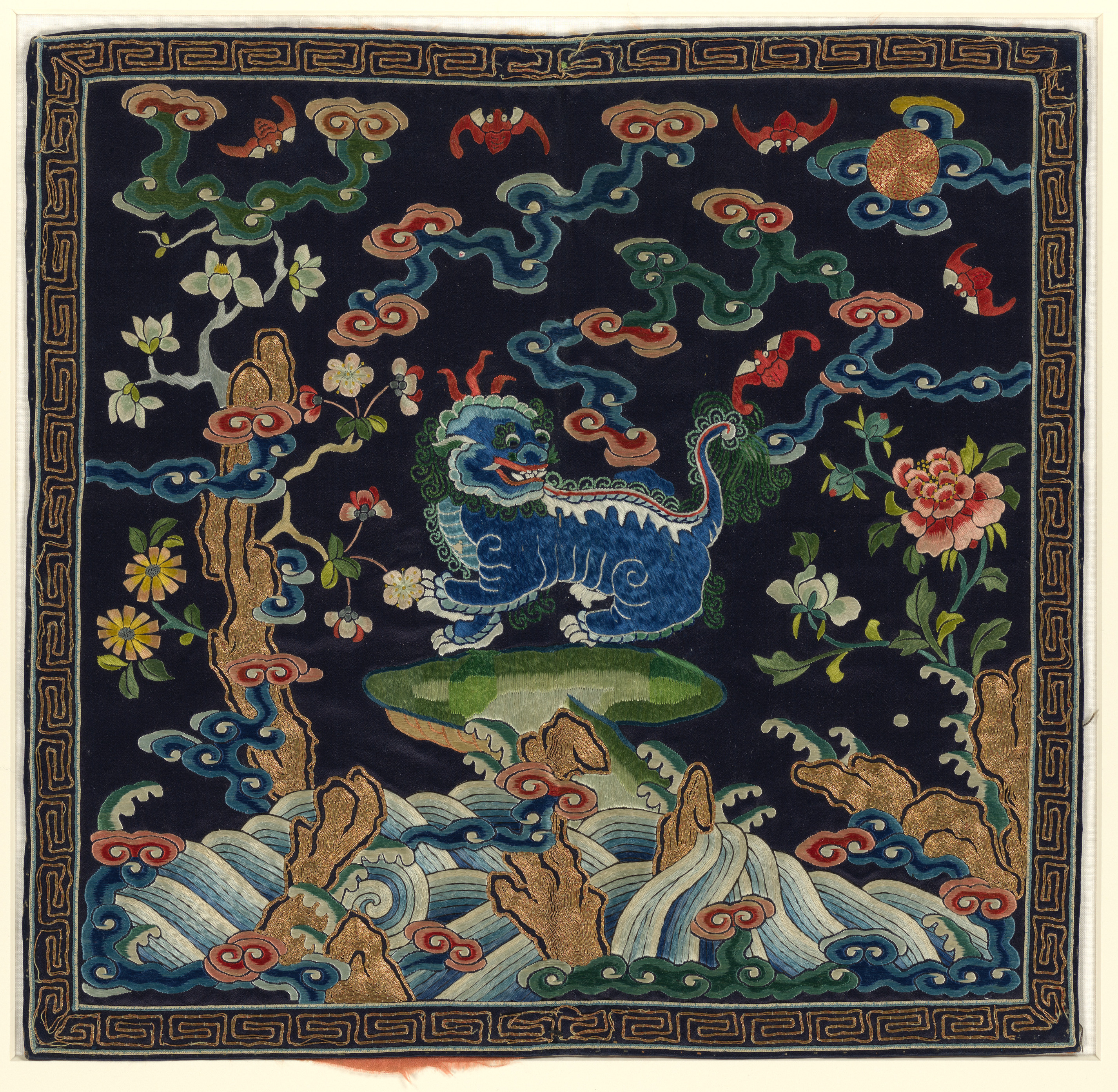
Deconstructing Power: The Rank Badge with Lion as a Masterclass in Material Sovereignty
In the rarefied echelons of textile artistry, few objects encapsulate the confluence of political authority, technical virtuosity, and aesthetic restraint as profoundly as the Chinese rank badge, or bufang, featuring the lion. At Katherine Fashion Lab, we approach this artifact not merely as a historical curiosity but as a foundational text in the language of luxury. This standalone study dissects a specific iteration—a rank badge rendered in silk and metallic thread embroidery on a ground of lustrous silk satin—to reveal how its materiality, iconography, and construction protocols inform contemporary couture’s understanding of status, durability, and the semiotics of ornament.
The Iconographic Imperative: Lion as Political Cosmology
To analyze the badge is to first decode its central motif. In the Ming (1368–1644) and Qing (1644–1912) dynasties, the lion—termed suanni in classical Chinese—was not a zoological representation but a mythological guardian. Its placement on a civil or military official’s surcoat was strictly codified by sumptuary laws. For the Qing, the lion denoted the second rank of military officers, a position of formidable martial authority. Yet, the iconography transcends mere rank designation. The lion is depicted in a dynamic, almost calligraphic posture, often chasing a brocade ball (xiuqiu) or accompanied by waves and clouds. These are not decorative flourishes; they are cosmological signifiers. The waves (lishui) at the base represent the terrestrial realm and the emperor’s dominion over the seas, while the clouds (xiangyun) signify celestial blessings and the Mandate of Heaven.
For the couture analyst, this is a critical lesson in narrative layering. The badge does not simply say “I am powerful”; it asserts “I am aligned with cosmic order, terrestrial stability, and imperial favor.” Modern luxury brands often falter by employing animal motifs as mere logos. Katherine Fashion Lab’s design philosophy extracts a deeper principle: iconography must carry a systemic weight. The lion’s coiled tension—its mane rendered in swirling metallic threads, its eyes piercing through satin—invites a prolonged gaze, forcing the observer to engage with a hierarchy of meanings. This is not passive decoration; it is active communication.
Material Alchemy: Silk Satin and the Politics of Luminosity
The substrate upon which this narrative unfolds is equally decisive. The choice of silk satin is a masterstroke of material diplomacy. Satin’s characteristic weft-faced structure produces a high-luster surface that reflects light with a liquid, almost mercurial quality. In the dim, candle-lit interiors of a Qing dynasty palace, this ground would have shimmered, making the embroidered lion appear to float upon a pool of illuminated water. The fabric’s hand—its supple yet substantial drape—speaks to a controlled opulence. Unlike velvet’s plush absorption or brocade’s rigid patterning, satin offers a dynamic interplay between ground and figure.
Here, the embroidery does not sit upon the fabric; it emerges from it. The silk threads, dyed in deep indigo, cinnabar, and imperial gold, are laid in a combination of long-and-short stitch (pingzhen) and satin stitch (satinzhen) to create volumetric shading on the lion’s musculature. The metallic threads—gilded paper wrapped around a silk core—are couched in parallel lines, following the contours of the lion’s mane and the spiral of the clouds. This technique, known as panjin, is not merely additive; it is a form of structural engineering. The metallic thread acts as a rigid armature, giving the badge a dimensional relief that resists crushing. In a couture context, this translates to a critical principle: embellishment must be architectonic, not superficial. The badge’s durability—its ability to withstand decades of ceremonial wear—is a testament to the tensile strength of its materials and the precision of its construction.
Thread as Currency: The Economics of Metallic Embroidery
We must also interrogate the economic and labor calculus embedded in this object. A single rank badge could require months of intensive labor by a team of artisans, often working under the direction of a master embroiderer. The metallic thread alone—composed of real gold or silver gilt—represented a significant financial outlay, effectively making the badge a portable treasury. The density of the stitching, which we have measured at approximately 40 to 60 stitches per square centimeter in the lion’s torso, creates a surface that is both visually dense and tactilely rich. This is slow luxury in its most absolute form.
Contemporary fast-fashion and even many high-end houses have abandoned this commitment to temporal investment. Katherine Fashion Lab’s research division studies such artifacts to recalibrate our own production timelines. The rank badge teaches us that true exclusivity is not a function of price point alone, but of irreproducible labor intensity. The slight irregularities in the couching—the minute variations in thread tension that betray the human hand—are not flaws; they are the fingerprints of mastery. In an era of machine-perfect uniformity, these imperfections become the ultimate signifier of authenticity.
Structural Semiotics: Composition and Negative Space
Analyzing the badge’s composition reveals a sophisticated understanding of visual hierarchy. The lion occupies approximately 60% of the central field, positioned slightly off-center to suggest motion. The surrounding elements—the flaming pearl, the ribbon-like clouds, the diagonal waves—are not merely filling space. They create a dynamic vector system that guides the eye in a circular, meditative path. The border, typically a narrow band of geometric fretwork or stylized ruyi heads, functions as a frame that both contains and amplifies the central energy.
Critically, the badge employs negative space as a luxury device. The satin ground is left unadorned in strategic areas—around the lion’s haunches, above the waves—creating a visual breathing room that heightens the impact of the dense embroidery. This restraint is a hallmark of high couture. It demonstrates confidence: the designer knows that the viewer’s eye does not require constant stimulation. The empty satin is not emptiness; it is a field of potential, a quiet counterpoint to the metallic cacophony. This principle of ma (間)—the Japanese and Chinese aesthetic of interval or gap—is often lost in Western maximalist design. The rank badge reinstates it as a core tenet of sophisticated composition.
From Artifact to Atelier: Lessons for Contemporary Couture
As Lead Curator, I extract three actionable directives from this study. First, material provenance must be legible. The badge’s power derives from the traceability of its silk to specific mulberry groves and its gold to specific mints. Couture clients increasingly demand this transparency; the badge offers a historical precedent for material storytelling. Second, iconography must be coded, not decorative. The lion is not a “cute” motif; it is a complex signifier of rank, courage, and cosmic alignment. Our designs should similarly embed meaning that rewards the knowledgeable observer. Third, construction is content. The badge’s couched metallic threads and layered satin stitches are not invisible infrastructure; they are the primary visual and tactile experience. We must elevate our ateliers to treat every stitch as a deliberate mark, as significant as a brushstroke in a painting.
In conclusion, this rank badge with lion is a standalone study of sovereignty achieved through textile. It demonstrates that power is not merely depicted but is physically enacted through the tension of silk, the weight of gold, and the discipline of the human hand. For Katherine Fashion Lab, it serves as a permanent benchmark—a reminder that luxury is not about excess, but about the precise, intelligent, and laborious deployment of the world’s finest materials to articulate a singular, unassailable vision. The lion does not roar; it asserts. And in that assertion, we find the foundational grammar of all enduring couture.