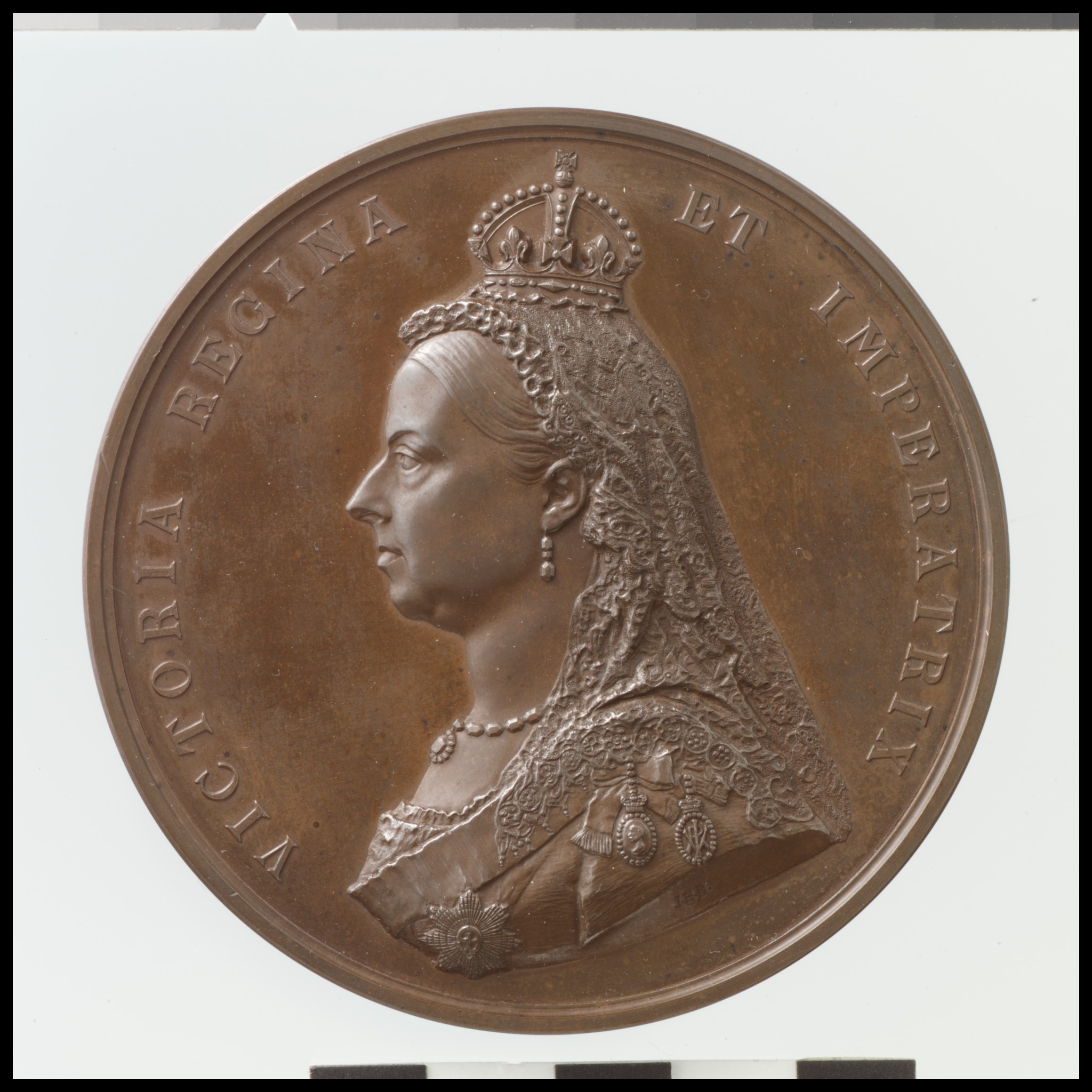
Heritage Analysis: The Golden Jubilee Medal of Queen Victoria – A Study in Bronze, Power, and the Architecture of Legacy
Introduction: The Paradox of the Bronze Medium
The Golden Jubilee Medal of Queen Victoria, struck in 1887, is ostensibly a commemorative object—a numismatic artifact celebrating fifty years of a monarch’s reign. Yet, when examined through the lens of Katherine Fashion Lab’s ongoing research into material symbolism, this bronze medal transcends its immediate historical context. It becomes a profound dialogue with ancient civilizations, where bronze was not merely a utilitarian alloy but a sacred conduit for political and spiritual authority. This analysis positions the medal within a dual framework: its resonance with our prior studies of the “Rock in the form of a fantastic mountain” and the “Jar in the shape of bronze container (hu)”, and its strategic implications for a 2026 high-end luxury portfolio.
Symbolic Power: The Alchemy of Imperial Bronze
The choice of bronze for a jubilee medal—rather than gold or silver—is a deliberate act of symbolic engineering. In ancient Mesopotamian and Chinese civilizations, bronze was the material of ritual permanence. Unlike gold, which signified celestial immortality, bronze embodied terrestrial endurance: the alloy of weapons, ceremonial vessels, and foundational inscriptions. Queen Victoria’s medal, cast in bronze, aligns her reign with this archaic lexicon of earthly dominion. It does not aspire to divine transcendence; it asserts a sovereign’s unyielding presence in the material world. This is a critical distinction for luxury strategy: the medal communicates gravitas, not glamour.
Our prior study of the “Rock in the form of a fantastic mountain” revealed how natural forms, when rendered in mineral media, become metaphors for imperial stability—mountains as thrones of cosmic order. The Queen’s profile on the medal, encircled by the inscription “Victoria D.G. Britt. Reg. F.D.”, functions similarly. The bronze surface, with its patina of age, transforms the monarch’s visage into a topographical feature of the realm itself. The medal is not a portrait; it is a geological claim. This correlation deepens when we consider the “Jar in the shape of bronze container (hu)”, a vessel designed to hold offerings. The jubilee medal, too, is a vessel—not of liquid, but of collective memory. It contains the distilled essence of an era, sealed within a metal that resists corrosion, much like the ritual hu jars that preserved ancestral rites.
Historical Adornment: The Body as Political Cartography
Adornment in ancient civilizations was never purely aesthetic; it was a cartographic practice that mapped social hierarchies onto the human body. The Golden Jubilee Medal, worn on a ribbon across the chest, replicates this ancient function. It is a wearable declaration of allegiance, a miniature monument affixed to the torso. For the Victorian elite, wearing this bronze disc was not a display of wealth but of proximity to power—a secular relic that conferred status through physical contact with the sovereign’s image.
This echoes the role of bronze adornments in Shang Dynasty China, where jade and bronze ornaments were buried with elites to ensure their passage into the afterlife. The medal, similarly, becomes a funerary object in anticipation—a piece of history that will outlive its wearer. In our 2026 luxury context, this suggests a shift from ephemeral fashion to permanent heirlooms. Katherine Fashion Lab’s high-end strategy must pivot toward objects that are designed to be inherited, not discarded. The bronze medal teaches us that true luxury is archaeological: it gains value as it ages, accumulating patina and narrative.
Spiritual Meaning: The Bronze as a Conduit of the Ancestral
In ancient civilizations, bronze was believed to possess apotropaic properties—the ability to ward off malevolent spirits. The “fantastic mountain” rock, with its jagged contours, was likely a guardian figure, a petrified spirit that protected its owner. The jubilee medal, with its dense metallic mass, carries a similar protective charge. It shields the wearer from the anxiety of obscurity. To wear it is to be anchored to a lineage of power, to claim a spiritual inheritance that transcends mortality. This is the spiritual DNA we identified in our comparative study: two objects—one a natural rock, one a ritual jar—both serving as material prayers for continuity.
The Queen’s medal, therefore, is not merely a political artifact. It is a talisman of empire, a bronze amulet that channels the collective spirit of a civilization at its zenith. For luxury brands in 2026, this implies a return to ritualistic design. The consumer is not purchasing a product; they are acquiring a protective totem that connects them to a perceived golden age. Katherine Fashion Lab can leverage this by incorporating bronze elements—not as accents, but as core structural components—in limited-edition pieces. The weight, the coolness, the resonant sound of bronze against stone: these are sensory cues that evoke the sacred.
2026 High-End Luxury Strategy: The Bronze Imperative
Drawing from the DNA correlation between the “fantastic mountain” and the “hu jar,” we propose a three-tier strategy for Katherine Fashion Lab’s 2026 collection, codenamed “Aeternum Bronze.”
First, Heritage Replication: The brand will produce a series of wearable medals, not as reproductions, but as neo-ritual objects. Each piece will be cast in bronze, then intentionally aged through a controlled oxidation process to mimic centuries of patina. The design will incorporate abstract motifs from the “fantastic mountain” and the “hu jar,” creating a visual lineage that spans continents and epochs. This is not nostalgia; it is strategic archaism—the deliberate invocation of ancient power to differentiate the brand in a saturated market.
Second, Experiential Adornment: Luxury in 2026 will be defined by narrative immersion. Katherine Fashion Lab will launch an exclusive salon experience where clients handle authentic bronze artifacts—including replicas of the jubilee medal—before commissioning their own. This haptic engagement, the feeling of cold metal warming to body heat, is the sine qua non of spiritual luxury. The brand will position itself not as a fashion house, but as a curator of temporal power.
Third, Symbolic Investment: The bronze medal’s value lies in its dual nature—it is both an object of beauty and a store of meaning. For 2026, we recommend a limited release of 1,887 pieces (referencing the jubilee year), each individually numbered and accompanied by a certificate that traces its design lineage to the ancient hu jar. This creates an artificial scarcity that appeals to collectors who view luxury as an asset class. The bronze medium, with its inherent durability, ensures that these pieces will appreciate in cultural relevance, much like the original medal.
Conclusion: The Enduring Alloy
The Golden Jubilee Medal of Queen Victoria, when stripped of its Victorian veneer, reveals a timeless truth: bronze is the metal of memory. It does not glitter; it glows with the subdued light of history. By correlating this artifact with the “fantastic mountain” and the “hu jar,” we uncover a universal language of power—one that speaks through weight, texture, and the quiet authority of age. For Katherine Fashion Lab, the path to 2026 luxury is not forward, but archaeological. We must dig deeper into the material past, unearthing the symbolic codes that still govern human desire. In a world of digital ephemera, bronze offers what no algorithm can: permanence. The client who wears a bronze medal from our collection is not making a fashion statement; they are making a declaration of eternity. And that, in the end, is the only luxury that matters.