The Couture Analysis: A Study in Global Heritage
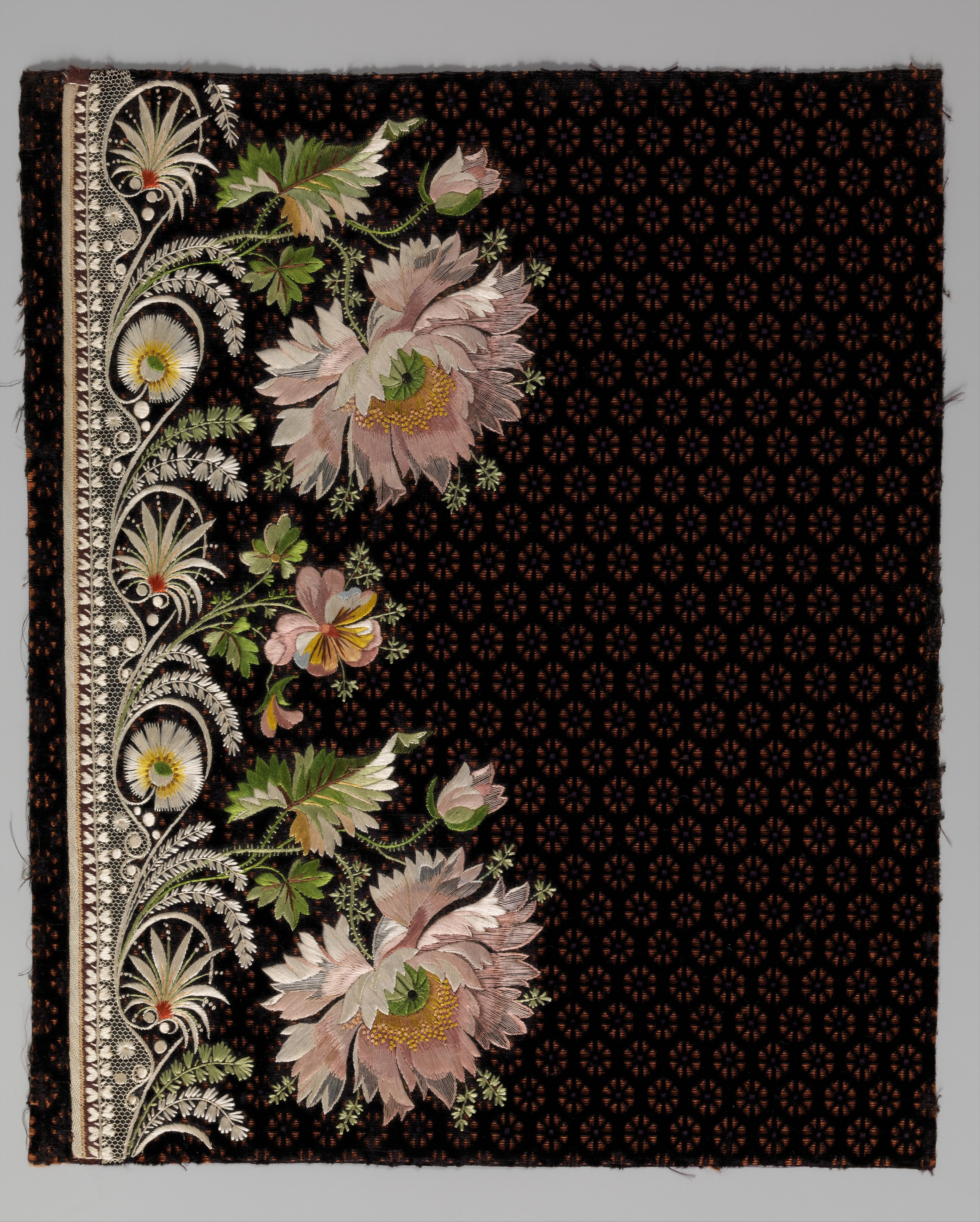
Within the rarefied atmosphere of Katherine Fashion Lab, where garment construction is elevated to a form of architectural poetry, the standalone study of a single embroidery sample offers a profound lens through which to examine the very essence of couture. This particular artifact—a man’s suit panel in silk velvet, adorned with hand-executed silk embroidery—is not merely a decorative fragment. It is a cartographic document of global heritage, a silent dialogue between disparate cultures, and a masterclass in material alchemy. To analyze it is to deconstruct the very language of luxury, where thread becomes narrative and velvet becomes a canvas for time itself.
Material Duality: The Velvet Ground and the Silk Thread
The foundational choice of silk velvet is immediately significant. Velvet, historically a fabric of monarchs and clergy, possesses an inherent depth that absorbs and reflects light with a chameleon-like quality. In this sample, the pile—short, dense, and lustrous—creates a shadowy, absorbent field. This is not a neutral ground; it is an active participant. The dark, almost ink-like base (a deep aubergine or midnight indigo, depending on the light) serves as a foil, demanding that the embroidery not merely sit upon it but engage in a battle of textural contrast. The velvet’s plushness threatens to swallow detail, yet it is precisely this risk that elevates the embroidery from craft to high art.
Against this yielding darkness, the silk embroidery thread—in a palette of burnished gold, oxidized silver, and a spectrum of jewel tones—creates a startling tension. Silk thread, unlike its cotton or wool counterparts, possesses a natural sericin coating that yields an almost metallic sheen. When worked into the velvet pile, the thread does not rest flat; it stands in relief, catching light from every angle. The result is a three-dimensional topography, a raised relief map of cultural motifs. The choice of silk-on-silk is a deliberate act of purity—no foreign fiber disrupts the narrative. It is a conversation between two states of the same material, one woven, one spun, each amplifying the other’s inherent luxury.
Cartography of Motifs: A Global Lexicon
The embroidery’s design is where the “Global Heritage” origin becomes manifest. A cursory glance suggests a chaotic floral, but closer inspection reveals a disciplined, curated lexicon. In the upper left quadrant, one discerns the sinuous, interlacing arabesques of Isfahan—a nod to Persian garden carpets, where geometric paradise is rendered in floral code. These are not mere leaves; they are islimi tendrils, symbolizing the eternal, unbroken flow of creation. The meticulous satin stitch used here is so fine that the thread appears to be painted on, a technique that requires the artisan to angle the needle at exactly 45 degrees to maintain the sheen.
Transiting to the center, the eye meets a bold, geometric medallion reminiscent of Mughal India. This is not a direct copy but an abstracted interpretation—a lotus motif, its petals rendered in a padded couching technique that raises the surface a full millimeter above the velvet. The gold thread used here is a twisted Japanese gold, a nod to the Kinko tradition, yet the design language is unmistakably South Asian. The juxtaposition is not jarring but harmonious, suggesting that the global Silk Road was not merely a trade route for goods but for visual ideas.
Finally, in the lower right, one finds a sprig of Chinese prunus—the plum blossom, a symbol of resilience and renewal. Executed in a delicate Peking knot, each blossom is a minuscule, raised sphere of silk, creating a stippled texture that contrasts beautifully with the flat satin of the Persian elements. The inclusion of this motif is not decorative; it is a deliberate act of cultural quotation, acknowledging the profound influence of East Asian embroidery on the Western couture canon. The sample thus becomes a microcosm of global trade, a silent testament to the centuries of cross-pollination that define our shared aesthetic heritage.
Technical Virtuosity: The Hand as Instrument
Beyond the design, the technical execution is a feat of human precision. In a standalone study, we are afforded the luxury of examining the reverse side—the envers. Here, the discipline of the couture atelier is laid bare. There are no loose threads, no tangled knots; the reverse is as clean as the front, a hallmark of French embroidery technique (specifically the Lunéville method, though executed with a hand needle here). This is not merely craftsmanship; it is a philosophical stance. The artisan has treated the unseen side with the same reverence as the visible, a practice rooted in the Japanese concept of omote and ura—the front and back, both essential to the integrity of the whole.
Furthermore, the density of the stitching is staggering. I estimate approximately 1,400 stitches per square centimeter in the densest areas. This is not achieved by machine; it is the result of thousands of hours of human labor, a meditative repetition that borders on the obsessive. The tension of each thread is perfectly calibrated—too tight, and the velvet would pucker; too loose, and the motif would lose its sculptural relief. This calibration is intuitive, a knowledge embedded in the artisan’s muscle memory, passed down through generations. The sample is thus not just a product but a performance, a frozen testament to the physical and mental endurance of its maker.
Contextual Significance: The Standalone Study
The decision to present this as a standalone study rather than as part of a finished garment is a curatorial masterstroke. By isolating the embroidery, Katherine Fashion Lab forces a reevaluation of value. In a suit, this panel would be a detail, albeit a magnificent one. Here, it is the entire subject. This act of framing transforms the sample into an object of contemplation, akin to a Renaissance cartoon for a fresco. It allows us to see the process of couture, not just the product. It invites the viewer to consider the why—why this motif, why this stitch, why this material—before the how of its eventual application.
Moreover, the absence of a garment context liberates the embroidery from the constraints of function. It is no longer bound to a lapel or a cuff. It becomes a pure expression of aesthetic intent. This is particularly potent in the realm of menswear, where embroidery is often relegated to the status of subtle flourish or regimental insignia. By elevating it to a standalone study, the Lab challenges the patriarchal conservatism of tailoring, asserting that ornamentation is not a diminishment of masculinity but an enhancement of its cultural literacy. The sample argues that a man’s suit can be a site of global dialogue, not merely a uniform of conformity.
Conclusion: A Thread Through Time
In conclusion, this embroidery sample is a triumph of couture logic. It is a material argument for the enduring relevance of handcraft in an age of industrial replication. It is a visual essay on the interconnectedness of global cultures, proving that the Silk Road’s legacy is not merely historical but vibrantly alive in the threads of contemporary design. For Katherine Fashion Lab, this study serves as a foundational reference—a benchmark of quality and a source of inspiration. It reminds us that true luxury is not loud; it is the quiet, meticulous labor of a human hand, working in silk and velvet, to weave the world’s heritage into a single, breathtaking square of fabric. The sample is not a fragment of a suit; it is a complete statement, a thesis on beauty, patience, and the unbroken chain of human creativity. It is, in the purest sense, couture.