Deconstructing the Vessel: "Fragments of a Dish" as a Metaphor for Cultural Memory
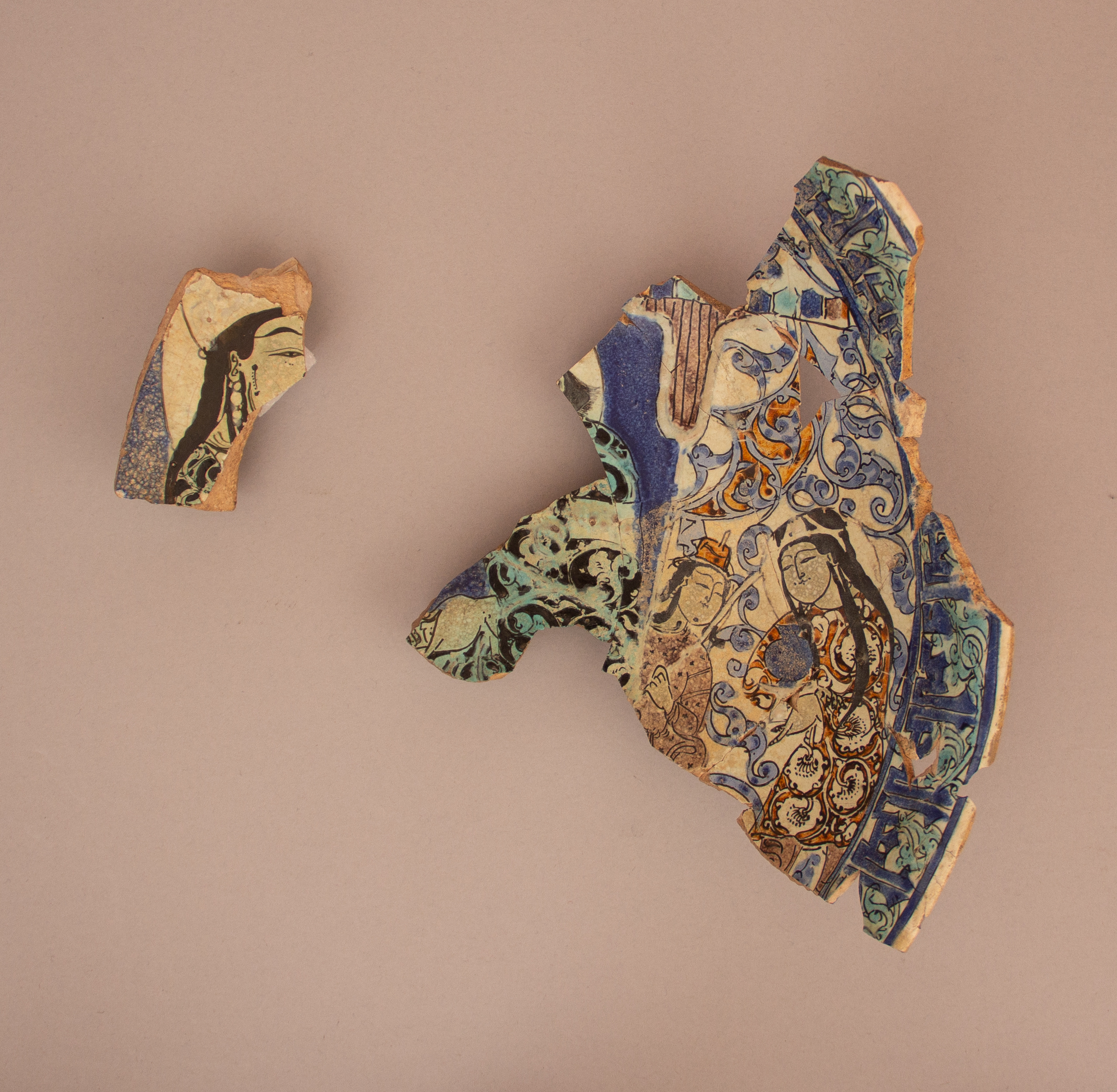
The presented artifact, designated "Fragments of a Dish," transcends its physical state as a collection of stonepaste shards to become a profound case study in the very philosophy of contemporary couture. Its origin, inscribed simply as "Global Heritage," is not an evasion but a precise intellectual provocation. It compels us to move beyond simplistic geographical attribution and engage with the object as a nexus of transcontinental dialogue. This analysis for Katherine Fashion Lab posits that these fragments, crafted through the sophisticated mina'i technique, offer a master blueprint for fashion that is intellectually rigorous, materially innovative, and narratively capacious. They teach us that true luxury lies not in pristine wholeness, but in the eloquent assembly of fractured histories, where the seams of cultural confluence are not hidden but celebrated as the strongest part of the garment's structure.
The Mina'i Technique: A Precursor to Multi-Dimensional Textile Engineering
The material specification—stonepaste with polychrome inglaze and overglaze painting on an opaque white glaze, molded—is a technical dossier of immense relevance. Mina'i, or "enamelled" ware, developed in 12th-13th century Persia (specifically Kashan), represents a pinnacle of ceramic science and artistic ambition. The process is a layered performance: first, a quartz-based stonepaste body is fired, then an opaque white glaze is applied and fired, creating a pristine, canvas-like ground. Inglaze painting with cobalt and turquoise is fixed in a subsequent firing, followed by the meticulous application of overglaze enamels (red, green, black, brown, white) in a lower-temperature firing to preserve their vibrancy.
For the couturier, this is a direct analogue to advanced textile manipulation and surface design. The opaque white glaze is our foundational silk gazar or wool crepe—a surface of pure potential. The inglaze painting represents structural embellishment integrated into the very weave: think of complex jacquard narratives, inlaid lace, or embroidery that becomes one with the base fabric. The overglaze enamels are the audacious, tactile additions: hand-painted motifs, applied crystals, dimensional beading, or delicate featherwork that sits upon the surface, catching the light and demanding a separate, careful construction phase. The "molded" element further introduces three-dimensionality, urging us to consider garment architecture—draping, folding, and sculpting that moves beyond the flat pattern.
The Poetics of the Fragment: From Archeology to Asymmetry
The object's condition as fragments is its most potent conceptual asset. In a world saturated with fast fashion's sterile newness, these shards speak of time, use, rupture, and survival. They reject the myth of the intact, singular origin. Each fragment, with its partial narrative—a sliver of a princely figure, a segment of Kufic script, a burst of floral arabesque—functions like a sartorial non sequitur. It challenges the designer to construct coherence from discontinuity, to find harmony in dissonance.
This directly informs a couture methodology centered on intelligent asymmetry, deconstruction, and palimpsestic layering. Imagine a gown where one sleeve draws from the precise geometry and calligraphy of these fragments, rendered in precise, inglaze-like trapunto stitching, while the opposite bodice explodes in the polychrome chaos of overglaze enamels, interpreted in scattered, irregular sequins and resin shards. The hem might be raw, revealing layers of substrate like the cross-section of stonepaste, suggesting a narrative of wear and discovery. The "standalone study" context liberates these fragments from the burden of reconstruction; we are not tasked to rebuild the dish, but to let its broken logic inspire entirely new forms.
Global Heritage as a Design Ecosystem
The "Global Heritage" origin is the critical lens through which Katherine Fashion Lab must interpret this piece. Mina'i ware itself was a product of the Silk Road, absorbing influences from Chinese porcelain, Mesopotamian painting, and Seljuk courtly aesthetics. It is a material testament to globalism avant la lettre. Therefore, to engage with these fragments is to engage with a networked, rather than a linear, history.
In couture terms, this mandates a transcultural, rather than merely multicultural, approach. It is not about appropriating a "Persian" motif for exotic effect. It is about understanding the underlying principles: the synthesis of mineral science (stonepaste) with artistic narrative (painting), the dialogue between geometric order and lyrical figuration, the balance of ground and ornament. A collection inspired by this study might therefore combine the structural rigor of a Savile Row tailleur with the fluid drapery of a sari, employing Japanese shibori dyeing to achieve the blurred, inglaze effect, and French broderie to execute the overglaze brilliance. The "heritage" is in the process of connection itself.
Conclusion: The Couture Object as a Curated Fragment
"Fragments of a Dish" ultimately proposes that the highest function of contemporary couture is to act as a curated vessel for cultural memory. Each garment becomes a new assemblage, a careful composition of "shards" drawn from a boundless, global archive of techniques, forms, and histories. The white glaze is our blank slate, the inglaze our structural integrity, the overglaze our poetic flourish. The fractures are our seams, our darts, our deliberate points of departure.
For Katherine Fashion Lab, this artifact is a silent partner in the atelier. It whispers that a sleeve can be a citation, a hem can be an excavation, and a silhouette can be a thesis on the beautiful, incomplete, and perpetually evolving nature of identity. The finished garment, like the conserved fragment, does not seek to hide its composite nature. It stands as a confident, wearable testament to the idea that we are all, gloriously, assembled from fragments of a wider, shared world.