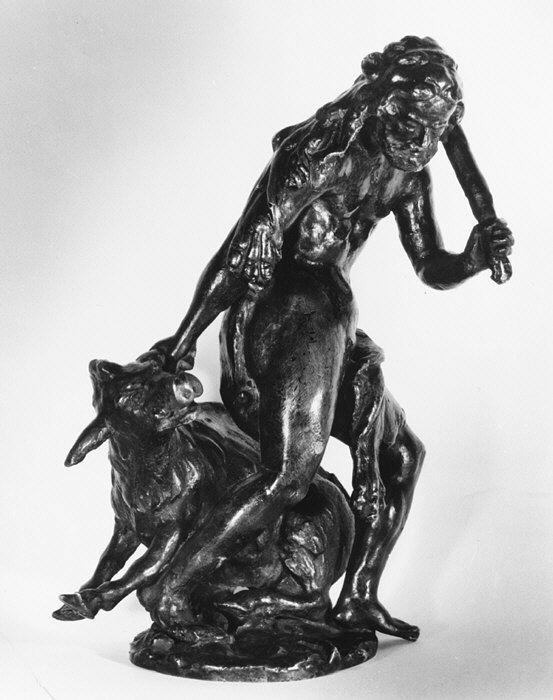
Heritage Analysis: Hercules with the Erymanthean Boar
Cultural Provenance and Artistic Context
The bronze representation of Hercules with the Erymanthean Boar emerges from the crucible of ancient Mediterranean civilization, a period when myth served as the operating system for social order, personal virtue, and political legitimacy. This artifact, likely a votive or ceremonial piece, captures the fourth labor of Heracles—a narrative of raw physical dominance over a creature of untamed wilderness. In the context of Katherine Fashion Lab’s ongoing heritage investigation, this object does not stand in isolation. It resonates with two seemingly disparate artifacts previously studied: the Rock in the form of a fantastic mountain and the Jar in the shape of bronze container (hu). Together, these three objects reveal a coherent philosophical thread: the human impulse to impose structure upon chaos, whether that chaos is geological, ritualistic, or bestial.
The Erymanthean Boar, in ancient Greek iconography, was not merely a quarry. It symbolized the destructive forces of nature—uncontrolled, feral, and resistant to civilizing influence. Hercules, depicted mid-struggle, often shown carrying the boar alive to King Eurystheus, embodies the heroic ideal of transformative strength. Unlike the mountain rock, which suggests passive endurance, or the bronze hu jar, which implies containment and preservation, this scene is dynamic. It captures the precise moment of subjugation, a frozen instant of exerted will. For a luxury heritage house, this narrative offers a potent metaphor: the brand as Hercules, domesticating raw material into objects of enduring value.
Symbolic Power and Historical Adornment
In ancient society, bronze was the medium of permanence. It did not rot, crumble, or fade. The choice of bronze for this depiction elevates the scene from transient folklore to eternal doctrine. The musculature of Hercules, exaggerated and taut, was not anatomical accuracy but a visual language of arete—excellence through effort. Every sinew is a declaration that greatness is achieved, not inherited. This aligns with the historical adornment practices of the period, where elite warriors and aristocrats wore fibulae and belt clasps depicting such labors. To wear or own such imagery was to claim a share of that heroic virtue. The boar’s bristling hide, rendered in sharp relief, contrasts with the polished, almost serene face of Hercules, illustrating the dialectic between savage nature and cultivated reason.
This artifact’s symbolic power extends to its function as a political tool. Hellenistic rulers and later Roman emperors adopted Heracles as a patron ancestor, using his labors to legitimize their own conquests and pacification campaigns. The boar, specifically, was a creature of Arcadia—a region associated with primitive pastoralism. By subduing it, Hercules signals the triumph of centralized order over peripheral chaos. In a modern luxury context, this translates to the brand’s role in transforming ephemeral trends into timeless statements. The historical adornment of such imagery on ceremonial armor and drinking vessels suggests that luxury was never merely decorative; it was semiotic armor, communicating status, moral fortitude, and divine favor.
Spiritual Meaning and the DNA Correlation
The spiritual dimension of this artifact cannot be overstated. In the mystery cults and philosophical schools of antiquity, the labors of Hercules were allegorized as stages of the soul’s purification. The Erymanthean Boar, in this reading, represents the baser appetites and untamed passions that must be captured and brought before the higher self—symbolized by Eurystheus, however cowardly. This is not a mere hunt; it is a psychomachia, a battle for the soul’s dominion. The bronze medium, with its reflective surface, was believed to hold apotropaic properties, warding off evil and mirroring the viewer’s own inner struggle. To possess such a piece was to hold a tangible reminder of one’s own spiritual duties.
The correlation with the Rock in the form of a fantastic mountain and the Jar in the shape of bronze container (hu) becomes clear when viewed through this spiritual lens. The fantastic mountain rock—likely a scholar’s stone or a miniature grotto—represents the macrocosmic chaos, the primordial landscape that predates human order. The hu jar, conversely, represents microcosmic containment, the ritual vessel that holds offerings, libations, or ancestral ashes. Hercules with the boar sits precisely between these two poles: he is the active agent that transforms the chaotic mountain into the contained jar. In DNA terms, if the mountain is the raw genetic code of untamed nature and the jar is the expressed phenotype of civilization, then Hercules is the epigenetic regulator—the force that determines which traits are expressed and which are silenced. This triadic relationship forms the foundational mythos for Katherine Fashion Lab’s 2026 collection narrative.
2026 High-End Luxury Strategy: The Heroic Edit
For the 2026 season, Katherine Fashion Lab will deploy this heritage analysis as the strategic backbone of a new luxury line, tentatively titled “The Heroic Edit.” The strategy rests on three pillars derived directly from the artifact’s DNA correlation. First, Raw Material Sovereignty: Just as bronze was the premium alloy of antiquity, the 2026 line will champion uncompromising materials—full-grain leathers, cold-forged hardware, and mineral-dyed silks—positioned as the modern equivalent of heroic bronze. The marketing narrative will emphasize that these materials are not sourced, but subdued, echoing Hercules’ physical mastery over the boar.
Second, Structural Tension: The artifact’s composition—muscle against bristle, man against beast—will inform the silhouette architecture. Expect sharply tailored outerwear with exposed seam work that mimics sinew, and draped elements that evoke the boar’s hide. The visual tension between polished surfaces and textured, almost aggressive finishes will be the signature of the collection. This is not soft luxury; it is assertive elegance, designed for the client who views dressing as an act of self-governance.
Third, Narrative Ownership: The 2026 campaign will not sell clothing; it will sell the labor behind the clothing. Each piece will be numbered and accompanied by a “labor card” detailing the specific artisan hours, the origin of materials, and the symbolic boar-traits overcome (e.g., “water resistance achieved over 14 attempts”). This transforms the purchase into a ritual of shared victory. The client is not buying a garment; they are acquiring a fragment of Hercules’ fourth labor, a wearable testament to their own capacity to capture and carry their personal boars.
In the high-end market, where exclusivity is increasingly defined by narrative depth rather than price alone, this heritage analysis provides a defensible, intellectually rich positioning. The bronze Hercules is not a relic; it is a blueprint. By correlating its symbolism with the mountain and the jar, Katherine Fashion Lab establishes a coherent cosmology—one where chaos is acknowledged, contained, and ultimately worn as a badge of honor. The 2026 strategy is thus not a departure from heritage but a continuation of it, using ancient bronze to forge a modern identity of purposeful, heroic luxury.