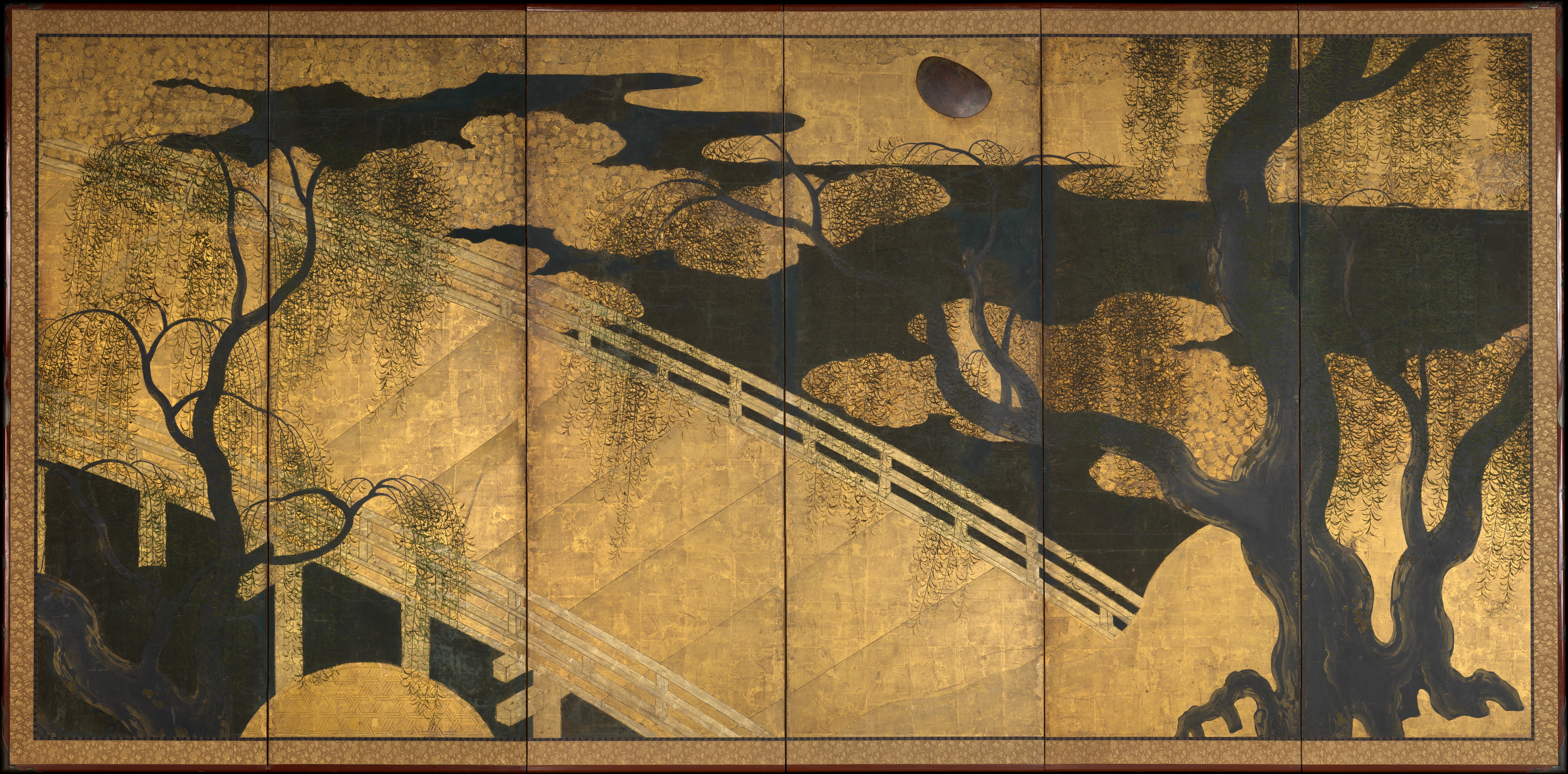
Willows and Bridge: A Study in Material Poetics and Spatial Philosophy
In the rarefied echelons of couture analysis, where the garment and the gallery converge, Katherine Fashion Lab’s curation of Willows and Bridge presents an object lesson in the translation of architectural temporality into wearable narrative. This pair of six-panel folding screens, originating from Japan, is not merely a decorative artifact; it is a masterclass in the manipulation of negative space, the alchemy of metallic surface, and the profound cultural grammar of the byōbu. As a standalone study, the piece demands a forensic reading—not of its literal imagery, but of its structural and material intelligence, which resonates deeply with the principles of haute couture construction.
The Structural Lexicon: From Folding Screen to Garment Architecture
The folding screen, or byōbu, is a quintessential Japanese innovation—a functional partition that simultaneously conceals and reveals, creating a mobile threshold between interior and exterior worlds. In Willows and Bridge, the six-panel format is not arbitrary. Each panel functions as a discrete column of visual data, yet the composition flows seamlessly across the hinges, forming a continuous horizon. This is a direct analogue to the couture silhouette: the garment is assembled from panels—front, back, side—each cut with precision, yet the final form exists only when the panels are joined, creating a sculptural volume that moves with the body.
The choice of a bridge as the central motif is particularly telling. In Japanese aesthetics, the bridge—often a simple, arched wooden structure—symbolizes transition, the passage from the mundane to the sacred, or from one state of being to another. For the couture analyst, this translates into the concept of the seam as a site of transformation. A master tailor does not hide seams; they employ them as structural devices that guide the eye and shape the fabric’s fall. Here, the bridge’s arc mirrors the curve of a shoulder seam or the sweep of a trained hem, suggesting that the wearer is perpetually in a state of elegant becoming.
Material Alchemy: Copper, Gold, and the Luminescence of Surface
The materials employed—ink, color, copper, gold, and gold leaf on paper—are not mere pigments; they are strategic interventions of light. The copper, with its warm, oxidizable patina, introduces an element of time and impermanence. Unlike the static brilliance of pure gold, copper suggests a living surface, one that will darken and shift with exposure to air and humidity. This is a profound couture principle: the fabric of a garment is never static. Silk changes under body heat; metallic threads catch and refract light differently with each movement. The screen’s copper elements function as the snag or the sheen on a jacquard—they invite touch, they promise a sensory experience beyond the visual.
Gold leaf, applied in delicate, irregular patches, creates a topography of reflection. In couture, gold is often used as an accent—a thread, a bead, a lamé underlay—but here, it is deployed as a field of intermittent luminosity. The gold does not cover; it suggests. It catches the ambient light in a manner that is both opulent and restrained, much like a Chanel tweed woven with Lurex threads that shimmer only at certain angles. The gold leaf on the screen is not a flat coating; it is a series of decisions, each flake placed to enhance the willow branches’ sinuous curves or to illuminate the water beneath the bridge. This is the couture ethos of deliberate embellishment—every sequin, every bugle bead, every metallic fleck is positioned to serve the overall composition, never to overwhelm it.
The Willow: Drapery, Fluidity, and the Grammar of Movement
The willow tree is a recurring motif in Japanese art, celebrated for its drooping branches that bend without breaking. In Willows and Bridge, the willow is rendered with a calligraphic fluidity—the ink strokes are confident, yet they taper into delicate flicks that suggest the sway of leaves in a breeze. This is the couture equivalent of bias cutting. A bias-cut gown, pioneered by Madame Grès, drapes across the body in a continuous, unbroken flow, following the natural curves and creating a liquid silhouette. The willow’s branches, painted with ink and heightened with gold, mimic this effect: they are not rigid lines but organic, breathing forms that seem to move with the viewer’s shifting perspective.
Furthermore, the willow is a symbol of resilience and grace under pressure—a fitting metaphor for the modern couture client. The garment, like the willow, must be structurally sound yet appear effortless. The screen’s composition, with its interplay of dense ink and sparse gold, speaks to the balance between substance and ethereality. A couture gown must have weight to hold its shape, yet it must feel weightless on the body. The willow’s branches, heavy with leaves yet light in their visual impact, achieve this paradox. The artist has used the paper’s natural absorbency to create soft edges, while the gold leaf provides crisp, reflective accents—a duality that mirrors the contrast between a matte crepe bodice and a lustrous satin skirt.
Spatial Philosophy: Ma, Negative Space, and the Wearer’s Presence
Perhaps the most sophisticated aspect of Willows and Bridge lies in its treatment of negative space—the concept of ma (間) in Japanese aesthetics. Ma is not emptiness; it is a charged interval, a pause that gives meaning to the surrounding forms. In this screen, the bridge does not span the entire width; it is interrupted by the willow’s branches and by expanses of untouched paper. These voids are not accidents; they are compositional anchors that allow the eye to rest and the mind to contemplate.
In couture, ma manifests as the strategic cutout, the sheer panel, or the exposed collarbone. It is the space between the fabric and the skin, the negative volume that defines the garment’s architecture. A designer who understands ma does not cover the body; they frame it. The screen’s empty spaces function as the “skin” of the garment, suggesting what is not seen—the underlying structure, the corsetry, the hidden boning—while the painted elements represent the visible, tactile surface. The wearer of a garment inspired by this screen would not be adorned; they would be contextualized, their physical presence completing the visual sentence that the fabric begins.
Conclusion: A Standalone Study in Temporal Couture
As a standalone study, Willows and Bridge transcends its status as a decorative object to become a theoretical blueprint for haute couture. Its materials—copper, gold, ink, and paper—are not merely traditional; they are narratives of impermanence and luxury. The folding screen’s structure—hinged, flexible, yet rigid in its panels—mirrors the skeleton of a tailored jacket or the internal architecture of a structured gown. The bridge motif speaks to the couture’s role as a transitional garment, one that carries the wearer from one social sphere to another with grace and authority.
For Katherine Fashion Lab, this piece is not a historical artifact to be admired from a distance. It is a working document, a source of design intelligence that informs fabric selection, silhouette construction, and the ethical use of embellishment. The gold leaf is not ostentation; it is a disciplined act of highlighting. The willow is not mere decoration; it is a study in drape and resilience. The bridge is not a literal structure; it is the seam that connects the past to the present, the art to the body.
In a fashion landscape saturated with digital prints and synthetic textures, Willows and Bridge offers a return to the fundamental principles of couture: material honesty, structural logic, and the poetic use of space. It is a reminder that the most profound garments are not those that shout, but those that whisper—through the subtle glint of gold, the fluid line of ink, and the silent, powerful interval of the unfilled panel. The screen is, in the end, a garment for the room itself—a couture piece that dresses the architecture, and in doing so, teaches us how to dress the body.