The Kasuga Deer Mandala: A Heritage Analysis for Katherine Fashion Lab
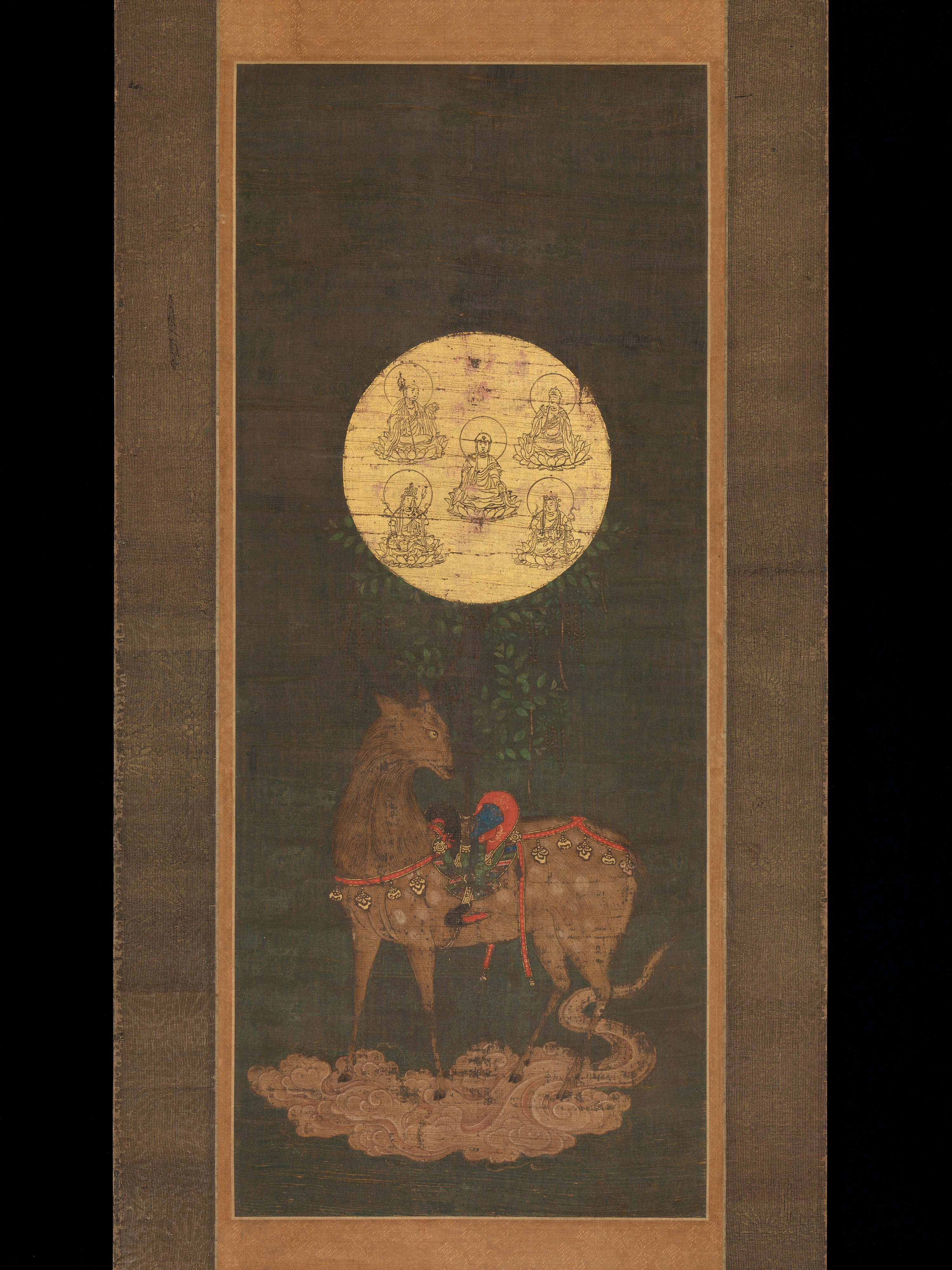
The Kasuga Deer Mandala (Kasuga shika mandara zu) represents one of the most sophisticated intersections of spiritual iconography, political power, and aesthetic refinement in Japanese visual culture. For Katherine Fashion Lab, this hanging scroll—executed in luminous color on silk—offers a compelling blueprint for translating sacred heritage into contemporary luxury. This analysis examines the mandala’s symbolic architecture, its historical role in aristocratic adornment, and its strategic relevance for a 2026 high-end fashion positioning.
Symbolic Power: The Deer as Divine Messenger and Imperial Axis
At the heart of the Kasuga Deer Mandala lies a deceptively simple zoomorphic figure: the sika deer. Yet within the Japanese cosmological framework, this animal is anything but ordinary. The deer is venerated as the sacred messenger of the Kasuga deities (Kasuga no kami), particularly Takemikazuchi-no-Mikoto, who is said to have arrived at Mount Mikasa riding a white deer. This narrative transforms the deer from a mere forest creature into a conduit between the celestial and terrestrial realms. In the mandala’s visual composition, the deer is depicted not as a passive animal but as an active agent of revelation, often shown standing before the towering Kasuga Shrine, its antlers echoing the sacred tree forms that frame the shrine’s architecture.
For Katherine Fashion Lab, this symbolism offers a profound narrative resource. The deer embodies grace under divine mandate—a creature of quiet power that does not assert dominance through aggression but through spiritual alignment. In a 2026 luxury landscape increasingly defined by authenticity and meaning-driven consumption, the Kasuga deer provides a counter-narrative to overt logos or ostentatious displays. It speaks to a clientele that values subtle authority, where the wearer’s status is implied through symbolic depth rather than explicit branding. The mandala’s deer also suggests a dual nature: it is both wild and sacred, untamed yet auspicious. This duality resonates with the modern luxury consumer’s desire for pieces that bridge the natural and the crafted, the spontaneous and the deliberate.
Historical Adornment: The Mandala as Aristocratic Identity Marker
Historically, the Kasuga Deer Mandala was not merely a devotional object; it was a marker of aristocratic identity and political legitimacy. Commissioned by the Fujiwara clan—whose tutelary deity resided at Kasuga Taisha—these scrolls functioned as portable shrines, allowing the elite to carry their spiritual and political capital across distances. The medium itself, color on silk, was a costly and technically demanding material, reserved for the highest echelons of society. The use of gold and mineral pigments, such as azurite and malachite, further elevated the object’s status, making it a wearable—or at least displayable—statement of clan supremacy.
The mandala’s iconographic structure also mirrored the hierarchical ordering of Heian and Kamakura court society. The deer, positioned at the visual center, is flanked by the shrine’s architectural elements and the surrounding landscape, all rendered with meticulous detail. This composition served a dual purpose: it reinforced the Fujiwara’s divine mandate while also providing a visual lexicon of proper social order. For Katherine Fashion Lab, this historical context is instructive. The mandala demonstrates that luxury is not merely about material opulence but about the curation of meaning. A 2026 collection inspired by the Kasuga Deer Mandala should not simply replicate deer motifs or shrine imagery; it must evoke the same sense of portable prestige—garments and accessories that function as personal talismans, carrying the wearer’s identity and values into new contexts.
Spiritual Meaning: The Mandala as Meditative Cartography
Beyond its political and social functions, the Kasuga Deer Mandala operates as a spiritual tool—a visual map for meditation and pilgrimage. The term mandala itself derives from the Sanskrit for “circle” or “essence,” and in the Japanese context, it denotes a diagrammatic representation of the cosmos. The Kasuga variant is unique in that it substitutes the usual Buddhist deities with Shinto kami, reflecting the syncretic religious landscape of medieval Japan. The deer, in this reading, is not merely a messenger but a guide through the sacred landscape, leading the viewer’s eye from the earthly plane of the shrine’s precincts to the transcendent realm of the kami.
This spiritual dimension offers Katherine Fashion Lab a rich vein of conceptual material. The mandala’s composition—with its concentric layers of meaning, from the literal deer to the symbolic mountain to the abstract divine presence—can inspire a collection that operates on multiple levels of interpretation. A 2026 luxury line might employ layered textiles, where an outer garment reveals a hidden inner pattern, or reversible pieces that reflect the mandala’s duality of surface and depth. The color palette, drawn from the scroll’s mineral pigments—deep indigo, malachite green, cinnabar red, and gold leaf—can be translated into a sophisticated chromatic strategy that evokes both historical authenticity and contemporary freshness.
Moreover, the mandala’s function as a meditative aid suggests that luxury fashion can serve a similar purpose in the modern world. In an era of constant digital stimulation, the quiet contemplation embodied by the Kasuga Deer Mandala becomes a rare and desirable commodity. Katherine Fashion Lab can position its 2026 offerings as objects of pause—garments and accessories that encourage the wearer to slow down, to connect with a deeper sense of self, and to engage with the world from a place of centeredness. This is not merely a marketing angle; it is a design philosophy that permeates every aspect of the product, from the choice of natural fibers to the intentional placement of symbolic motifs.
2026 High-End Luxury Strategy: From Sacred Scroll to Wearable Heritage
Translating the Kasuga Deer Mandala into a 2026 luxury strategy requires a nuanced approach that respects the source material while innovating for a contemporary audience. The following strategic pillars emerge from this heritage analysis:
Pillar One: Narrative-Driven Exclusivity
The mandala’s historical role as a commissioned object for the elite suggests a made-to-order or limited-edition model. Katherine Fashion Lab could offer a “Kasuga Atelier” series, where clients participate in the design process, selecting motifs, colors, and materials that resonate with their personal narratives. This mirrors the historical practice of commissioning a mandala for specific spiritual or political purposes, transforming each piece into a unique artifact with its own story.
Pillar Two: Material Storytelling Through Silk and Mineral Hues
The medium of color on silk is not incidental; it is integral to the mandala’s power. For 2026, Katherine Fashion Lab should invest in highly tactile, luminous fabrics—silk charmeuse, organza, and velvet—that capture the scroll’s interplay of light and pigment. A dedicated color lab could develop a “Kasuga Palette” based on the exact mineral compounds used in the original scrolls, offering clients a chromatic experience that is both historically precise and aesthetically novel.
Pillar Three: Symbolic Modularity
The mandala’s deer is not a static image but a dynamic symbol that shifts meaning based on context. Katherine Fashion Lab can embrace this by creating modular accessories—brooches, scarves, and bag charms—that feature interchangeable symbolic elements. A deer motif might be paired with a shrine arch, a mountain silhouette, or a celestial orb, allowing the wearer to compose their own personal mandala. This approach fosters engagement and repeat purchase while maintaining the collection’s coherent narrative.
Pillar Four: Experiential Retail as Pilgrimage
Finally, the mandala’s function as a pilgrimage map can inspire a retail experience that transcends traditional shopping. Katherine Fashion Lab could host immersive pop-up installations that recreate the sensory journey of a Kasuga pilgrimage—from the forested paths to the shrine’s inner sanctum—using scent, sound, and curated lighting. The purchase of a piece from the collection would be framed as the culmination of this journey, imbuing the object with a sense of earned significance.
Conclusion: The Deer as a Luxury Archetype
The Kasuga Deer Mandala is far more than a historical artifact; it is a masterclass in the alchemy of meaning, material, and status. For Katherine Fashion Lab, this scroll offers a strategic roadmap for 2026 that is at once deeply rooted in heritage and boldly forward-looking. By embracing the deer’s symbolic power, the mandala’s historical role as aristocratic adornment, and its spiritual function as a meditative guide, the brand can craft a luxury proposition that resonates with discerning consumers seeking authenticity, depth, and beauty. The deer does not run; it walks with deliberate grace. So too should Katherine Fashion Lab proceed—with reverence for the past, precision in the present, and vision for the future.