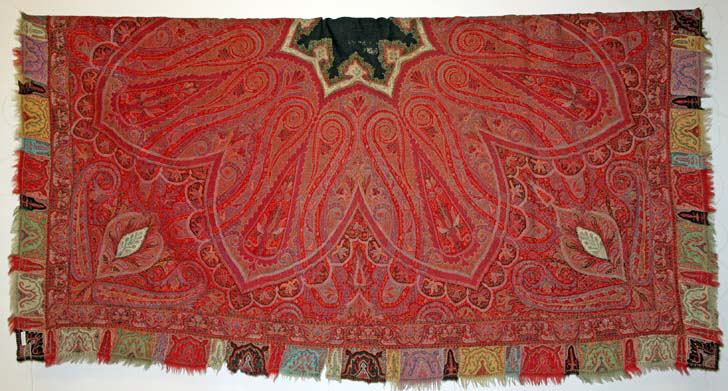
The Indian Wool Shawl: A Study in Material Poetics and Cultural Cartography
The shawl, in its most reductive definition, is a rectangle of fabric designed for warmth. Yet within the hallowed ateliers of Katherine Fashion Lab, this utilitarian object undergoes a profound transmutation. It ceases to be a mere garment and becomes a canvas for cultural memory, a testament to the dialogue between raw material and human artistry. In this standalone study, we dissect the Indian wool shawl not as an accessory, but as a complete, autonomous entity—a wearable sculpture whose value lies in its tectonics, its drape, and its silent, eloquent narrative of origin.
Materiality as Metaphor: The Primacy of Wool
The selection of wool as the foundational medium is far from arbitrary. In the Indian subcontinent, wool is not merely a fiber; it is a climatic and spiritual response to the harsh, elevated terrains of the Himalayas and the arid plateaus of the Deccan. The wool used in a high-couture context is not the coarse, industrial-grade yarn of mass production. Rather, it is the fine, hand-spun fleece of the Pashmina goat or the resilient, lustrous fiber of the indigenous Chokla or Deccani sheep. This distinction is critical. The hand-spinning process, often performed on a traditional charkha, imparts an irregular, organic twist to the yarn that machine-spinning cannot replicate. This irregularity is not a flaw; it is the fingerprint of the artisan, a subtle rhythm that catches light differently across the fabric’s surface.
From a structural standpoint, wool’s inherent properties—its hygroscopic nature, its ability to absorb up to 30% of its weight in moisture without feeling damp, and its natural crimp—create a fabric with exceptional thermal regulation and memory. For the couturier, this means the shawl is not a static object. It responds to the body’s heat, softening and molding to the wearer’s posture over time. This is a slow, intimate process of co-creation, where the garment and the wearer enter a symbiotic relationship. The wool is not a passive material; it is an active participant in the design’s lifecycle, aging with grace and developing a patina that synthetic fibers can only envy.
Deconstructing the Drape: A Study in Volume and Gravity
In the context of a standalone study, the shawl is liberated from the constraints of a full ensemble. It is the entire narrative. This necessitates a rigorous examination of its drape—the way it falls, folds, and occupies space. The Indian wool shawl, particularly in its finer weaves, possesses a paradoxical quality: it is at once substantial and ethereal. The weight of the fabric, typically between 200 and 400 grams, provides a grounding presence, while the fine gauge allows for a fluidity that defies its apparent density.
When draped over the shoulders, the shawl creates a series of vertical and diagonal lines that elongate the silhouette. The fall of the fabric is governed by its weave structure—a twill or a plain weave—which dictates its stiffness and bias. A loosely woven shawl will have a softer, more forgiving drape, clinging to the contours of the body. A tightly woven one, often used for ceremonial purposes, will hold its shape with more authority, creating sharp, architectural folds. The couture analysis, therefore, must consider the shawl’s "hand"—its tactile quality—as a primary design element. The way the fabric whispers against a silk blouse or rests heavily upon a tailored coat is a study in contrast, a dialogue between the rustic and the refined.
The Weave of History: Regional Lineages and Artisanal Codes
To analyze the Indian wool shawl is to trace a cartography of regional identities. Each geographical origin imprints its own aesthetic and technical vocabulary. For instance, the Kani shawl from Kashmir, woven on a wooden loom with small bobbins (tujas), is renowned for its intricate, tapestry-like patterns. The weaver works from a coded graph paper pattern (talim), a system of symbolic notation that is passed down through generations. This is not mere decoration; it is a form of encryption, a visual language that encodes botanical motifs, celestial bodies, and Mughal courtly iconography. The time investment is staggering—a single high-quality Kani shawl can take over a year to complete, making it a piece of wearable history.
In contrast, the Jamawar shawl, also from Kashmir, employs a technique of discontinuous weft inlay, where colored threads are woven into the fabric to create rich, floral patterns. This technique allows for greater pictorial freedom, resulting in dense, almost painterly compositions. Meanwhile, the Phulkari shawls of Punjab, though often cotton-based, find their woolen counterparts in the Pattu shawls of Himachal Pradesh, which feature bold, geometric, and often monochromatic designs. These are not merely aesthetic choices; they are markers of social status, marital rites, and community identity. In the couture context, to wear a specific regional shawl is to wear a passport to a specific cultural epoch.
Functional Autonomy: The Shawl as a Complete Garment
The decision to study the shawl in isolation is a deliberate curatorial act. It forces us to re-evaluate its functional autonomy. Without the support of a dress or a coat, the shawl must perform all the duties of a primary garment: it must provide warmth, create a silhouette, and convey status. This is achieved through the art of draping—a skill that is almost lost in contemporary fast fashion. The shawl can be wrapped tightly to create a cocoon-like form, cinched with a brooch to define the waist, or allowed to hang loose to create a dramatic, cape-like train. Each configuration transforms the wearer’s presence, altering their perceived stature and movement.
From a design perspective, this autonomy demands a higher level of finish. The edges, or hashiya, are not simply hemmed; they are often hand-embroidered with silk thread, or finished with a delicate web of interlocking stitches that prevent fraying while adding a decorative border. The corners, often adorned with small tassels or intricate knots, serve as counterweights, ensuring the shawl falls correctly over the shoulders. These details are not incidental; they are the hallmarks of couture-level craftsmanship, where every millimeter is considered and executed with precision.
Conclusion: Beyond Utility, Toward a Legacy
In concluding this standalone study, it is evident that the Indian wool shawl transcends its material origins. It is a repository of intangible heritage, a product of slow, deliberate labor that stands in stark opposition to the relentless velocity of modern production. For Katherine Fashion Lab, this object is not a nostalgic relic but a living template for sustainable luxury. It teaches us that true value lies not in novelty, but in the depth of skill, the purity of material, and the cultural resonance embedded in every weave. The shawl is a masterclass in restraint—a single, unadorned rectangle that, in the hands of a master, becomes an instrument of infinite expression. It is not just clothing; it is a manifesto.